“They are the hope for the community”
Building pathways to learning for Roma children fleeing the war in Ukraine

- English
- Українська
- Polish
In 2022, after the escalation of the war in Ukraine, Lidiia Shulha arrived in Poland from the Zhytomyr region with her husband. Volunteers quickly directed the couple to a collective accommodation center for refugees in the village of Soczewka in the Mazowieckie Voivodeship.
As a teacher with many years of experience, Lidiia wanted to give back in return for the help she received during this difficult time. With the support of the centre director, she began organizing classes for refugee children living at the centre, most of whom are Roma. Currently, some 78 children aged 1 to 17 live at the centre.

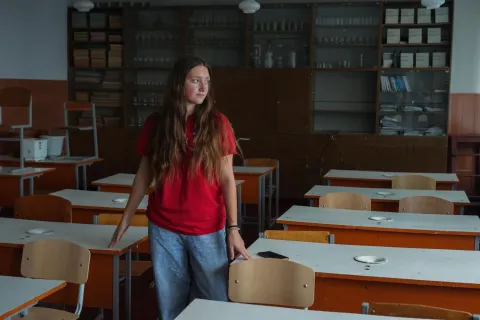
Her classroom is made up of children aged 6 to 10. “The children are capable, energetic, open. They are not afraid to make mistakes. I like that,” says Lidiia. However, the beginning was not easy. “Some children had never been to school and had no idea what learning in an educational institution looked like.”
Over time, Lidiia expanded her work beyond preschool classes, establishing creative arts clubs for older children. She also works with another group of children who began school in Soczewka this fall, helping them with homework. Every Saturday, another teacher who speaks Polish joins her.

Katarzyna Tomsia, another teacher at the centre, works with Roma children from Ukraine in the preparatory class. The children go on to continue their education in Soczewka or the nearby village of Nowy Duninów.
“One of the challenges is that their ages range from 7 to 14, which makes it difficult to run the activities,” she says. “I need to plan two types of activities to engage both the younger and the older children.”

At first, Katarzyna found it challenging to engage the children and find a common language, but over time, she built trust with her students.
Since 2023, the centre has received support from the Polish Foundation Towards Dialogue, an organization that advocates for Roma communities in Poland. The foundation, in partnership with UNICEF provides UNICEF provides assistance, addresses inequalities, and empowers communities to take action , ensuring refugee children can continue learning in Poland.
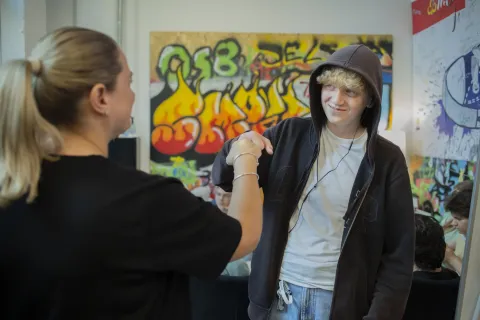
Noemi Łakatosz, an education and culture specialist visiting the center since 2025 to run arts activities, highlights the creative impact of Lidiia’s lessons.
“You can see how creatively Ms. Lidiia approaches these activities,” she says. As a result, she says, the students “don’t just count down to break time. Here, I see that children count down to the moment lessons begin. They stay in front of the classroom and just want to go in.”

Sabina Tkacz, project manager at the Foundation Towards Dialogue, emphasizes that Ms. Lidiia is the core of the Foundation’s work in Soczewka, leading the preparatory class for three years:
“Furthermore, we have previously arranged Polish language lessons, hobby workshops, well-being training sessions, and art therapy classes at this location. Psychologists make regular visits, facilitating group sessions and being available for diagnostic, observational, and consultative meetings, including individual discussions with children and their parents. While these services are highly valued, they are not available daily — unlike the continual presence of Ms Lidiia at the centre.”

Another key element of the foundation’s work is its educational workshops for parents and school staff also implemented in partnership with UNICEF. Workshops were held at schools in Nowy Duninów and in Soczewka, for example, and around 90 per cent of the teaching staff attended. The workshops focus on discussing the everyday challenges and situations faced by Roma communities.
"We jointly develop a model of action, identifying how we can support them, what the school needs, and how to respond to certain situations,” says Sabina Tkacz. "Many members of [the Roma] community come from regions where poverty has persisted for generations, and where, due to exclusion and marginalization, access to basic services has been limited. Adjusting to life in a completely different environment can therefore be an immense challenge. It’s important to recognize these circumstances.”
The foundation also works closely with parents, communicating with them about aspects such as how the school year is organized and how the school system works.
“Anywhere in the world, when a group is completely excluded and has limited access to basic social services, the challenges they face are shaped by social circumstances rather than cultural traits,” Sabina says.
"If a child struggles to understand how to behave in a classroom, this is not a reflection of their culture. It is a consequence of the constrained opportunities and resources within their family, where, for example, previous generations – such as their mother or grandmother – have not had access to education.”
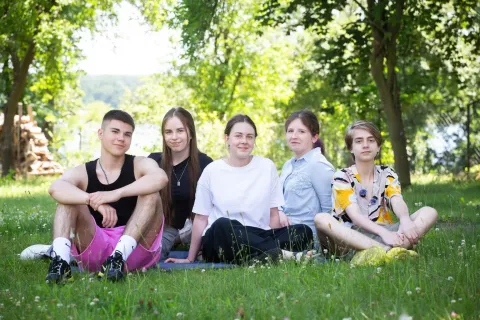
Noemi concludes by highlighting the children’s potential: “So it’s not just about strict school preparation, but also about life skills that they will definitely use in the future, and these children are a hope for community.”
As Milena Harizanova, Chief of Child Protection for the UNICEF Refugee Response Office in Poland, puts it,
“Roma children have the same rights to quality education, safety, and opportunities as any other child. Yet they often face greater barriers, both in displacement and in their country of origin. UNICEF supports Roma refugees because inclusion cannot be selective. Every child must be reached, especially those who are most at risk of being left behind.”
This year’s theme for World Children’s Day, “My Day. My Rights”, highlights every child’s right to learn, play, and grow in safety and dignity. In Soczewka, this vision comes to life through the partnership between UNICEF and the Foundation Towards Dialogue, which provides refugee children with access to education, creative activities, and psychosocial support in a safe and inclusive environment.


Stories like this show how children’s rights – to learning, protection, and the opportunity to develop their skills and talents – are being realized in practice, helping them thrive despite the challenges of displacement.
Since March 2022, UNICEF’s Refugee Response Office in Poland has been supporting children and families fleeing the war in Ukraine. In close partnership with government institutions, municipalities, and civil society organizations, UNICEF works to ensure equitable access to education, protection, health care, and social services for all refugee children and their families in Poland. The focus is on the most vulnerable groups, including families living in collective accommodation centers and members of the Roma community. In the centres, UNICEF provides case management, mental health and psychosocial support, educational support, legal assistance, and activities aimed at preventing violence against children and gender-based violence.
The Roma refugees from Ukraine are at high risk of social exclusion and face multiple barriers when seeking support, limiting their access to housing, employment, healthcare and education. The majority of Roma refugees are women and children, who represent some of the most vulnerable groups and face heightened protection risks, including abuse and exploitation.
To ensure that no one is left behind, Roma refugees require comprehensive support, including access to education, mental health and psychosocial services, and opportunities for integration into Polish society. Recognizing the specific challenges faced by Roma women and children, the UNICEF Refugee Response Office in Poland is supporting targeted interventions to address their needs and promote inclusion.
This important work for refugee children and caregivers from Ukraine in Poland is made possible thanks to the generous support of the Bureau of Population, Refugees, and Migration of the US Department of State (PRM) and the Government of the Republic of Korea.