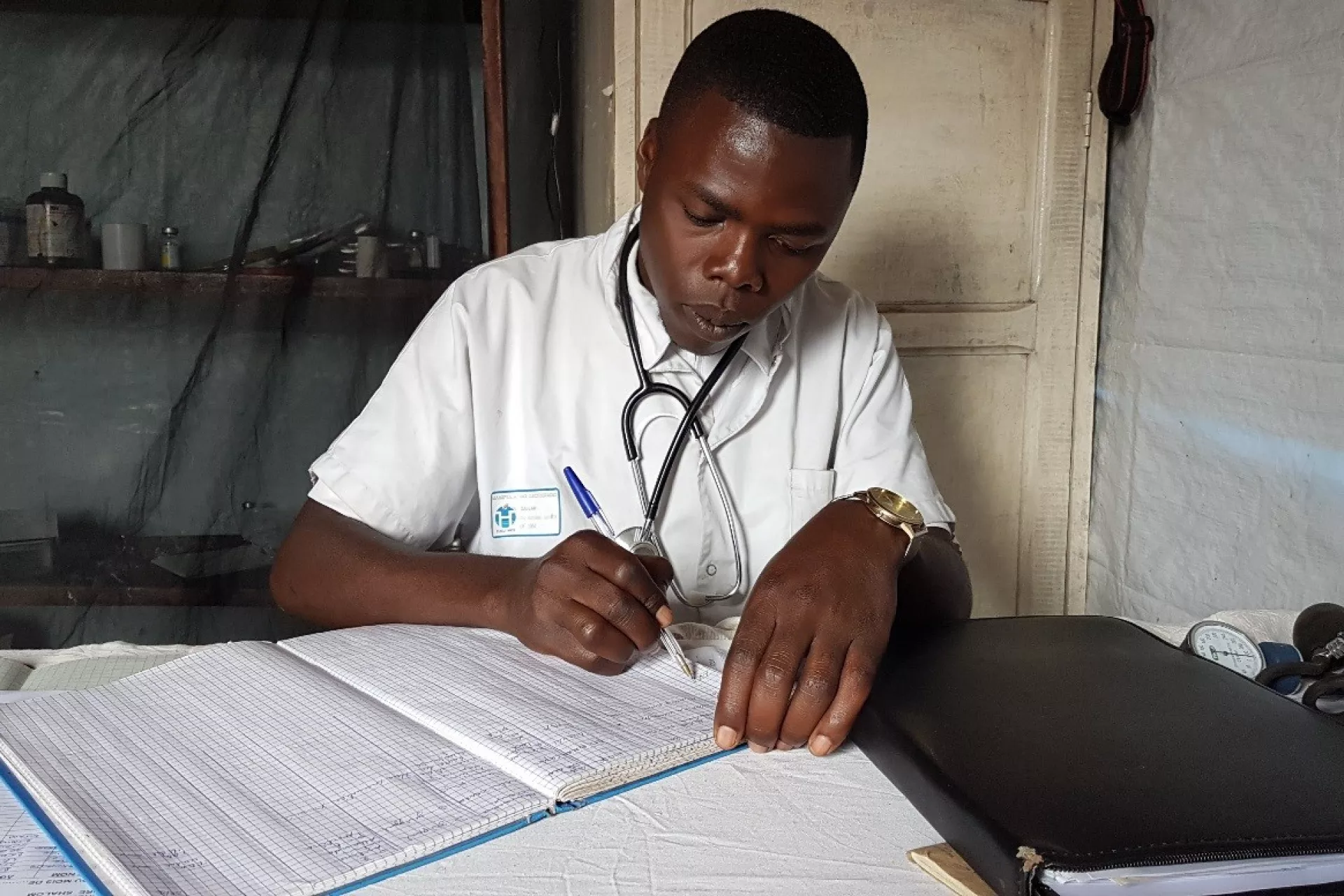
From weapon to stethoscope: Fadhili, former child soldier
Fadhili, 28 years old, personifies the hope of a whole generation who has endured the horrors of war and chronic instability
- Français
- English
Forced to take up arms at the age of 16, the young Fadhili has succeeded in becoming a nurse, swopping his weapon of war for a stethoscope and a syringe.
“It was a Tuesday in February 2016”, recalls Fadhili. “I was coming back from school with six classmates when armed men intercepted us halfway and asked us to help them carry their luggage.” When they reached the bush, the armed men told Fadhili and his friends that they were now members of the movement: they had to take up arms and learn to defend the homeland against the enemy.
Fadhili was in the third year of secondary school when he was recruited by the rebel group and fortunately he could read and write very well. Appointed secretary, he stayed away from the battlefields. “I wrote reports, minutes of meetings and official reports of arrests and judgements made by the company commander,” Fadhili explains.
For more than a year, Fadhili lived in the bush as the movement moved. One morning in December 2007, the regular army launched an offensive against the rebel group’s position. During this offensive, all members of the movement were captured and transferred to Goma. Separated, the minors were placed in a transit and orientation center supported by UNICEF thanks to the support of Sweden (SIDA), the USA (USAID), Canada, Japan (JICA), the Netherlands, Belgium as well as UNICEF France, Amade Mondiale, UNICEF Germany and CERF. “My life totally changed”, recalls Fadhili. “There was food and drink and I could have a wash”.
A few months after arriving at the center, Fadhili was placed with a host family in Goma as the insecurity in his home village did not permit him to return to his biological family. To mark the beginning of his new life, his host family gave him a chukudu, a traditional wooden bicycle to transport goods and materials.
“Every morning, I would go to school and then in the evening I would use my chukudu to earn money to support myself,” Fadhili explains. By means of this activity and the assistance provided by his host family, Fadhili was able to study through to university and graduated with a degree in nursing.
Now officially a nurse, Fadhili has been working part-time in a local health centre. At the same time, Fadhili is pursuing university studies in paediatrics. “My greatest wish is to be able to help children”, said the young nurse.
“They represent the future of our country.