They no longer run to escape, but to move forward
With the right support, children once associated with parties to conflict are rebuilding and forging a new path

- Français
- English
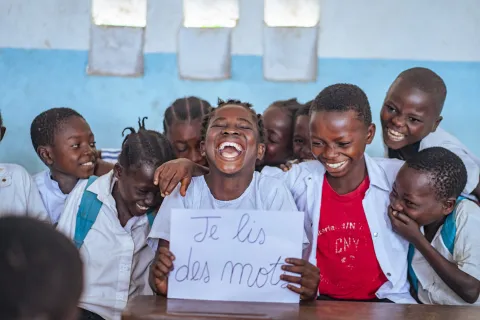
Their faces cannot be seen. Only blurred silhouettes of children running. For a long time, running meant escaping danger. Today, it means something else: these children are running to get to school, to build their future, to reconnect with friends and loved ones. Simply to be children again.
On International Day against the Recruitment and Use of Child Soldiers, also known as Red Hand Day, these shadows tell the stories of children and young people who, after being associated with parties to conflict, are gradually reclaiming their childhood and rebuilding their lives.
To protect them, no identifying details are being disclosed, and all names have been changed. But their voices deserve to be heard.
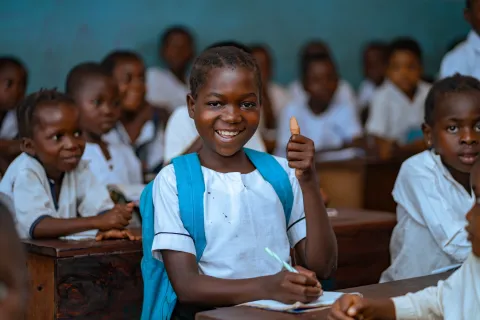
In a classroom in South Kivu, 14-year-old Daniel* stares at the periodic table. At that precise moment, he is doing far more than studying: he is imagining the life he wants to build and the future ahead of him.

For several months, Daniel was forced to work in an armed group’s camp deep in the bush. There, he was nicknamed “Kadogo,” meaning “the little one” in Swahili, and was tasked with guarding a stock of traditional medicines.
Today, that memory has shaped a new ambition.
“When I was in the forest, I saw the leader making medicines from plants. Now I want to learn how real medicines are made,” Daniel explains.
Back with his family, he is receiving psychosocial support and help to return to school, alongside other children from his community affected by conflict.
“I want to become a pharmacist. To help people and show that chemistry can save lives.”

In eastern Democratic Republic of the Congo, conflict continues to weigh heavily on children. Grave violations of children’s rights remain high, including the recruitment and use of children by parties to conflict.
Behind this alarming reality are disrupted childhoods but also paths toward recovery. Together with its partners, UNICEF supports children at every stage. This includes release, temporary care, family tracing and reunification, psychosocial support, return to school or vocational training, and reintegration into their communities.
In a UNICEF-supported centre in Ituri province, a 16-year-old tailor works on brightly coloured garments. He asked to be called Mygod*, a name he chose himself that reflects, in his own way, a sense of protection and a determination to move forward.


For several months, he was associated with an armed group. Today, he is back with his family and training in tailoring.
“After the training, I’ll be able to open my own sewing workshop. With the money I earn, I’ll be able to provide for my family.”
In 2025, more than 5,350 children associated with parties to conflict were supported with the help of key partners, including the European Union (ECHO), the U.S. Department of State’s Bureau of African Affairs, the United Nations Peacebuilding Fund (PBF), MONUSCO, as well as the Governments of Canada, France and Norway, alongside KOICA and Sida.
UNICEF also works upstream to prevent new recruitment. This includes training age verifiers, supporting children from communities most at risk, and working closely with families and community leaders to strengthen child protection.

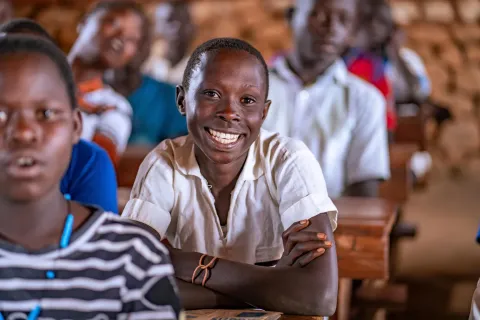
Communities are the first line of prevention. Schools are also safe spaces where children learn, heal, and stay away from armed groups. In North Kivu, Mavala* embodies that reality.
Recruited at the age of 15 by an armed group, she endured and survived sexual violence. Convinced that education has the power to protect children, she chose to become a teacher.
“Education is very important because the future of the country is in the hands of children. After life in an armed group, there is a normal life,” says the 25-year-old teacher.
With patience and care, she now supports her students every day. She is attentive to each child and determined to offer them what conflict took from her: the chance to grow up without fear and to look to the future with confidence.