Ensuring education continuity for children affected by conflict
In Mahagi, Pascaline continues her education despite violence and displacement

- Français
- English
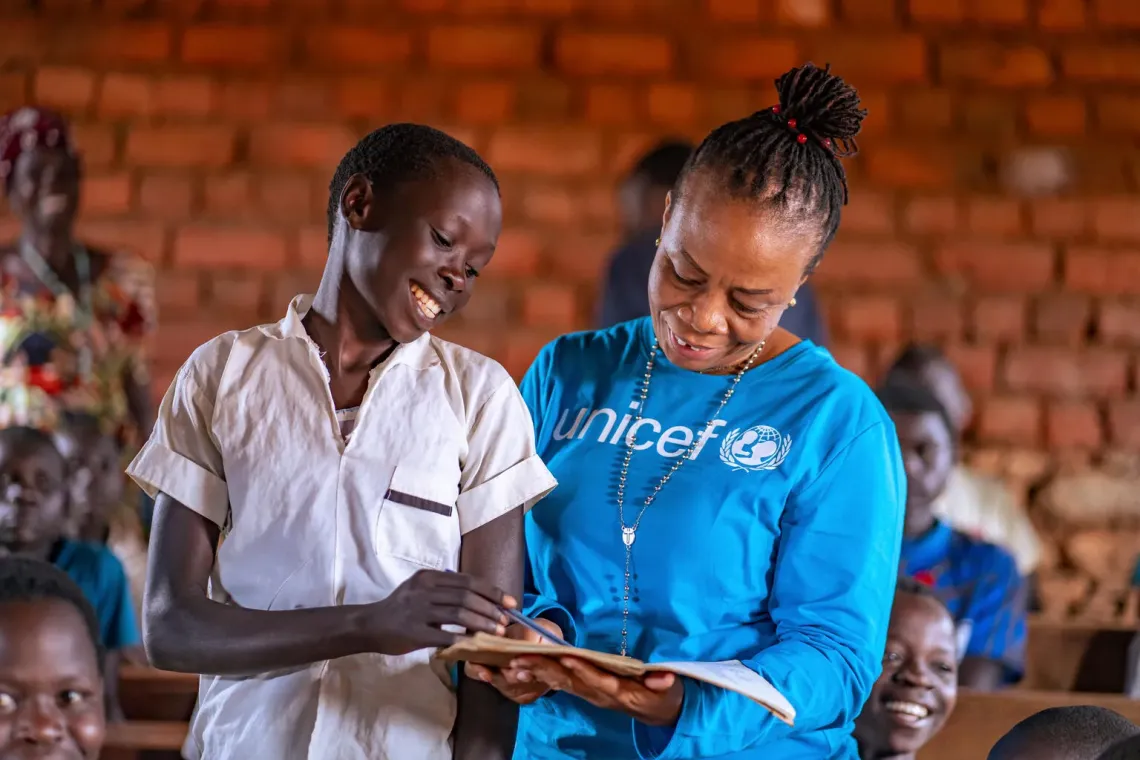
Pascaline is 15 years old. Sitting at her desk in a classroom in Mahagi, in Ituri province, she wears a wide smile. It is a bright, genuine smile – one that feels almost unexpected, given everything she has been through.
Pascaline comes from the village of Mokambo, around 70 kilometres away. She was forced to flee when armed violence tore through her community. Some memories remain painfully vivid. “Grace and Neema were beheaded,” she says quietly, recalling her classmates.
During the chaos of the flight, Pascaline was separated from her parents. Today, she lives with her younger sister in a host family in Mahagi, with no news of their five other siblings. Childhood ended abruptly, replaced by uncertainty and waiting.
For a time, school disappeared from her life. Like many displaced children, Pascaline experienced long periods without learning.

Then one day, a message broadcast on the radio changed everything. Children could return to school. Her host family decided to take Pascaline and her younger sister. That is how they arrived at Dronju Primary School, supported by UNICEF.
Going back to class was not easy. “Because of the years without school, I had fallen behind,” Pascaline explains. Slowly, however, school became a place of healing. Catch-up classes, supportive teachers and a safer learning environment helped her rebuild confidence.
“Now I’m getting back on track. I can even read a text without difficulty,” she says proudly. Every word read and every new skill learned feels like a small victory over the past.
Despite everything she has experienced, Pascaline does not dwell on the past:
“I like school because it is the future. I want to become a teacher,” she says.
For Pascaline, education is more than a right. It represents stability, protection and the chance to give back – to pass on what she herself is slowly reclaiming.
In Mahagi territory, heavily affected by armed conflict, Pascaline’s story is far from unique. Thousands of girls and boys have had their education disrupted by violence and displacement.
With support from the European Union (ECHO), Education Cannot Wait, the Global Partnership for Education and the Central Emergency Response Fund, UNICEF and its partners are working to restore access to quality education for children affected by violence.


Last year, 229 temporary learning spaces were established in eastern Democratic Republic of the Congo, allowing more than 75,000 children to continue their education. School supplies were distributed to nearly 80,000 students.
At the same time, around 6,500 teachers received training in conflict-sensitive and innovative teaching approaches, including psychosocial support and catch-up learning, helping children recover from learning losses.
Communities were also engaged to support education continuity, particularly for girls, in safer and more protective environments.
Thanks to these efforts, schools are gradually becoming safe spaces again for children to learn, grow and look to the future with confidence.