As some children return to school in the eastern DR Congo, fears of a lost school year for many
Around 330,000 additional children have been deprived of school in the space of a few weeks in North and South Kivu provinces
- Français
- English
The year could hardly have started worse for schoolchildren in the Democratic Republic of the Congo (DRC), as fighting spread to major cities in the east.
Around 330,000 additional children have been deprived of school in the space of a few weeks as around 9,500 schools in North and South Kivu provinces were forced to close for at least a period with the upsurge in violence. Overall, at least 3,000 people are estimated to have died in the fighting so far this year.
“Even in your own home, you no longer feel safe,” said Cassien, a second school student in the city of Goma, which is no longer in government hands. “I have seen and heard the bullets.”
Several schools and learning spaces built by UNICEF now stand deserted following the rapid closure of displacement sites around the city, which formerly housed around 700,000 people, mainly children.
"For the past two years we have invested heavily in learning structures at displacement sites around Goma,” said Jean Francois Basse, UNICEF's acting Representative in DRC. “But these are now largely empty, and we are extremely worried that children who are displaced once more may never return to school.”
In the region’s second city, Bukavu, schools remain closed, something that is also the case in secondary towns and communities affected by ongoing fighting between non-state armed groups and national forces. Many children in North and South Kivu provinces may now risk losing the school year.
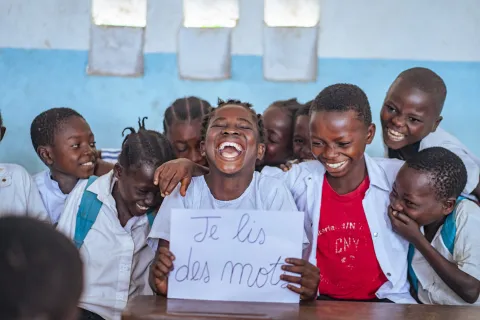
Cassien and his friend Lesly are back in school, though attendance in the province is only half of 2024 levels, with many families having fled. Returning to school, they restart lessons amid a trail of broken glass, a damaged school bus, bullet holes and rocket impact scars.

“Personally, what I experienced was horrible,” said Lesly. “I must have seen things I'd never seen before: rape, theft, looting...it was horrible. I saw my friends lose their parents, their loved ones, people they cared about. It's painful and stressful.”
After 25 years of conflict, the eastern DRC already counted more than six million people displaced and 465,000 children deprived of education. “When you're studying, you wonder if one day you'll be able to live in peace again,” said Lesly.
UNICEF is working with local partners to assess the scale of the damage, as well as work to reopen schools in the city of Goma and Nyiragongo territory. Around 152 schools were directly affected by the fighting including 68 that are now sheltering displaced families, 45 that have seen looting, and 35 that have been damaged by rockets and bullets, according to the Education Cluster. The crisis response will also see the setting up of temporary learning and protection spaces, the distribution of teaching and learning materials to teachers and students, and organizing home based and distance learning opportunities for displaced children.
“The damage I can see here is distressing,” said Cassien as he looks around his school, “but first of all I am very happy to see that some of my colleagues have survived…it's already something I couldn't have hoped for. With everything I've seen, I was thinking that maybe some of my colleagues could die at any moment but seeing them all alive and in good health gives us hope and gives us the strength to carry on for ourselves, for our friends and for our community.”
Lesly agrees. “Being here, seeing my friends, the teachers…I tell myself that I must have hope, because it could be all right one day or another.”
“One last word: we want peace.”