Refurbished school is a beacon of hope in newly peaceful village
Inspirational Congolese teacher describes satisfaction – and challenges – of teaching

- Français
- English
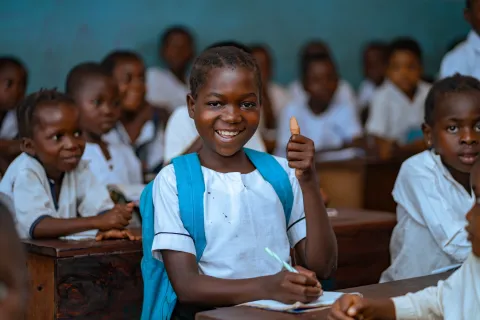
Kisimba Lazard is a secondary school teacher at the UNICEF-supported Lubile 1 primary school in the village of Mpungwe, 20km north of the town of Kalemie, provincial capital of Tanganyika province.
He is currently based at the primary school because both the primary and secondary schools were destroyed during the conflict but, so far, only the primary school has been rebuilt.
Regularly teaching classes of 60 pupils, he perhaps has one of the most demanding teaching jobs in education.
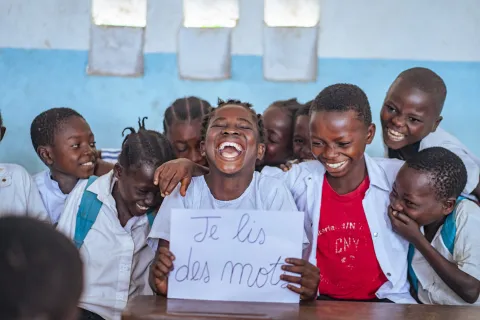
The extensively refurbished school stands as a beacon of hope for post-conflict DRC, successfully bringing together previously feuding communities in a peaceful environment.
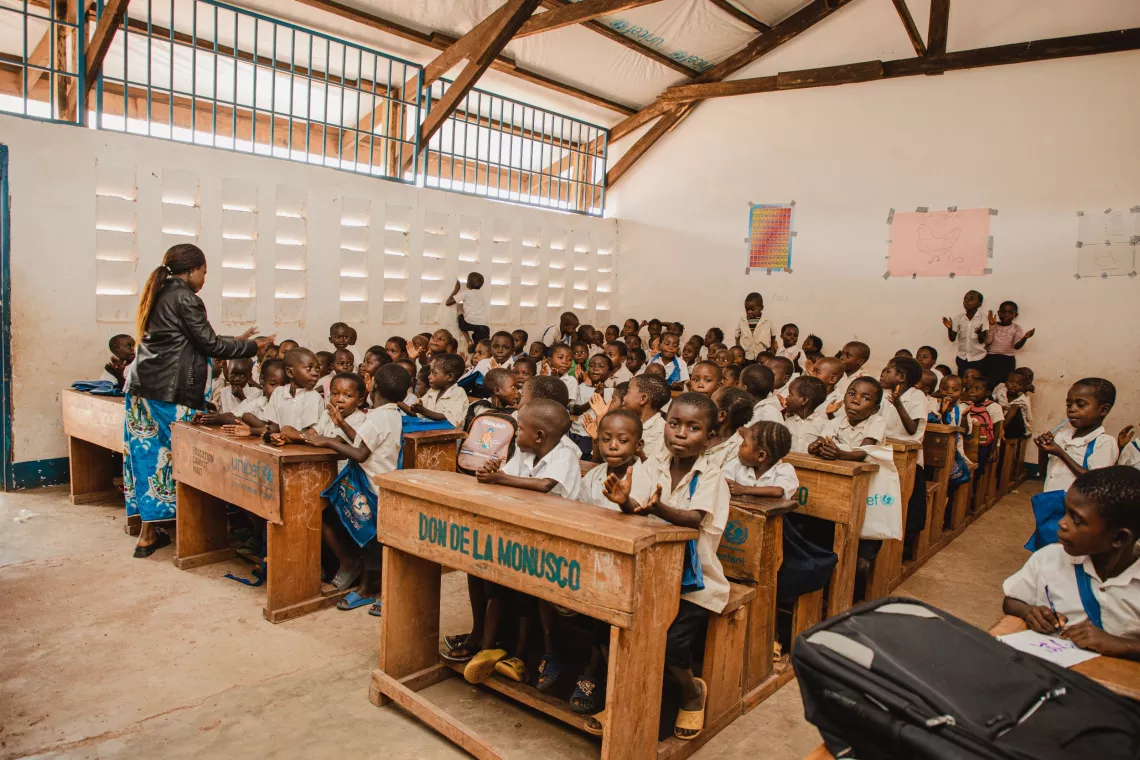
Mr Lazard says that while it is hugely satisfying to work at the school after several years of ethnic conflict, major challenges remain, not least overseeing huge classes.
“It’s not at all uncommon for teachers to be in charge of classes of 60 pupils,” he says. “This is definitely not a job for the faint-hearted!”
So, what are Mr Lazard’s tips for teachers facing such a formidable challenge?
“I find that it’s imperative to walk around the class constantly in order not to lose pupils’ attention,” he counsels.
“At the same time, it’s vital to have lots of group activities so that the class is sub-divided. I usually put pupils in groups of 20 and give them reading and writing exercises, along with stand-up/sit down singing exercises. At all times it’s really important to look as if you’re in control, even if you don’t feel that is the case!”

Huge class sizes are not the only challenges at the school. “We have significant shortages of educational equipment – from desks to exercise books – while only two of our secondary school teachers are paid by the government,” Mr Lazard says. “That is why we rely so extensively on volunteers and parents to help us out.”
Another challenge is children attending the school who have been traumatised by conflict, but who have not received any psychological support.
“Then there is the problem of secondary school fees,” he says. “While the primary school is free, it costs $8 a month to come to secondary school and many parents cannot afford it. But I hope that with the income-generating activities we have begun in our village – from agriculture to sewing initiatives – this situation will begin to change. I don’t mind teaching large classes, if it means children that receive an education.”
‘So excited’ to be back at school
Mwamba Jeanne Marie, 14, and Kyungu Kabwe Anastasie, 13, both come from families that were displaced from their village 40km from Kalemie in 2018. Both girls arrived in the village of Mpungwe in 2020 to resume their education after spending two years in the Tanganyika capital.

“I am so excited to be back in school,” says Marie. “I thought that my education had ended after we were displaced.”