Pregnant Goma mother hails UNICEF-supported volcano water stands
Without access to safe water and sanitation, children and families are at increased risk of waterborne diseases, with concern especially growing at the threat of a cholera outbreak.

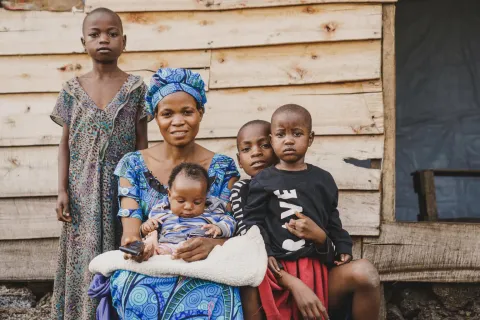
Pregnant mother, Aimerance Kabuo, 24, and her husband Matthieu Palulu, 32, are relieved to have a UNICEF-supported water distribution centre outside their home in the north of Goma, under the shadow of Mount Nyiragongo.
When Nyiragongo erupted on 22 May, a water reservoir was damaged and pipes were melted by lava. Aimerance and her family no longer had access to water via a nearby fountain. At one point more than 510,000 people in the city did not have access to safe water.
But the creation of the temporary water distribution point near Aimerance’s home means her family no longer have to pay for water or walk 5km to Lake Kivu to collect it.

A water carrying truck operated by UNICEF’s partner, Caritas, makes round the clock deliveries to an area outside Aimerance’s house, where scores of local people collect water in jerry cans. Similar water distribution points, supplying thousands of people, have been set up all over the city with support from the Central Emergency Response Fund (CERF), the European Civil Protection and Humanitarian Aid Operations (ECHO), USAID's Bureau for Humanitarian Assistance (BHA) and the Government of Norway and the Democratic People's Republic of Korea.
For Aimerance, getting clean water was just one of the problems she faced in the aftermath of the eruption. As people fled Goma to escape lava and dangerous gasses, she was temporarily separated from her children – Elodie, 5, Gabriella, 2 and one-year-old Edith.

When the family was eventually reunited, the water problem was acute. “After the eruption it was very difficult and stressful for us,” four-months pregnant Aimerance said. “We either had to pay 1,000 francs (roughly half a dollar) for our water or walk to [nearby Lake] Kivu to collect it. We had to manage this way for two weeks.”
The family’s water problems eased when they were given water chlorination tablets – water from Lake Kivu is not suitable for human consumption. “We are very lucky to have a water supply so close to where we live,” Aimerance said. “I can now get water whenever I need it.”