Nyunzu training project provides out-of-school adolescents with new opportunities
Learning a trade allows young people a way to earn an income and become self sufficient

- Français
- English
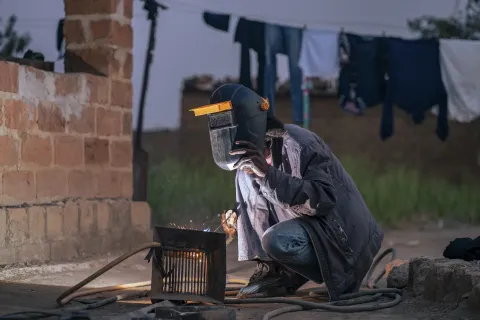
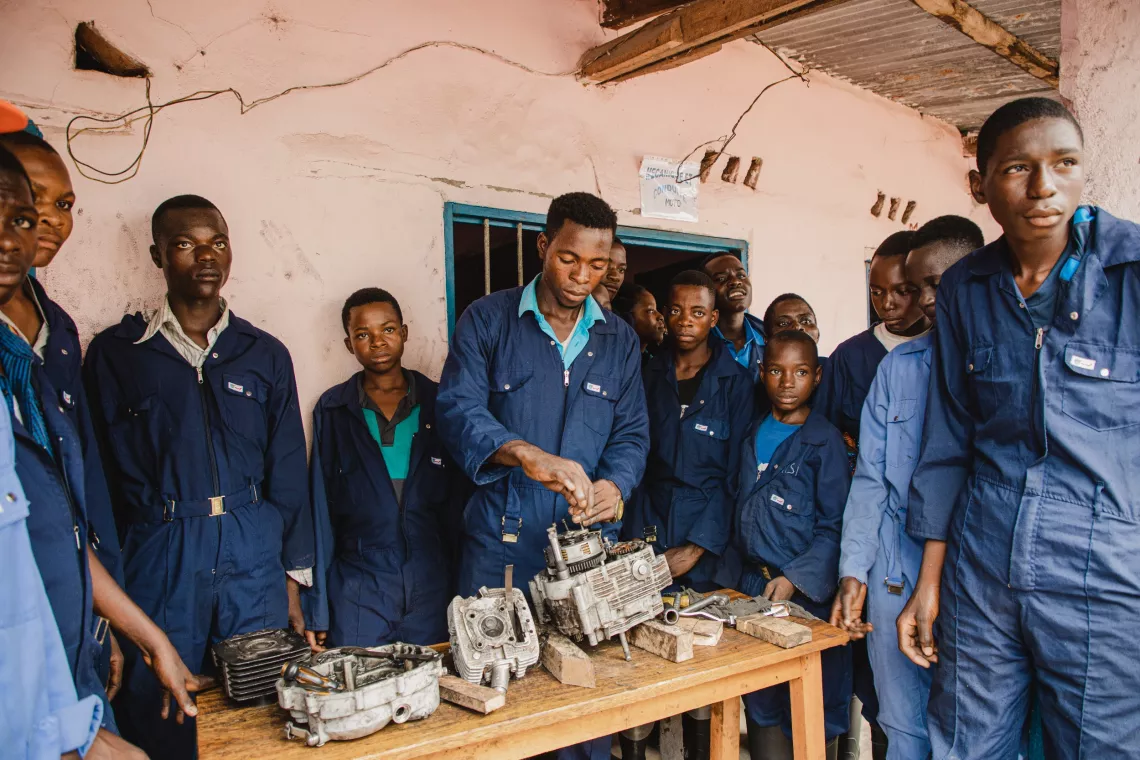
The Institut National de Préparation Professionnelle (INPP) training centre in the Kamituga area of Nyunzu is buzzing with activity as 77 adolescents in boiler suits carry out a variety of tasks including masonry, carpentry, brick laying, mechanics, soap making and food preparation.
“Our objective is to train young people from the Twa and Bantu communities for jobs,” says Kabale Jolie, the head of the INPP.
The initiative is supported by the Peace Building Fund, a UN joint entity that includes UNICEF, UNHCR and FAO and centres around promoting social cohesion and conflict prevention.
“Initially we had to overcome residual hostility between the two communities – our staff had to visit the adolescents’ homes to persuade their parents to let them to come here,” Jolie says.
Now children from both communities are firm friends and eager to learn a skill so that they can make a living. Once they complete the course at the training centre, most students join a co-operative where they receive the essential materials required to continue whatever trade they have learned.
“We want to strengthen their capacity to establish socio-economic independence,” Jolie adds.

There are five Twa girls attending the centre and seven Twa boys – the remainder all come from the Bantu community.
The overwhelming majority of young people attending the centre to learn new skills have been directly affected by recent conflict in Tanganyika with many coming from displaced families.
An additional bonus provided by the centre is protection for the children from being recruited by armed groups, Jolie says.
All the students had been forced to leave school early. It is estimated that only 20 per cent of Nyunzu’s school-aged population attends school, which explains why the need for vocational training is so enormous.

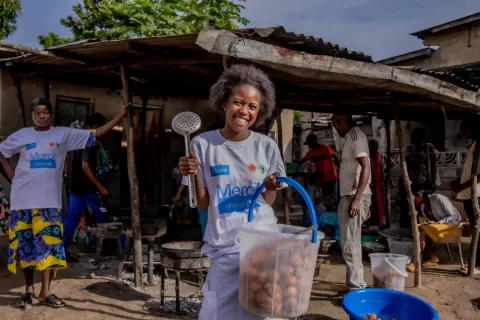
Jolie, a former accountant, is a qualified food nutritionist and food processing expert. As well as running the centre, she also teaches a group of teenagers how to prepare food and a range of their produce including bread, pastry, snacks and various fruit drinks are on display outside the centre’s kitchen.
Nearby – in the courtyard of the centre – a range of other inside and outside activities is taking place, including adolescents learning brickwork by constructing a makeshift wall, mechanics (by taking a motorcycle engine apart) and a group of teenagers preparing the ingredients for soap making.
Pombo Mukeina Yumiliya, a 16-year-old Bantu, is learning how to become a bricklayer. She is discovering how to use a spirit level, make cement and lay bricks properly.
“I want to become the go-to bricklayer of my community,” she says. “And prove to the boys that I can do it.”


Her family was displaced to near Nyunzu and have decided to remain in the area. She lives with her grandparents because she and her two siblings were orphaned by the conflict. She was in the first year of secondary school when her family was displaced in 2017.
Kiyombo Mangala, a 17-year-old Twa, is also learning how to be a bricklayer. “I love the work,” he says. “It’s motivating, not tiring.”
Kiyombo lived in a village 10km from Nyunzu, but his family was displaced in 2020. “It’s better now without conflict,” he asserts.
It’s a 20km round trip to get to the centre. If he can fine one, Mangala will take a motorbike taxi to the town centre. But, as if often the case, if he can’t find one, he has to walk.
This means getting up at 6 am to arrive at the centre at around 7.30 am. He returns home at about noon and works on a neighbour’s farm in the afternoon. He lives with his father because his mother was killed in conflict. In his village, members of the Bantu and Twa communities now live together.
Both of his siblings have also benefitted from learning at the centre. His sister, 15, is a soap maker and his brother, 14, has become a carpenter.
Kisinja Mangala, a 15-year-old Twa, is learning how to make soap. “I love the course,” she says. “Now I will have a means to make a living, especially if I can sell it in my village.”
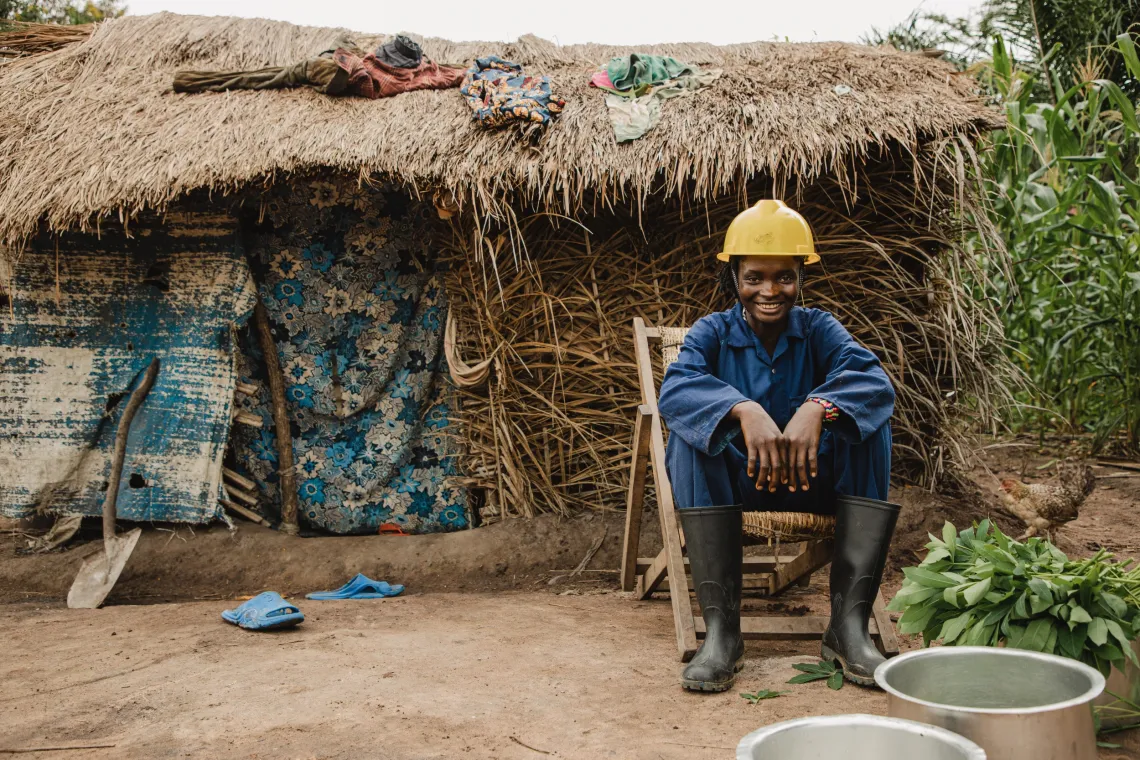
Kisinja lives with her family about 12km outside of Nyunzu. Most days she walks to and from the centre to attend her training. She will receive three months of training on her course, in addition to one month’s assistance, advice and a small cash advance to set up a business at home once she has completed it.
Kisinja’s family was displaced in the violence of 2015, which killed her mother.
“No-one knows how to make soap in my village,” she says. “So, I hope I will have a market for my product. “There is a big demand here because it’s mostly used for washing clothes.”