‘Getting a new exercise book is like a fresh start’
In Goma, UNICEF is helping to ensure a safe return to school for children affected by conflict

- Français
- English
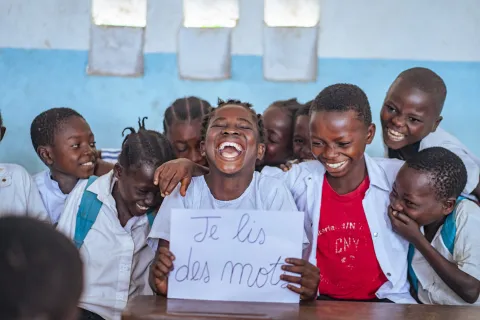
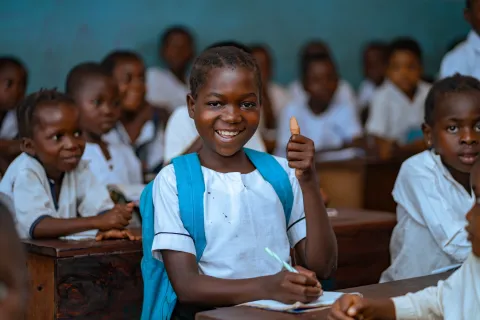
Sitting on a bench at Muningi Primary School in Goma, Justine can't help but smile. She has just received a school bag, pens and notebooks, after losing her school supplies when the Kanyaruchinya site for displaced people was dismantled at the start of February 2025.
Since 2021, Justine has been displaced multiple times. Originally from Rugari in Rutshuru, she fled the violence with her mother and siblings, finding refuge at the Kanyaruchinya site for displaced people just outside Goma. She slept in churches, lived in makeshift shelters and tried to continue her education despite the challenges.
Over the years, school become a pillar of hope and stability for Justine in a daily life characterised by displacement and uncertainty. Justine has attended Muningi Primary School since 2023. When conflict flared at the beginning of 2025 and the displacement camps were dismantled, Justine fled back to Rugari with her family.

She had hoped to be able to return to school in her hometown – but schools there remain closed. When she heard that classes were starting up again at Muningi Primary School, she decided to return to Goma to finish her school year. She is currently living with family friends. Her mother and brothers stayed in Rugari to work in the fields – Justine is the only one who has gone back to school.
“When I heard that school had started again, I was so happy,” Justine says.
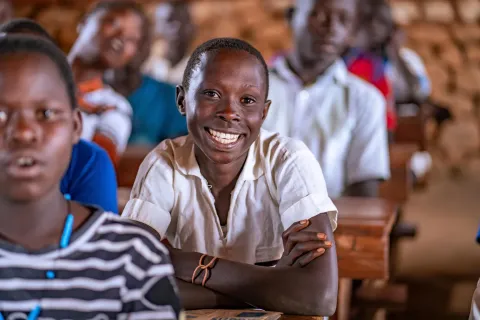
For her classmate Barthélémy Kasago, 16, the return to school was a more mixed experience.

“I went back to school on 15 February, but I didn't feel very comfortable that day because I was still afraid of the fighting,’ Barthélémy recalls. “I didn't feel really safe, either at home or at school, because we heard [rumours] that pupils were being forcibly recruited” into armed groups.
Today, Barthélémy is gradually regaining a sense of security and sees school as a real springboard to the future.
“I think school is essential,” he explains. “It allows you to learn languages such as French and English.”

But Justine and Barthélémy know that many children have not been able to return to school. As of mid-April, more than 1,930 schools remain closed in North Kivu and South Kivu due violence and displacement, impacting at least 732 890 children, according to DRC Education Cluster. Some have been destroyed, while others have been turned into shelters for displaced families.
In response to this, UNICEF and Education Cannot Wait (ECW) support the continuity of education for children, by, among other things, distributing educational supplies to students and teachers, by building classrooms in zones where many classrooms are no longer serviceable (because of damage when they were being used as shelters or during fighting), organizing catch up classes, and so on.
At Muningi Primary School, where Justine and Barthélemy are enrolled and other schools in North Kivu and South Kivu, UNICEF has distributed education kits to more than 43,000 pupils and teachers thanks to the partnership of the European Union and Education Cannot Wait.
In addition to supporting the return to school for children in affected areas, UNICEF is also supporting information campaigns about the risks associated with unexploded bombs and other weapons left behind after fighting.

“There are explosive devices everywhere and children can pick them up, thinking they are toys,” says Ariane Rubenga, team leader of SYOPADI, a partner organization of the education cluster.
During awareness-raising activities, Ariane and her team sometimes meet survivors of left-behind explosives.
“Some mothers say they have lost a limb while working in the fields,” she says. “Children pick up live cartridges thinking they are pens.”
At the same time, UNICEF and partners are also raising awareness about mpox and cholera outbreaks. Vital information about mpox has reached 1,7 million people since the start of the year in North Kivu.


As a U-Reporter, a community volunteer affiliated with UNICEF, Cousin Kasumbo regularly goes out to meet families and children to remind them of the essential actions they can take to protect themselves from diseases.
"I’m motivated to raise awareness in the community about the dangers of mpox, because once someone is infected, they’re isolated from their loved ones — and that takes a toll on their mental well-being."
UNICEF is also supporting the disinfection of schools in places where these diseases are known to be present. Together with the Red Cross, 14 rapid response teams in North Kivu are being deployed to areas where cholera cases have been reported.
As reports of sexual violence, abductions and forced recruitment of children continue to skyrocket in eastern DRC, schools remain an essential space to be safe and protected, to learn and to feel some stability.