Enjoying peace after years of conflict
New stability provides foundation to rebuild quality social services

- Français
- English
Mwamba Kabatalanga Baruti is chief of Ngoy village, which lies 65km south of Nyunzu in Tanganyika province. He is responsible for helping to oversee local amenities including the school and hospital in his community, which is 60 per cent Twa and 40 per cent Bantu.
“I am enjoying peace after years of conflict,” he says.
The community leader’s confidence in the peace process is so high that Mr Baruti, who is a Bantu, has bodyguards who are Twas.
“I am not sure it’s even necessary to have bodyguards at all today, but it shows how far both sides have come since the cessation of hostilities,” he says. “I am confident there will be no return to violence here. I’m convinced that most people from both communities want peace.”
Throughout his life Mr Baruti, 50, has suffered because of conflict in his part of Nyunzu.
Family members – including some of his nine siblings – have been killed and he was displaced three times between 2014 and 2020 due to recurrent violence.
He returned to his village from his most recent displacement in 2021, because there was no work for him in Nyunzu town and the beginning of the peace process meant it was safer for him to go back.

The peace negotiations in Nyunzu, led by Umoja Pour la Paix, le Progres et le Developement Integre (UPPDI), a grass roots organization, involved nearly 50 participants, including community leaders, the Congolese army, the police, the government and armed groups. The negotiations were supported by UNICEF via a partner called the Cohesive Leadership Initiative (ILC). The negotiations resulted in a tentative peace accord which in turn paved the way for humanitarian, development and additional peace-building programmes following the so-called nexus approach.
The humanitarian-development-peace (HDP) nexus refers to an approach that seeks to strengthen linkages between multiple programmes addressing needs, reducing vulnerabilities and preventing conflict through improved coordination and convergence of services. It also promotes strong local ownership and reflects national plans and priorities. In Tanganyika, UNICEF worked closely with the provincial planning ministry to unite stakeholders and help bring durable solutions to increasingly stable areas.
Mr Baruti was at the centre of an awareness campaign to encourage Bantu and Twa communities to embrace the peace process. He hopes that plans for improved social services will persuade displaced people to return to their villages.
“People can now plant their crops, send their children to school and go to the health centre,” he says. “Life in the villages is still not easy. Our primary school was destroyed during the conflict and has still not been repaired, but we are making progress.”
Rebuilding after conflict
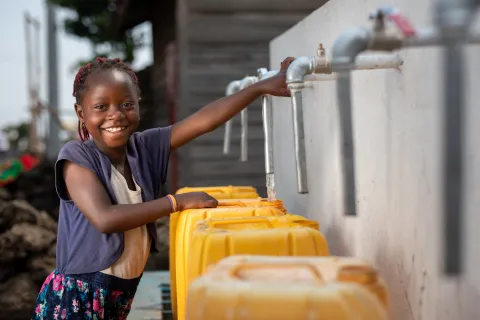
There are now 13 water points in the locality and four health centres. Primary and secondary school pupils in the village share the remaining undamaged school, with younger children attending in the mornings and older children in the afternoons.

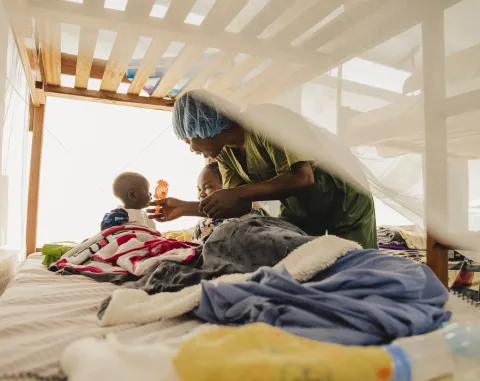
The village health centre, which was destroyed during years of conflict, was rebuilt with the support of UNICEF and its local partner AIDES. The centre can provide basic first aid, but for the treatment of more serious illnesses like malaria or respiratory infections patients must go elsewhere. The centre also lacks essential medicine, and the maternity ward consists solely of a birthing bed, but no other equipment. Hope is that medical services can further improve over time.
However, it is at the village’s medical centre where another sign of peace is visible nowadays. While most of the medics are Bantu, the security staff and cleaners are Twa.

“The presence of both communities here reassures people that medical care is provided for everyone, regardless of their community,” says village doctor Joseph Manda Wasango.
The centre usually treats about 25 patients a day, 35 per cent of whom are Bantu and 65 per cent of whom are Twa. “We may lack medicine, but things are better than before,” he adds.

Maternity nurse Mulobe Sophie Mangaza, 60, has lived in the village all her life and has witnessed first-hand the horrors of conflict.
She too says that life is better. “After years of conflict life here is improving slowly but surely,” she says.