Displaced on multiple occasions – but “life is better now”
Ready supply of clean water draws villagers back home

- Français
- English
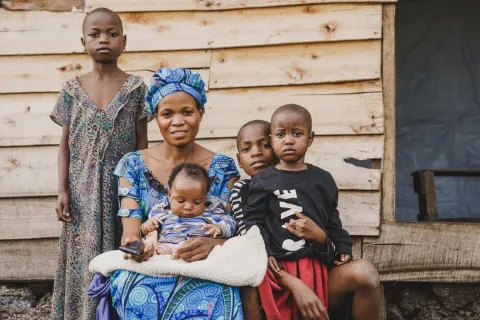
After she and her family were displaced numerous times from their village near Nyunzu over the past ten years, 30-year-old mother Mwayuma Luzinga needed to have a compelling reason to risk returning once again.
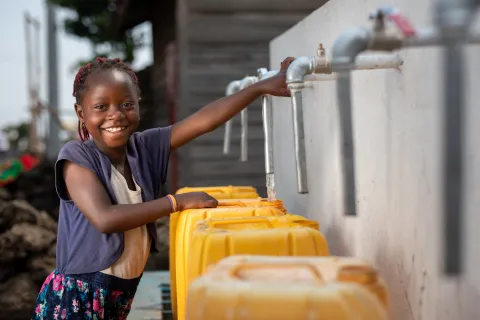
She says that the determining factor behind her latest decision to make her most recent return to Katampa village with her husband – about 20km outside of Nyunzu – was in part because this time a water stand had been erected in the village thanks to a partnership between UNICEF and the Salvation Army.
The couple, who have nine children aged between 18 years and six months old, said that having access to water on their doorstep makes their lives immeasurably better.

“Before it was difficult and time-consuming to get water,” Mwayuma says. “A member of the family would have to walk 3km there and back every day to collect it, and oftentimes it was dirty. Water collection took about half a day, and we had to stay at the river if we wanted to wash our clothes.”
But the ready supply of water for cooking and washing has transformed their lives.
Part of the Bantu community, Mwayuma and her family were first displaced in 2018 following inter-ethnic violence in her neighbourhood. They went to live with a host community family in Nyunzu.

They briefly returned to their village – who’s population today is roughly 60 percent Bantu and 40 percent Twa – in 2020.
But they were displaced again to Nyunzu soon afterwards. They returned again in 2021 and have so far remained there.
“We strongly feel that conflict in this part of the world has finished,” Mwayuma reflects. “People are returning to work in the fields and relations between the Bantu and Twa communities are much better. We now have a variety of things to eat including fou-fou, vegetables and sometimes even chicken and fish.”
Mwayuma says that the priority now is to rebuild latrines that were destroyed during the years of conflict. “Slowly but surely our lives are improving here,” she concludes.