Detect early, act fast, and support every child over time
From early community-based screening to follow-up at home, a comprehensive approach to saving lives

- Français
- English
Sitting on her aunt’s lap, Ngalula smiles. At the Banga Lubaka health centre in Kasai province, the three-year-old calmly lets her arm be measured. A simple coloured tape is used to check her nutritional status. Today, the result is reassuring: the indicator shows green.
Just a few weeks ago, things were very different. Ngalula was suffering from severe acute malnutrition, a life-threatening condition if not detected and treated in time.
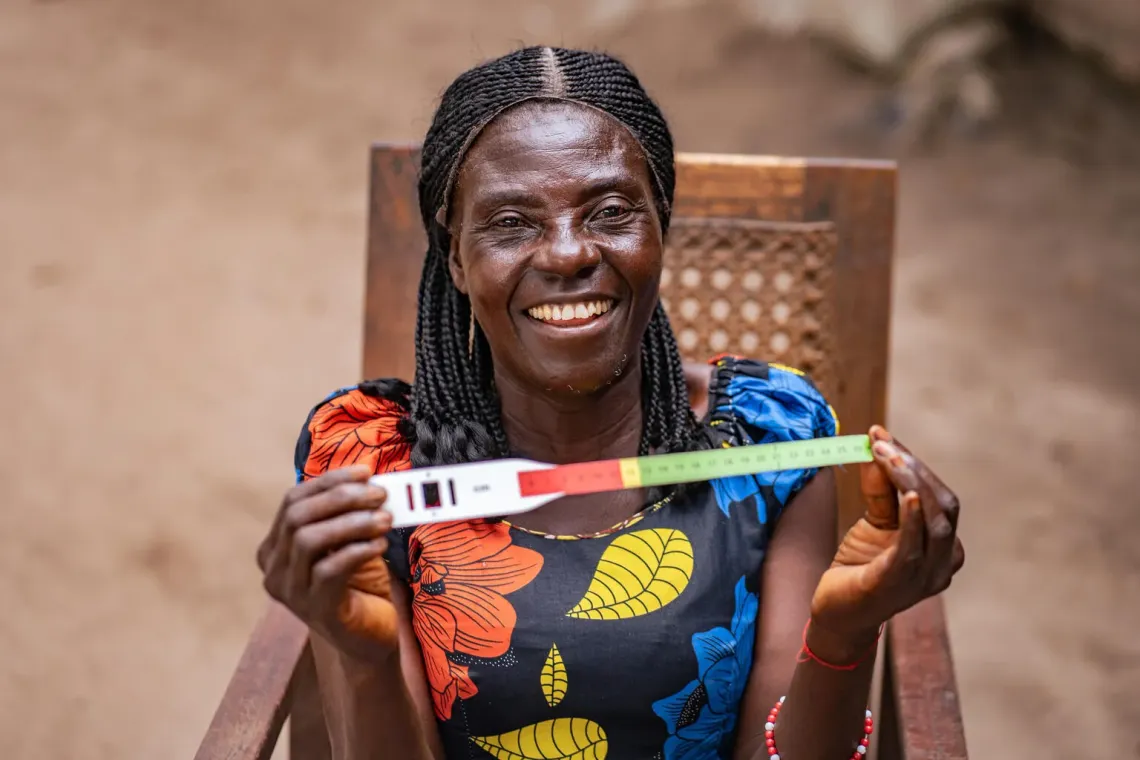
It all starts at home, when her aunt Joëlle receives a mid-upper arm circumference (MUAC) tape, along with simple training from community health worker Faby Mboyo. She learns how to measure children’s arm circumference and recognise the early signs of malnutrition.
The tape uses a easy-to-understand colour code: green means the child is healthy, yellow signals that the child is at risk, and red means the child is in danger and must be immediately referred to a health centre for urgent care.

At first, the indicator falls in the yellow zone, signalling risk. But Ngalula’s condition quickly worsens: her feet begin to swell and she loses her appetite. A new measurement confirms the concern: the tape has turned red.
Aware of the danger, Joëlle alerts Faby Mboyo. After confirming the measurement, she issues a referral slip and directs Ngalula to the Banga Lubaka health centre.
There, nurse Micheline Pembe confirms the diagnosis: Ngalula is suffering from severe acute malnutrition, with complications. She is referred to the Intensive Therapeutic Feeding Unit at the Banga Lubaka General Referral Hospital, where the most severely affected children receive specialised care.
Her condition improves quickly. After a week of treatment, Ngalula is able to return home. She continues her recovery there with ready-to-use therapeutic food, helping her regain her appetite, put on weight and rebuild her strength.


“We don’t just treat children. We also support families with advice,” explains Micheline Pembe, who has worked at the health centre for over ten years.
Back in the community, Faby Mboyo continues her close support. She visits families, offers guidance and reassurance, and helps ensure good practices are maintained.
Joëlle takes part in cooking demonstrations with other women in the neighbourhood. They learn how to prepare simple, nutritious meals adapted to young children’s needs, using locally available ingredients.
For Faby, every MUAC tape distributed is a chance to act in time. “When a family understands early that their child is in danger, it can save their life. Seeing a child recover is what motivates us every day.”
Regular follow-up after treatment is essential. It allows any deterioration to be detected early and addressed before the situation becomes critical. Early care not only prevents severe complications, but also reduces treatment time and lowers costs for families and the health system.
With support from the Bureau of African Affairs of the United States Department of State, more than 1.3 million children aged 6 to 59 months were screened in the provinces of Kasai, Kasai-Central and Kasai-Oriental between June 2025 and March 2026. Among them, over 55,000 children suffering from severe acute malnutrition received treatment through a combination of community-based interventions and care in health facilities.
After seven days of treatment in hospital and more than a month of follow-up at home, Ngalula is doing much better. She is eating again, playing and smiling. Today, the tape shows green: a sign that she is healthy.
Thanks to what she has learned, her aunt now continues to monitor her regularly to prevent any relapse.