Choosing, prioritising and moving forward after violence
Humanitarian cash transfers are helping families rebuild their lives in Minova

- Français
- English
In the bamboo-trimmed courtyard of her home, Florenciane Habima feeds her two goats with a large banana leaf. At 54, the mother of seven has found a semblance of stability after more than two decades marked by conflict and displacement.
Originally from Masisi territory in eastern Democratic Republic of the Congo (DRC), Florenciane lost her husband in 1988—he was killed while working in their fields. “That day, my family lost its pillar, and I had to raise our children alone in extremely difficult conditions,” she says.
After years of surviving through farming, Florenciane was forced to flee once again in 2023. She sought refuge in Minova with her four youngest children, settling in a displacement camp and earning just enough to survive by carrying goods for others.
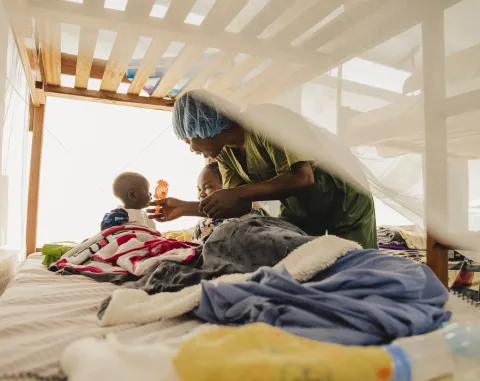
As a woman who was considered to be particularly vulnerable, Florenciane was chosen at the displacement site to be part of an joint assistance programme intended to prevent and reduce gender-based violence. Food assistance provided by the World Food Programme (WFP) was complemented by cash assistance from UNICEF.


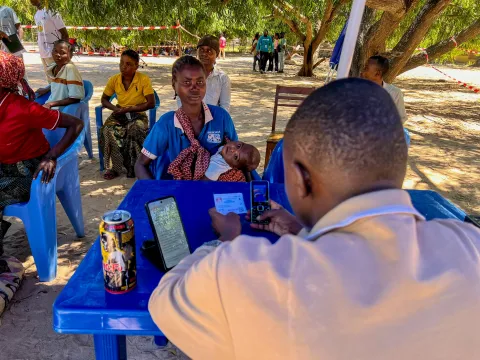
In December 2023, over 14,000 families, including Florenciane’s, received a mobile phone and SIM card, enabling them to receive money through mobile cash transfers.
With the funds, Florenciane chose to rent a plot of land and resume farming. When the displacement site was dismantled in early 2025, an additional cash transfer allowed her to rent a home, extend the plot lease for a year, and buy two goats. Now, she hopes to open a small shop.
“I have a roof over my head, a field [to grow food] to feed my children, and a project that could help us move even further forward,” she explains.
Thousands of families displaced by violence in eastern DRC have taken refuge in Minova. Located in South Kivu province, the town was among the first to feel the impact of the escalating violence early 2025. Prices of basic goods have soared, and access to food, shelter, and healthcare has become a daily struggle.

Bayomba Kamuke, a father of five, reflects on the life they left behind: “We used to live off our land and our livestock. We never needed to buy food.”
Thanks to the cash transfers, he was able to rent a large field, and his wife started a small business at the local market.
“I’ve already had three harvests, which means we can eat without relying entirely on humanitarian aid,” says Bayomba. “My wife’s business brings in a more stable income, and we can better manage our children’s needs.”
Despite the hardships, Bayomba has never lost hope.
“We must keep moving forward. If we hold onto hope, we can build a better future for our children.”
Since March 2025, approximately 6,000 families in Minova have received humanitarian cash transfers. With support from the German and Swedish governments, UNICEF aims to reach all 14,000 families who previously received phones and SIM cards.


Mwavita Rohomoya is also determined to rebuild her life. She arrived in Minova several years ago with her husband and four children, fleeing violence in Sake territory.
When she recently received a transfer of $107, she decided to launch a small drinks business.
“It’s been two months, and some days I earn over 30,000 Congolese francs [around $10],” she says. “I dream of going back home, but it’s still too unstable.”
Each household received an initial transfer of $25 per person, for up to five people, along with an allowance to cover transportation and withdrawal fees. A second transfer is planned to support families over the longer term.

When Georgina Dunia received her first payments in 2024, she joined a savings group and contributed part of her cash. After some time, she saved enough to open a small shop in Minova. But in January 2025, insecurity in the area forced her to flee to Goma. Upon returning, she restarted her business with the help of a new cash transfer.
“Thanks to the transfer, I was able to replenish my stock and cover our daily expenses. All I want now is a stable future for my family.”
Her granddaughter Jeanine was also able to return to school, equipped with a backpack and supplies—one more burden lifted for Georgina, who holds on to hope for a better life.

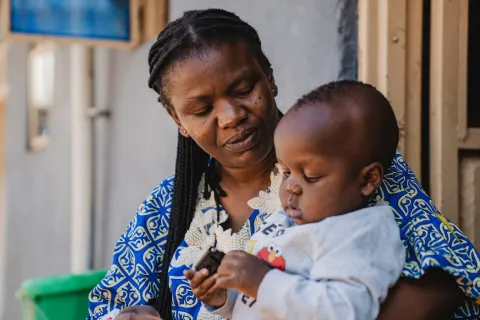
The mobile transfer approach is also being used in Goma to support 70 foster families caring for children separated from their parents. These transfers help cover food and other care-related expenses. In parallel, similar assistance has been provided to more than 670 families, including survivors of sexual violence.
Behind every transfer lies more than just emergency assistance. It’s a chance to choose, to decide, and to rebuild at one’s own pace. Each family defines its priorities and invests where it matters most.
“I still hope peace will return for good so we can live with dignity, without being forced to start over again and again,” Georgina says.