

A study on violence affecting children and adolescents in Cuba was launched
- Español
- English
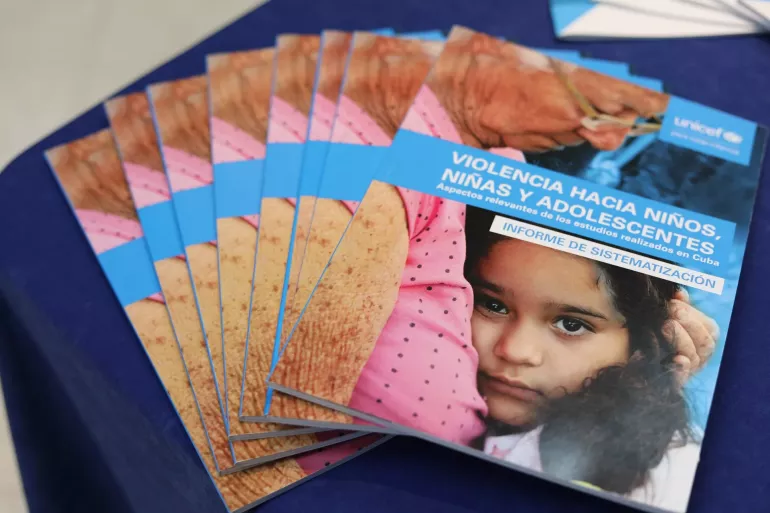
Havana, 24 June 2024.- The presentation of a study that systematizes 209 research studies on violence affecting children and adolescents, published between 2000 and 2020, took place in Havana, with the presence of the United Nations Resident Coordinator in Cuba, Francisco Pichón, and the UNICEF Representative in Cuba, Alejandra Trossero.
This UNICEF Cuba study was carried out by researchers Clotilde Proveyer Cervantes, María Antonia Miranda and Succel Pardini. The systematisation work analysed undergraduate and postgraduate theses, research, reports on professional practices, articles published in the country's specialised journals, monographs and conference proceedings.
The Resident Coordinator of the United Nations System in Cuba considered the systematisation is very relevant and of great value for implementing the rights of children and adolescents. “These issues are at the centre of national policies. They are part of the United Nations commitments to the country and are at the heart of the 2030 Agenda.”
“For decades, the Cuban State has shown a strong political will to guarantee the adequate development and well-being of its children. Recent examples include the Code of Families, which includes the international standards set out in the Convention on the Rights of the Child, such as the best interests of the child and progressive autonomy; the Comprehensive Policy on Children, Adolescents and Youth; and all the efforts being made to prevent teenage pregnancy through the Macro-Programme for Human Development, Equity and Social Justice.”
“This publication, while delving into research on different forms of violence and discrimination, brings up the challenges associated with the prevalence of patriarchal culture, gender stereotypes and their impact on people from an early age,” concluded Pichón.
For her part, UNICEF Representative in Cuba, Alejandra Trossero, thanked the authors for their excellent work systematizing 20 years of research on violence against children and adolescents by the Cuban Academy.
“The systematisation provides us with relevant results for our future cooperation plan. It allows us to make visible a real phenomenon that affects children and adolescents in different ways, scenarios and forms. The systematisation emphasises the need to strengthen research data generation to understand and transform the social norms, conceptions and practices that reproduce violence.”
“The study shows the interrelationships among the various types of violence. When we think about violence against children, we also think about violence against women and gender-based violence. The recommendations enshrined in the document constitute a fundamental input for a social and behavioural change strategy that, at UNICEF, we have incorporated through our Mídete campaign. The latter promotes respectful, positive parenting, responsible use of social networks, prevention of gender-based violence and child sexual abuse,” said Trossero.
The issues addressed in the systematisation include forms of violent discipline, exposure to domestic and/or gender-based violence and other forms of violence at home. The researchers also analysed violence affecting children and adolescents in the educational, institutional and peer settings, as well as discriminatory violence (due to disability, skin colour, economic status or other), violence in the digital environment and discriminatory violence based on sexual orientation and gender identity, along with sexual violence.
The scientific document showed partial dissemination and use of the Convention on the Rights of the Child, as gaps were found in the knowledge, dissemination and application of the Convention by institutions with this social responsibility, by the socialisation agents responsible for compliance and by the children themselves.
The systematisation revealed the link between the different forms of mistreatment, which take place simultaneously or are conducive to the exercise of other forms of mistreatment. Therefore, highlighting the multidimensionality of the factors fostering child mistreatment is of utmost importance. For example, several of the studies analysed show that child sexual abuse is linked to other forms of domestic violence and other parallel forms of abuse, which qualify as physical and emotional mistreatment.
The Cuban studies confirm the international trend related to adolescence as the period of greatest vulnerability to certain types of violence, especially sexual violence. One specific connection found in adolescence is the link between gender-based violence and sexual abuse. However, this is an area little explored by social research.
The systematisation showed that violence in the school environment occurs both between students, from teachers to students and vice versa, although the most studied is peer violence.
The other most studied manifestation of peer violence was bullying, in its different manifestations. All of this can be interpreted as a result of its naturalisation in the culture and the failure to make it visible, both in school practices and in the normative documents of the education system.
The conclusions of the systematisation included the fact that recognising children and adolescents as fundamental subjects of dialogue in the construction of knowledge and moving from researching and deciding about childhood to doing so with children and adolescents continued to be a pending issue.
In the subsequent exchange with the participants of the presentation, it was possible to identify opportunities in the context to address existing barriers and to put an end to all expressions of violence that limit the well-being and development of children and adolescents.
Among the opportunities identified were the updating of the normative framework, with the approval of the comprehensive policy for children, adolescents and youth; the process of building a new cooperation framework of the United Nations System in Cuba; the existence of trained personnel in universities and research centres, as well as new actors in the country interested in working with children and adolescents, for example, entrepreneurship and local development projects.
In addition, they also pointed out the existence of communication platforms (press media, digital social networks) that can be effective channels to promote rights, services, complaint and questioning mechanisms of social and gender norms, adult-centred and violence-based practices.
Media contacts
About UNICEF
UNICEF promotes the rights and wellbeing of every child, in everything we do. Together with our partners, we work in 190 countries and territories to translate that commitment into practical action, focusing special effort on reaching the most vulnerable and excluded children, to the benefit of all children, everywhere.
Follow UNICEF Cuba on X, Facebook, Instagram, Threads, YouTube, LinkedIn, WhatsApp and Telegram


