Pathways to resilience
UNICEF Cuba, with the contribution of the European Civil Protection and Humanitarian Aid Operations works to support communities exposed to multi-risks

- Español
- English
In the courtyard of the Celia Sanchez Manduley special education school, the students remain attentive, not missing a single word from teacher Marien Pollo Morel. They find her practical classes very attractive because she uses the natural environment and images with pictograms to help her students learn better.
She points out on the map, marked with red and yellow colors, the different risks that exist in the community where the school is located.
“We are very close to El Uvero river. When there are heavy rains, it can overflow. On one occasion it went out of its course and flooded the whole area of the village up to the general clinic (community health center),” she tells them. “We also have the general power line near the school. If there is a short circuit, this power line could be damaged and a fire could break out. We must take into account that we have pine and mango trees very close by, which are more than six meters high and can fall if there are strong winds due to a tropical cyclone”.
In the distance, you can see the mountains, the pride of the locals because of the natural resources they hold, but also because of the number of legends and true stories told by the elders in the community. However, these mountains are also the source of risks, especially landslides, which can cause accidents during the rainy season, when the stones that fall are usually larger.
Teacher Marien Pollo Morel understands that she has a complex and beautiful mission, as she has to rely on clear language and friendly images to help her students with intellectual disabilities and autism spectrum disorders learn better.

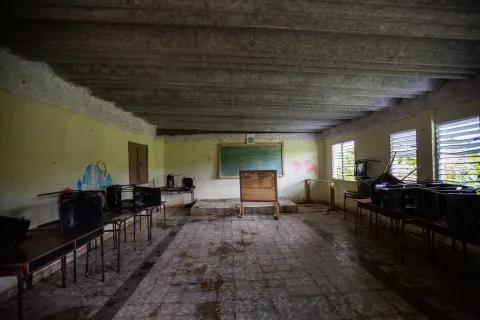
Life at the Celia Sánchez Manduley Special School is peaceful, with regular schedules that allow for the organization of the educational program, as well as recreation and rest. The students remain in the institution in a boarding system in which the school is their home for most of the year.
There they have space for learning the educational content of each school level, as well as for games and socializing. In addition, because it is located in the community of El Uvero, in Santiago de Cuba’s municipality of Guamá, the school also prioritizes the acquisition of knowledge about disaster multi-risks and about providing first aid.
The province of Santiago de Cuba is located very close to the Oriente fault, which marks the edges of the North American and Caribbean tectonic plates. For that reason, perceptible earthquakes or earth tremors, as the inhabitants of the community call them, are not uncommon. It is a fact that is talked about as much as hurricanes. In 2022, in the Santiago-Baconao area alone, 1,468 earthquakes were recorded, making it the area with the highest seismic activity in the country.
The school’s director, Damary Miranda Rivera, is well aware of this and feels much more confident when talking about these issues, thanks to the training, educational materials and resources received from the Ministry of Education, with the support of UNICEF in Cuba and the contribution of the European Civil Protection and Humanitarian Aid Operations (ECHO).
Miranda Rivera stresses that “the main mission of the institution is to prepare students for life, to give them knowledge on how to reduce the risks of disasters and to ensure that one day they will be able to act calmly in the face of disasters and be resilient.
“The students participate in the project with a lot of motivation,” says the director. “We try to make the activities practical so that our students with intellectual disabilities can take advantage of them, because they learn a lot through what they see. For this reason, we make banners, teaching aids and the multi-risk map, in addition to using the friendly materials developed by the project. Likewise, the knowledge we receive on these topics allows us to contribute to the preparation of families and to be alert".

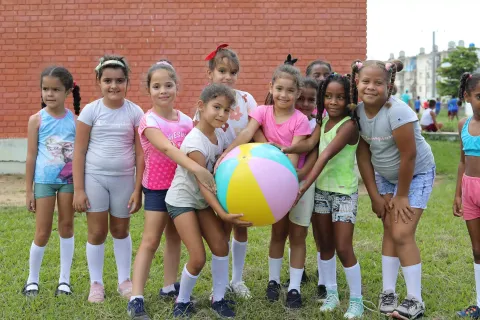
Under a mango tree, a dozen students from the elementary and high school levels of the Celia Sánchez Manduley special school are gathered. They look at each other and smile when they realize that the camera is taking their picture. Then, when the teacher gestures that the circle of interest class is about to begin, they all stand still, waiting.
Marien Pollo asks them to look around them and think about where they walk around the school every day.
“Do you recognize any multi-risks that exist in our school?” she asks them.
The children look around the courtyard, the classrooms, the dormitory area and an affirmative chorus encourages the teacher, who asks them another question, wrapped in a possible situation:
“If you were in your dormitories and suddenly an earthquake occurred, what would you have to maintain?”
“Distance!” one of the younger girls blurts out almost without thinking. The others look at each other in confusion and the teacher insists:
“What do you have to maintain? Discipline and...”
“Discipline and calm,” replies Sadianni, another elementary school girl.
“Very well. And why?”
“Because while walking down the stairs, if we are nervous, we can fall,” explains the student.
“To avoid accidents,” adds another student.
“When I ring the bell loudly, what am I telling you?” asks the teacher again.
“That there’s an earthquake,” says a tall, thin boy, after raising his hand.
“And where should you go?”
“Towards the park and the square,” they all agree.
“Away from trees, electrical wires and where you’re protected from landslides or crumbling buildings,” adds the teacher, very slowly, so that everyone understands the importance of what she’s explaining.
“And remain calm, teacher, until we’re told that the danger has passed,” they all chant again, proud that they have learned it well.