Children's well-being after the hurricane
In the aftermath of a hurricane or other natural disaster, UNICEF Cuba supports the psychological recovery of children and adolescents in affected areas

- Español
- English
The children at the Simón Bolívar Elementary School in Consolación del Sur (Pinar del Río province, Cuba's westernmost province) say their school never lacked a ball to play with or play sports. However, you only have to look into their eyes and ask them about the recreational kit provided by UNICEF, so that the sparkle in their eyes can speak for itself.
“That's something else,” they say in chorus with mischief and gratitude, rummaging through the balls and pawing through the sports equipment to make up the teams.

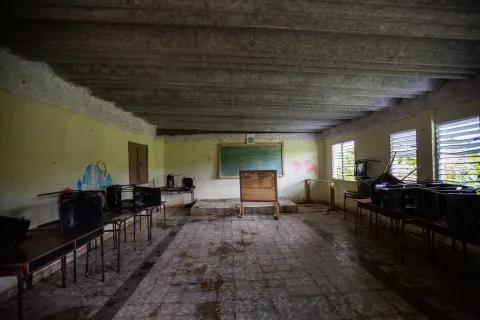
It is something else indeed. In addition to the supplies to play with, the bright colours, or the new smell, these materials came into the hands of children at the best possible time: when the homes of many were devastated by a major hydro-meteorological event. They lost clothes, toys and other belongings, while fear and sadness clouded their usual joy and excitement.
When a hydro-meteorological event like this one (category 4) happens, it devastates everything.
In the municipality of Consolación del Sur alone, 14,397 houses were damaged and 44 schools lost their roofs completely. The income of many families dependent on tobacco cultivation fell along with plantations and other agricultural production. Restoring electricity, access to drinking water and telephones can take weeks.
In such situations, the uncertainty, losses and worries, anguish and stress the affected people. Children and adolescents, in particular, may be exposed to negative feelings, leading to anxiety and even depression. Providing them with information, reassurance, confidence and love helps them cope with the difficult circumstances.

Returning to class in a safe space contributes to their psychological well-being because they can talk about their moods and emotions and, at the same time, have options to continue learning, play and relax.

As part of UNICEF Cuba's response to Hurricane Ian, 140 school kits, 38 early childhood kits, 154 recreation kits, 200 tarpaulins for temporary spaces and 50,200 square metres of waterproofing blankets for roofs were distributed. Currently, the rehabilitation of roofs and sanitary infrastructure of 67 schools in the most affected municipalities of Pinar del Río is being supported.
Financial contributions have been provided by the Government of Canada, the Basque Agency for Development Cooperation, the Xunta de Galicia, the Governments of the Canary Islands, Murcia and the Balearic Islands, the Spanish Committee of UNICEF and the Development Bank of Latin America and the Caribbean.
Unforgettable learning
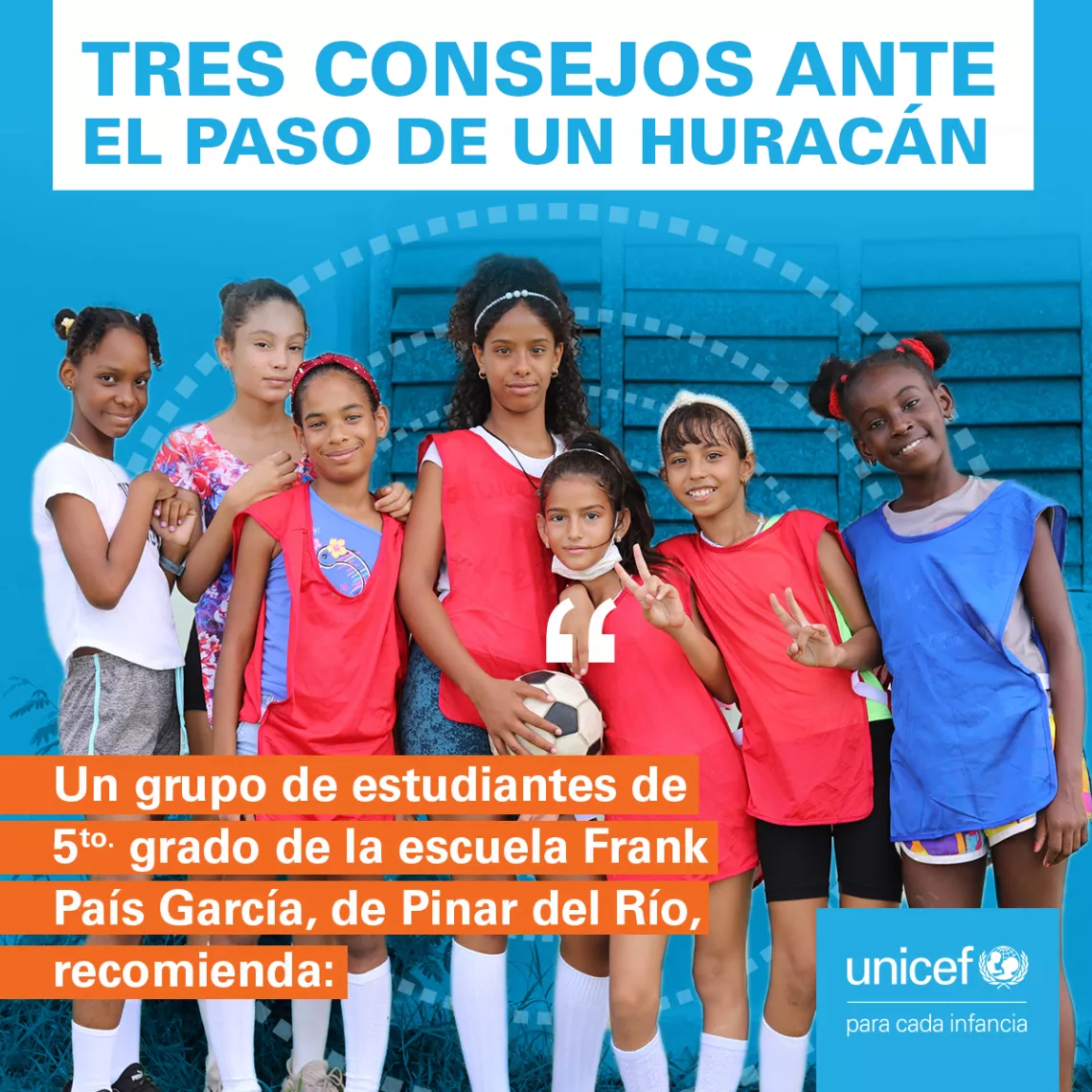
The Frank País García School, in the municipality of Pinar del Río, also received recreation kits to support its students’ socio-emotional recovery and rapid return to the classroom after Hurricane Ian passed through in September 2022.
This school serves as a temporary evacuation centre for disaster situations. During Hurricane Ian’s passage, it housed 43 families from the area.
Ainoa de la Caridad Palacios Leal, a fifth-grader there, nervously recounts the damage to her home after Hurricane Ian. Her voice gradually becomes more confident, and she mentions, one by one, the measures to protect herself from a hurricane that she, who lives in Pinar del Río, has known by heart from an early age.
“Before the cyclone, we pruned the nearby trees, we secured all the doors and windows of the house, we brought up the equipment and we put the most valuable belongings in safety...,” the girl explained.
For her part, Katherine Rivero Rodríguez, from the same school, emphasises that people should secure the roofs of their houses. “You have to put heavy things on the roof, because my aunt’s roof was completely blown off by the winds,” she recalls.


In every cyclone season in Cuba, UNICEF works in coordination with national and local authorities to support preparedness and response efforts, putting the rights of children and adolescents at the centre of its work in these adverse contexts.
After a disaster, the psychological well-being of children and adolescents is not recovered merely through play, recreation, sports, and art. However, these are essential for mental health.
UNICEF encourages the school and the community to work hand in hand to foster a climate of respect, empathy, solidarity and protection for children, especially in tense circumstances such as those left in the wake of a natural disaster.