“Different is not inferior, different is just – different!”
“Living Diversity” education: The importance of intercultural understanding

- Hrvatski
- English
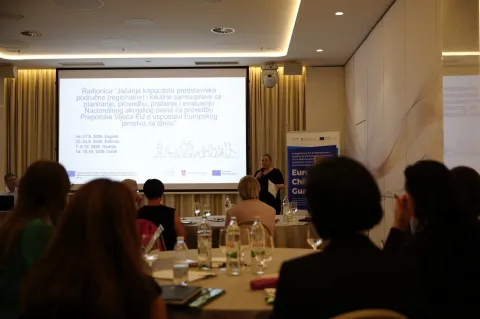
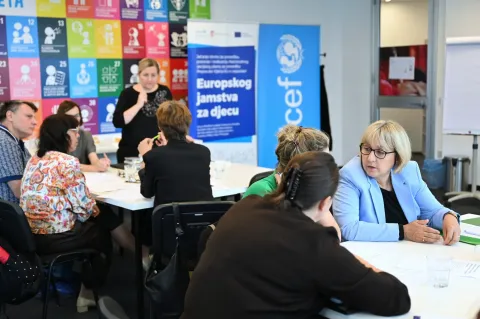
At the Center for provision community services Zagreb-Dugave, professionals work daily with unaccompanied and separated children, migrants, and refugees from various countries, each with different life stories and cultural backgrounds. They care for 400 unaccompanied and separated children annually and provide services to about 450 children and young people daily. To enhance their skills and ensure better support for their beneficieries, they attended the "Living Diversity" education, organized by the Open Academy “Step by Step” with the support of UNICEF.
The education was held within the Supporting protection and integration of children and families in migration in Croatia joint programme by the Swiss State Secretariat for Migration (SEM) and UNICEF, funded by the Swiss Government.
Through personal experiences, all participants emphasize the key importance of understanding diversity, active listening, and the continuous identification and elimination of prejudices, both in society and in daily work.


Empathy and active listening in working with children
For Ivana Lokas Šćetko, a social pedagogue at the Center for provision of community services Zagreb-Dugave, the education was an opportunity to further raise the standards of her and her colleagues’ work, especially when it comes to unaccompanied and separated children. “The education helped us refresh the core principles of our profession and reminded us of the importance of understanding the specific life circumstances of each child. This is the foundation for providing appropriate support”, says Ivana, emphasizing that such moments are opportunities for personal reflection and professional growth. She also highlights how the application of newly acquired skills, such as constructive listening, will help professionals connect better with the children and recognize their real needs. “Although we were already familiar with these approaches, now we can recognize, name, and apply them with even greater effectiveness”, says Ivana, adding: “In our work, it is very important to reflect on culture and intercultural differences and adopt an intercultural approach. I really liked how the trainers spoke about the ‘software’ of each of us in such a practical way, how each of us comes from our own stereotypes, prejudices, and knowledge about others. We must always keep in mind the filter through which we view both children and adults. Similarly, in our everyday work, we must consider the previous experiences of all the children who come to us.”

Social pedagogue Robert Janđel, who works daily with children from different cultural and social backgrounds at the reception unit in Dugave, shares a similar opinion. “The biggest challenge is recognizing and confronting prejudices, both in children and in society. Refreshing our knowledge about how we form prejudices helps us better understand the children we work with and enables easier integration”, says Robert and continues: “When prejudices arise, I always feel sorry because unaccompanied and separated children are, first and foremost, children! Once our “own” children and families lower their guard, the walls they’ve built around themselves, once they let it down, they play football together, hang out together... Once they see that they are actually more alike than different, a bond forms, and we realize that they are all just children!”
The importance of dialogue and understanding
One of the most important skills and messages the participants carried from the education is the importance of empathy, understanding, and creating space for dialogue. “When we listen with empathy, we can better understand other people's circumstances and provide appropriate support”, says Sima Ghoulani, proud of her role as the first intercultural mediator at the Center for provision of community services Zagreb-Dugave. “I’m proud to be the first foreigner working here. It is an honor, and I’m happy that after 33 years of living in Croatia, after everything that was given to me, I can give something back to society!”

Sima had no doubts about taking on this role, as she herself has faced numerous challenges.
“I believe I can now use my experience to help others. I want to be a valuable member of society, especially for children who are in vulnerable situations. I see this as an opportunity to contribute to better integration, better understanding among cultures, and ultimately, better interpersonal relationships. I can say that my motivation is strong because I want to show both children and parents that they have the right to better understanding and quality support. Moreover, the experience I gained working in Opatovac and Slavonski Brod during the refugee crisis, where I encountered many unaccompanied and separated children, deeply affected me. I witnessed the tears of single mothers, children who were physically and emotionally exhausted, and this shaped my approach. Today, I want to be the one who offers a helping hand, understanding, and support. I want to bravely fight for the rights of unaccompanied and separated children!”
Breaking stereotypes and prejudices
The professionals are aware that unaccompanied and separated children often face prejudices due to their origins, different habits, or behaviors. However, it is crucial to understand that there are numerous challenges and experiences they have been through. “Children who have crossed kilometers in dangerous conditions cannot immediately behave like children who grew up in safe conditions. This needs to be understood, and they should be given time and support”, emphasizes Sima.
Robert Janđel reminds us that the key to success lies in accepting diversity and creating space for dialogue. “Different is not bad, it’s not inferior. Different is just different.”


Educator Sanja Brajković emphasizes that it is extremely important for everyone to try to understand each other, especially in uncomfortable or challenging situations, and not to react hastily. “This training gives us a broader social context, talks about different interactions and social events, and how they affect every child and their family, but also us. And what’s important is that it reminds us that we, as complete individuals, come to work, and we need to accept ourselves as such. But also, our beneficieries, they don't just come with the problems that led them to the institution where we work; they come as complete individuals”, explains Sanja.
Her colleague, Marina Matešić, agrees, stating that she always learns something from the participants at every education. “At such educations, we deal with how we, as professionals, as adults, and as a society, are all somehow responsible for providing support to children. We also learn to think not only about what knowledge and skills we need to have, but also about what we bring to the table – our attitudes, prejudices, and ideas about who is in front of us. And finally, we work on ourselves, on our relationships with colleagues, to build the culture of the institutions where children stay in a way that provides the best possible, highest-quality professional services, and that they are accessible to their children.”
UNICEF and the Open Academy “Step by Step” have been collaborating for many years on integration and inclusion goals, as well as various projects and programs supporting Roma children, refugee and migrant children, unaccompanied and separated children, and children with disabilities.
“This education reminds us of the responsibility we have toward children. And toward ourselves. We must work on ourselves to be better at our jobs and contribute to a better society”, concludes Ivana Lokas Šćetko.


© UNICEF, 2025 “The information and views set out in this page are those of the author(s) and do not necessarily reflect the official opinion of the Schweizerische Eidgenossenschaft, Swiss-Europe Rapid Response Fund or UNICEF. Neither the Schweizerische Eidgenossenschaft, Swiss-Europe Rapid Response Fund or UNICEF nor any person acting on their behalf may be held responsible for the use which may be made of the information contained therein.”