How a young Sudanese refugee decided to help her Chadian peers access literacy
"They share their lands with us, I share my knowledge with them; I will always remember my time in Chad, and the Chadians will also remember me,"

- English
- Français
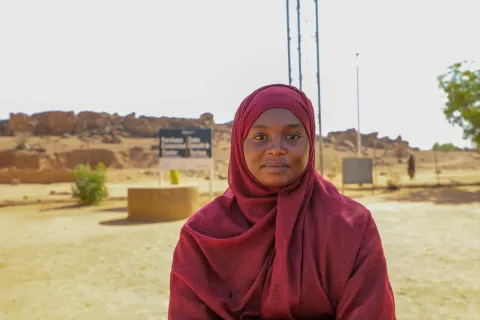
"They share their lands with us, I share my knowledge with them; I will always remember my time in Chad, and the Chadians will also remember me," says Mouwahib Mahamat Adam, a 23-year-old girl who found refuge in Chad after being forced to leave Sudan when the war broke out in April 2023.
Under the big tree in Guindo village, about twenty young girls and boys are gathered, sitting on a spread-out tarp on the ground. They are steadily listening to Mouwahib, who is giving them a reading and writing lesson.

As she was about to finish her biology studies at Al-Genaïna University in Sudan, Mouwahib fled to Adré, Chad, with her family. She was then relocated and settled in the Ourang refugee camp, about fifty kilometers from the border. On-site, the basics are provided - shelter, food, and water - but for Mouwahib, transitioning from city life to a small village came as a shock. Before the crisis, Guindo was home to about 2,000 inhabitants, most of whom were farmers and herders, who had never been to school and did not speak any of Chad's official languages. In both the village and the refugee camp, young people are worried because they feel their concerns are not being addressed, and with this new situation, they are exposed daily to the risks of intercommunal violence. Young girls are also concerned about the risks of gender-based violence, especially sexual violence.
UNICEF helped the youth delegation of Ouaddaï to gather indigenous and refugee youth as part of a community engagement program. Participants are invited to reflect on the common challenges they face due to this new situation, including cohabitation problems, and to find solutions to improve life around them.
During a water treatment awareness demonstration organized by the Ouaddai youth delegation and UNICEF, the facilitators realized they were having difficulty being understood - most learners, especially the indigenous ones, did not master Arabic. Mouwahib then proposed to help and translate into Massalit, the local language also spoken in Darfur, the Sudanese region on the other side of the border.

From there, Mouwahib decided to organize literacy lessons for indigenous youth. Enthusiastic about the idea, the village youth built a blackboard and pooled money to buy chalk. Guindo’s village chief himself granted a dedicated space for learning.
Three times a week, Mouwahib wears her black tunic and slings over her shoulder the small bag that a humanitarian worker gave her as a thank you for translating in the camp. Inside the bag is a notebook in which she has prepared the lesson of the day. Mouwahib crosses the camp and walks to the village. As she approaches the village, children run to meet her, some take her bag, others hold her hand and lead her under the tree where about twenty young people aged 14 to 22 are waiting. Each lesson lasts two hours, and Mouwahib ensures that all students participate, eager to learn.

"I thought it was impossible for a person of my age to learn to read and write; we were isolated because we don't know any national language to communicate with other Chadians or foreigners. Since I started the lessons, I don't want to miss any; I plan to continue learning, and then I would like to find an opportunity to enroll in a literacy program,"
Youssouf Ahmat Abakar, a 20-year-old learner, joyfully testifies.
Youssouf, who initially hesitated to have a girl teach him, has even become one of the most committed young people advocating for girls' education. "Mouwahib has become our sister, and thanks to her, we have increasingly fraternal relations with the refugees. Her commitment has also made us understand that an educated woman can better serve others," he says.
Mouwahib's commitment leads the village to open its doors even more to refugees, who can come to find shade during the day under the big trees and chat with others. Abdoulaye Abakar, Guindo’s village chief who decided to allocate Mouwahib a piece of cultivable land, admires the young girl teaching others to read.


Back at the refugee camp, Mouwahib cooks for her mother and sisters, then goes to the youth space after her nap. In this space set up by UNICEF and the Chadian government, Mouwahib joins other young people in the group planning hygiene best practice activities. The youth then engage in door-to-door activities, teaching families how to treat drinking water to prevent diseases. In these activities, the youth are supported by UNICEF and non-governmental organizations, which provide them with training and the necessary products for water treatment.