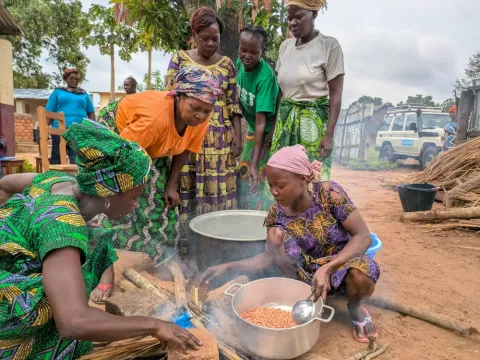
Women at the heart of change to sustainably improve children's nutrition and health
In the Central African Republic, transforming hygiene and health through community-based awareness-raising.

- English
- Français
During a UNICEF-supported community training workshop in the Central African Republic, women leaders from various communities gathered to strengthen their knowledge of nutrition, health, hygiene, gender and equity. Supported by the Government of Canada through UNICEF, this training aimed to equip participants with practical skills they could immediately apply and share within their communities.
For Fané Mahamat, President of the Muslim women's association in the Arab quarter of Dékoa, the message was clear and concrete: "We cannot raise awareness about hygiene and cleanliness without practicing these techniques ourselves every day."
She added, "Regularly washing our hands greatly contributes to improving health in our community. Upon my return to Dékoa, I will gather the other Muslim women in my neighborhood to raise awareness about the benefits of handwashing and encourage the adoption of good hygiene practices."
The workshop highlighted the close links between daily practices, equitable access to services, and children’s health. Participants discussed hygiene, maternal health, infant nutrition, and the role of women as community leaders and agents of change.
For Virginie Nguerinidji, President of the Central African Women’s Organization of the Gala Fondo commune, the training deepened her understanding of gender and equity.
“During this two-day training on gender and equity held in Sibut, I deepened my understanding of the concept of gender, which involves not only distinguishing between men and women, but also analyzing the power dynamics that exist between them.” She continued: “It is essential to treat all people equitably, whether they are Fulani, Muslim, Christian, have a disability, or are visually impaired, whether at work, in the market, or in the hospital. Everyone deserves the same respect and the same rights. Working together in a spirit of fairness and solidarity contributes to strengthening peace and enables every family to better meet its needs."
The ‘Vitamin A Supplementation in a New Age (VINA)’ project (2023–2026) is a UNICEF initiative targeting 41 million children in 15 sub-Saharan African countries to reduce child mortality. It aims to prevent 17,000 deaths per year by strengthening UNICEF’s service delivery systems and empowering women. This modernized approach emphasizes sustainable, gender-sensitive, and high-coverage supplementation.
In the Central African Republic (CAR), between 2023 and 2025, with funding from Canada, UNICEF provided technical and operational support to the Ministry of Health and Population in a humanitarian and development context marked by numerous challenges. This type of community engagement is a key pillar of UNICEF’s nutrition programme.
Over this three-year period, two national vitamin A supplementation campaigns were organized annually, integrated with immunization campaigns. Millions of children aged 6 to 59 months were reached, with national coverage exceeding 90 per cent during most campaigns, despite insecurity, access constraints, and logistical challenges.
A major achievement of the programme was the expansion of routine vitamin A supplementation across health facilities, increasing from 554 facilities in 2024 to 737 facilities in 2025, thus covering the entire country. This expansion allowed children to access services year-round, beyond the campaign periods. As a result, the number of children reached by routine services increased from 141,360 in 2024 to 256,699 in 2025.
Community engagement remained central to these results. Women leaders trained through UNICEF-supported workshops play a vital role in encouraging families to access health services, adopt good practices, and follow the advice of healthcare professionals.
“Thanks to the knowledge we have gained, we are better able to support our community through guidance, especially for pregnant women. We direct them to health facilities so they can receive appropriate care, enabling them to give birth safely and in good conditions,” said Abiba Dida, President of the Muslim Women of the Siri neighbourhood.
The workshops also strengthened the links between nutrition, hygiene, and child survival.
“We learned how to teach children proper handwashing, proper nail care, and essential hygiene practices. This training helped us understand that good personal hygiene is essential for maintaining good health and contributes to a better future for us and our children,” explained Mondjou Mbité Blanche from Dékoa.
At the national level, Canadian support has enabled the training of health workers, community leaders, and women’s groups in all 35 health districts, strengthened gender-sensitive planning, and led to the completion in 2025 of the first gender analysis in CAR for immunization, vitamin A supplementation, and reproductive health. The findings of this analysis are now guiding more inclusive approaches, including greater involvement of men in decisions related to children’s health and increased support for women’s leadership.
For women like Sali Blandine, a community leader in Ndjoukou, the impact is already noticeable.
“Due to a lack of resources, some mothers often tend to downplay their children’s health, which frequently leads to cases of malnutrition. As women leaders, we raise their awareness of the importance of regular health checkups and the need for a balanced diet for children. Our group also conducts regular field visits to ensure that the advice and guidelines given by healthcare staff are being followed.”
By anchoring the strengthening of national systems in community leadership, UNICEF and the Government of Canada are helping families across the Central African Republic to protect children from malnutrition, improve hygiene practices, and build healthier futures through concrete actions and local ownership.