Hungry in a fertile land
The Central African Republic continues to face one of the highest child malnutrition rates in the world. UNICEF is working alongside women’s groups striving to improve children’s health.

- English
- Français
Natasha arrives carrying a small bag of rice; Jacqueline brings groundnuts, while the other members of the ten-woman group contribute maize flour, sugar, lemon and oil. Together, they make up the Socada self-support women’s group, which meets regularly in a neighbourhood of Sibut, a town in the Central African Republic.
“I’ve been attending the group for the past few months, and I love it,” says Natasha Ngalo. “I always come away with practical ideas on how to better feed my children. It’s also a space where we can share our problems, enjoy ourselves and encourage one another.”
Natasha is a mother of nine, and since her husband passed away three years ago, she has had to shoulder the burden of caring for her family on her own. Keeping her children well fed, healthy and in school is a constant struggle. Like many women in her situation, she relies on subsistence farming and small-scale trading at the local market to make ends meet.
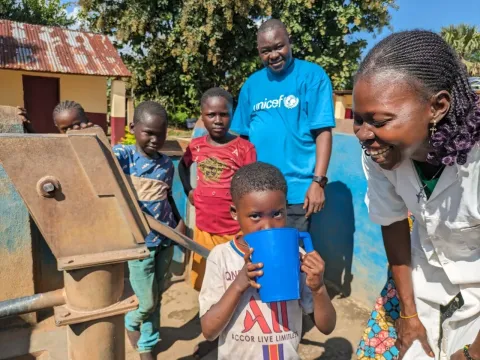
Her close friend, Jacquelina Bagaza, quickly lights a fire and begins roasting several handfuls of groundnuts, while another woman sets a second fire to boil water. Like a well-coordinated team, each woman takes on a specific task. Some welcome the two dozen children already gathered in the compound, each clutching a mug and gently guide them to sit together.
After a few minutes, one of the women washes a generous portion of rice and adds it to the pot. Maize flour and sugar follow, and finally the groundnut paste that Jacqueline has just prepared. Oil, lemon, and a pinch of salt complete the recipe. Taking turns, the women stir the mixture with a wooden spoon, chatting and laughing as they work side by side.
“Ever since I learned how to prepare this, I make it regularly for my children at home. When I can afford it, I also add some dried fish or meat,” Natasha says with a satisfied smile.
According to Dr. Marie Louise Boyos, UNICEF’s nutrition programme coordinator in the Central African Republic, “there are ten such women’s groups in Sibut, called Infant and Young child Nutrition (ANJE, in its French acronym), dedicated to improving child nutrition.” Funds from the US State Department support UNICEF’s efforts to improve child nutrition.

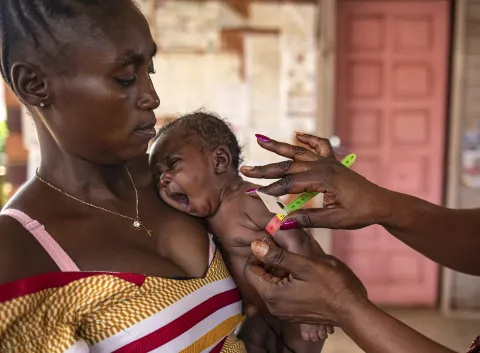
“I’m very encouraged to see how this centre operates,” she says. “Women’s groups gather here to exchange practical advice on nutrition, while mothers from the neighbourhood bring their babies to the clinic for regular check-ups to ensure they are growing well.”
Monitoring children’s nutrition is vital in a country like the Central African Republic, where 37.9 per cent of children suffer from chronic malnutrition and 5.5 per cent from acute malnutrition, according to data from the 2022 SMART research.
“Malnutrition never occurs in isolation. It takes hold where food is insufficient or unbalanced, where there is a lack of clean water, and where recurring illnesses eventually wear the body down — simple realities, but with brutal consequences. To eliminate it, we must ensure access to healthy food, clean water and basic healthcare, so that no child is denied the chance to grow up.”
Despite its fertile land, where crops can grow abundantly, years of conflict and creeping poverty have left generations of children undernourished. Natasha’s story reflects this reality. “I have to walk long distances to work in my fields, and while I’m away, there’s no one to look after my children. Since my husband died, I’m not sure they eat properly in my absence,” she says.
As Natasha and the other women finish preparing their porridge, next door in the clinic, Dr. Boyos speaks with Modoyassi, a 21-year-old mother. She beams with pride after being told during the consultation that her second child, 10-month-old Ouambeti, has a healthy weight: 8.9 kilograms.
“During my pregnancy, I attended six antenatal appointments and was given a tetanus jab. I’d heard many times that exclusive breastfeeding was recommended for the first six months, and when my baby was born, I put this into practice. At six months, I started supplementing breast milk with corn porridge, corn paste and sugar. For the last two months, I’ve also been giving him some of the family’s food, mashed up. My child has only been ill once, with malaria, a month ago, but he recovered straight away. The nurse says it’s because I’ve always kept him well fed.”
Arsene, the nurse, checks the weight and upper arm circumference of the ten children who came in today. He shows the mothers some educational posters and begins a discussion with them about how to feed their babies to ensure they stay healthy.

A woman raises her hand and explains her situation: “I gave birth at seven months, and in my village the other mothers told me I couldn’t breastfeed my baby exclusively, but I went to the hospital and they told me that even though he was premature, I had to breastfeed him exclusively for six months, and I realized they were right.”
Meanwhile, there seems to be a bit of commotion out front. The 20 children who arrived have turned into a crowd of 80, and they all want to be the first to drink the porridge that’s ready.
The mothers organize them so that everyone gets their share, starting with the youngest. Once everyone has had their cup, they still come back for seconds.
Everyone is satisfied. As soon as they return home, the mothers can put into practice what they have learnt today.