Before we used to go far, only to draw dirty water
A water and sanitation UNICEF project, funded by the EU Bekou fund, is changing the lives of thousands of Central Africans in remote rural areas.

- English
- Français
Christine and Yves have reasons to smile.
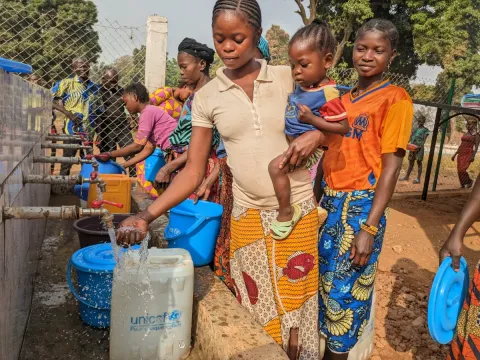
Their home, in the Sembe 3 neighbourhood of Bossangoa, is very close to the water pump that gives abundant clean, drinking water. Every day, after school, they help their parents carrying water to their home for their daily needs.
Only 36 per cent of the population of the Central African Republic have access to basic water services, something that is a basic right for every child.

Before the installation of the borehole in Sembe 3, women and girls had to walk several kilometres each day to collect water, and even then, the water was not clean.
Since the water point was rehabilitated by ANEA (the Central African water-supply agency) and UNICEF, with funding from the European Union, waterborne diseases have significantly decreased, and women and girls are less exposed to harassment.

In the Zoro neihbourhood, also in Bossangoa, Dartagnan Bossamboam, chairperson of the local maintenance committee, checks that the water pump is in a good working state. He and his team manage the residents’ modest monthly contribution of money to pay for any necessary repairs.

About 600 kilometres away from Bossangoa, in the town of Ndele, (Bamingui Bangoran Prefecture) 8-year-old Abdel Kharim has come with his mother and his small brother to draw water at the water pump installed in their Sara neighbourhood. Many of their residents are former displaced persons. Having a borehole within walking distance was a key factor that supported their resettlement.

In Golo-Mandja, another neighbourhood in Ndele, ANEA and UNICEF have built a borehole under the same programme. People from the area, and the primary school close by, now have easy access to clean water. Sadly, 84 per cent of schools in the Central African Republic do not have access to basic water services.
The construction of a borehole in a village changes the lives of thousands of people. In addition to meeting their daily water needs, access to clean water reduces the risk of disease and makes household chores easier. It frequently also leads to an increase in school attendance.

Since the installation of a water pump in 2023, the residents of the village of Yangou-Berlou, 20 kilometres from Ndele, have been developing their sanitation plan as part of the same WASH package. Only 14 per cent of the population in the Central African Republic has access to basic sanitation services, and over 25 per cent of the population practices open defecation.
UNICEF’s Sosthene Narbet is supporting them in monitoring this community project. The houses marked with an "X" have already built their latrines.

The importance of water was marked on World Water Day in 2024, with a visit to the centre of CAR by the Minister of Water Resources, Arthur Piri, and the deputy UNICEF representative Abdoulaye Seye. At Pladama village, on the outskirts of Bambari, they witnessed a voluntary resettlement project for internally displaced people.

The water project in Pladama, also funded by the European Union, satisfies the basic needs of its residents. The village is home to families who have moved from their places of origin and benefits from multifaceted support from the United Nations family. UNICEF took care of the water supply service.

During the same visit, several technicians who had been trained in borehole maintenance, with UNICEF’s support, were officially commissioned. They can quickly repair the water points in case of breakdown. Also, in every community where a new water pump is installed or rehabilitated, a management committee is elected, to foster a sense of ownership of this precious resource.

To give continuity to the European Union-funded WASH project, in 2025 UNICEF received a drilling rig and organized the training of twelve ANEA employees are currently in practical training on its use.
The practical exercises took place on the grounds of Bangui General Hospital. Two boreholes were drilled on site to supply drinking water to the neighboring pediatric complex.