Displaced by CAR conflict but still in school
A EU-funded education programme is expanding access to education in rural Central African Republic

- English
- Français
Felix Tembo, 52, dresses up in his smartest clothes. From the makeshift shelter he calls home at a site for displaced persons, he walks the short distance to the new school building, which is being officially opened in at Kpodikalam by the Governor of the Yade region in northern Central African Republic.
Before the formal speeches began, his 12-year-old son, Juvenal, slips into the new classroom and finds the brand-new desk which will soon be his place of study.
“I want to study hard so I can become the president of my country. I will build many, many classrooms like this one everywhere, so that all children can go to school. And I will also bring complete peace.”
His father, the head of community in the displaced persons camp, looks at his son and nods, proud to see him following in his footsteps as a leader. He leans in and whispers that, to achieve his dream, he will need to learn to speak good French—and English too—so he can deliver convincing speeches and work with other Heads of State to support the Central African Republic by funding the construction of more schools.
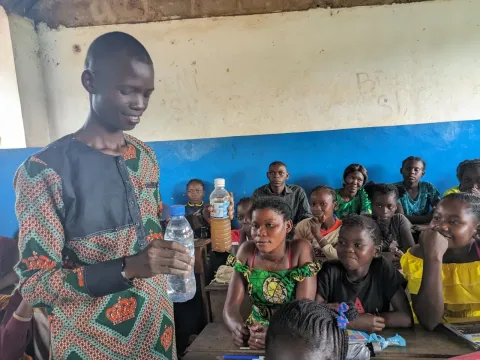
Until the previous week, Juvenal and the other 180 children had been sitting on the ground in cramped, grass-thatched shelters. Now in addition to a brand new school kit each, they have a solid building with three classrooms—each equipped with enough desks—and an office. The school also includes three toilet blocks.

The new classrooms are part of a UNICEF education programme in the Central African Republic, funded by the European Union, in support of the Ministry of National Education. The programme aims at facilitating access to school for children in rural areas of the country. The building or rehabilitation of 450 classrooms is well under way at 150 school sites in ten prefectures. Ouham, where Kpodikalam village is located, is one of them.
60,000 children, including girls with some specific vulnerability as well as children living with a handicap are expected to benefit from this project, which includes some other aspects: radio clubs with pre-registered lessons, as well as training courses of parent teachers.
The school at Kpodikalam village has four teachers, although only one of them, the headmaster, is academically qualified. The other three are volunteer ‘parent-teachers’.
About half of the pupils at Kpodikalam Primary School live in the displaced persons’ camp, which was set-up in December 2024 after an armed group attacked their home village of Muru, a small hamlet 25 kilometres away. Although the security situation has been gradually improving—thanks to various agreements with rebel groups and an increasing number of fighters joining Disarmament, Demobilization, and Reintegration (DDR) programmes—the 186 displaced families prefer to remain in Kpodikalam.
Eleven-year-old Jasmine remembers the day when violence struck his home.
“The armed men came at night. I heard gunshots everywhere. I was terrified, and I ran in the bush with my parents and my two siblings until dawn. I never want to go through that again"
Jasmine says she wants to be a doctor. His father, Victorien Waluba, 28, is a farmer. His other two children, aged five and three, make frequent use of the UNICEF-sponsored child-friendly space nearby, which works as a day-care and is run by RECOPE, a local child-protection committee made up of volunteers.

Not all girls in CAR are as fortunate as Jasmine. Most of the out-of-school children both in primary in secondary schools are girls.
Aid cuts are also beginning to limit children’s opportunity to learn. The reductions are likely to put substantial numbers of children at risk of being out of school.
In many remote, poverty-stricken areas of countries like the Central African Republic, children like Juvenal and Jasmine hold big dreams for their future. Education is the key to turning those dreams into reality—an opportunity that can only flourish if conflict keeps subsiding and funding increases.