"We are not invisible"
In Ngoukpe and Oumba, displaced people receive vital aid from UNICEF's Rapid Response Mechanism: a lifeline for them.
- English
- Français
“Running? It has happened too many times, I have lost count of the exact number of times I have been forced to flee to escape death in recent years,” says Jean-Marie Sengoto. He recalls that each time an armed conflict has erupted in the Central African Republic, he and his family have been victims in their village of Oumba.
Incessant attacks by armed groups in the Central African Republic continue to cause massive population displacement, leading to further chaos, loss, and trauma for thousands of innocent children.
In Oumba, in the prefecture of Ombella-M'Poko, hundreds of families were forced to flee their homes following a deadly attack on their village.
"Around three o'clock in the morning, the silence of the night was suddenly broken by heavy gunfire in our neighborhood. The children, terrified, started to cry and scream, begging us to protect them," recounts Jean-Marie, the 42-year-old father of six. "Faced with the violence that was unfolding, I had no choice but to flee with my wife Magdalena and our children to the nearby forest. We stayed there hidden, waiting for order to be restored in our area. Fear was omnipresent and we were only able to find a semblance of calm after several weeks."
Returning home a few days later to assess the damage was a new shock for Jean-Marie. "My house was in ruins, and our modest food supplies had been looted. I didn't know how I was going to feed my family."

"My house was in ruins, and our modest food supplies had been looted. I didn't know how I was going to feed my family."
Seventeen kilometers from Oumba, in the village of Ngoupkbe, the situation is not much different. The inhabitants experienced the same terror and told similar stories.
Chantal Guereko, a 32-year-old mother of five, waits her turn for the distribution. Her eyes betray the fear she felt when armed groups attacked her village. "We didn't know what to do, we just ran for our lives," she explains, her voice trembling. The pain is palpable in her words as she recalls these traumatic events.
Despite the ordeal they have been through, Chantal and other families share more than just the trauma of being uprooted from their lives. They are today receiving vital humanitarian aid thanks to UNICEF's Rapid Response Mechanism.
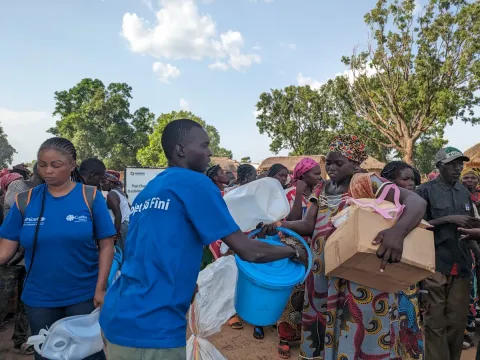
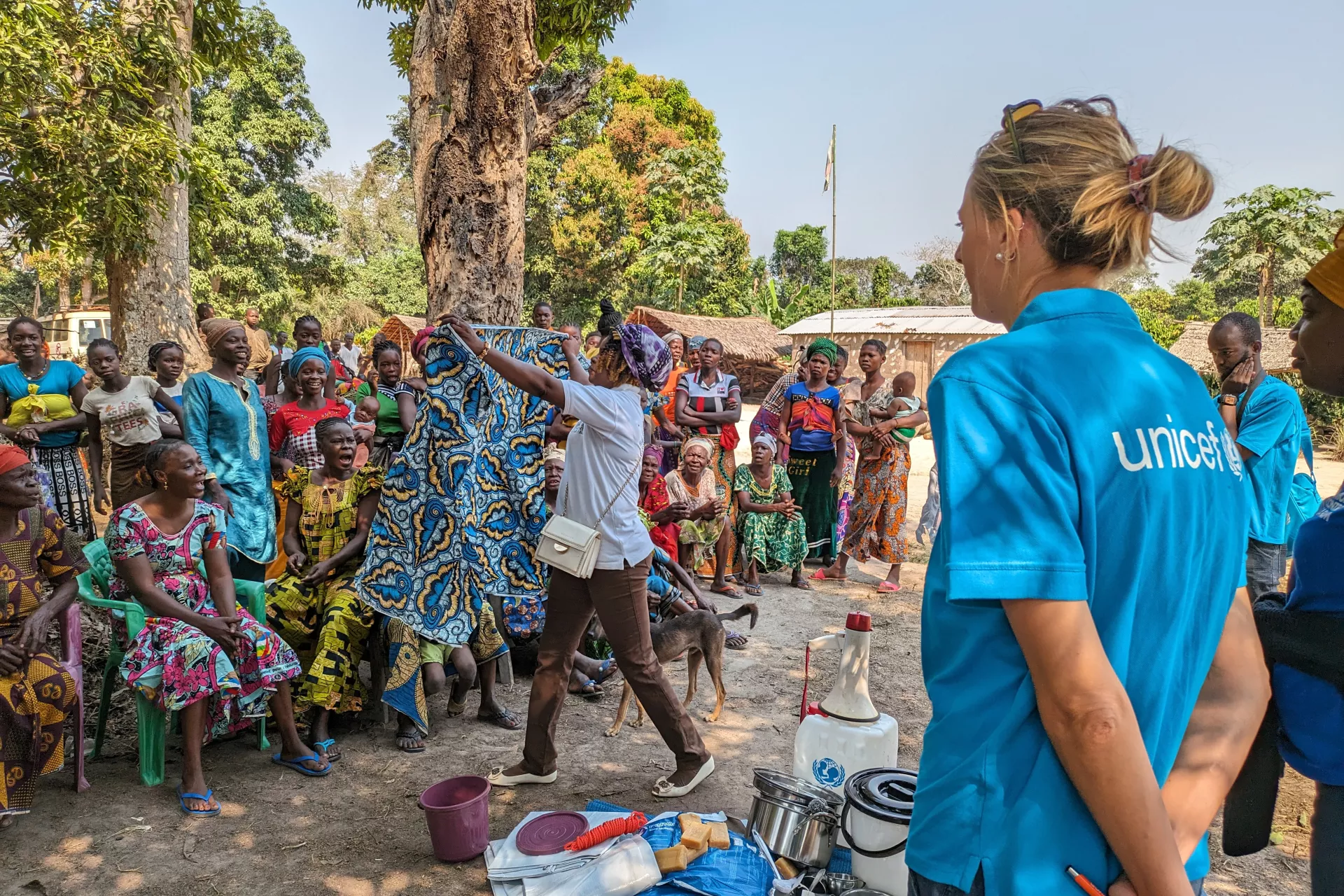
It is noon, and already, hundreds of people, mostly women and children, have gathered in the shade of the trees in the centre of Oumba. All listen attentively to the advice on hygiene from a social worker from Action Against Hunger, a UNICEF partner. On this crucial day, some 250 families will receive emergency humanitarian aid.
While volunteers are busy unloading boxes and bags, the social worker lists the items that will be distributed to each household: a jerrycan, a bucket, a kitchen utensil kit, two mats, blankets, a tarpaulin, soap, two large pieces of cloth, mosquito nets, a hygiene kit with underwear, and other essential products for women and girls.

"Do you know how difficult it is to cook a meal for your family when you don't even have a pot left and everything was taken away from you?"
Many consider the Rapid Response Mechanism (RRM) to be a lifeline for families in crisis. On the front lines of emergencies, the RRM is a critical intervention mechanism that allows UNICEF to provide vital humanitarian aid to the most vulnerable populations, including children, affected by crises and displacement. In close collaboration with its partners, UNICEF delivers life-saving supplies to the most remote and hard-to-reach areas, including front lines.
For Chantal, the assistance received is a real treasure: "Do you know how difficult it is to cook a meal for your family when you don't even have a pot left and everything was taken away from you?"
The feeling of relief is shared by Jean-Marie: "We felt abandoned, that's the truth. But today, we are filled with joy to see that people care about us and have come to our rescue."
With funding from the European Commission's Humanitarian Aid Department (ECHO), the USAID Bureau for Humanitarian Assistance (BHA), Swiss Humanitarian Aid, and the Swedish International Development Cooperation Agency (Sida), UNICEF and its partners are providing essential non-food items and hygiene kits to thousands of displaced households in affected areas of the Central African Republic.
Thousands of displaced families in affected areas receive essential non-food items and hygiene kits. This concrete assistance allows them to meet their urgent daily needs and maintain proper hygiene, thus contributing to their well-being and dignity in a crisis context.