School, not marriage, for adolescent girls in CAR
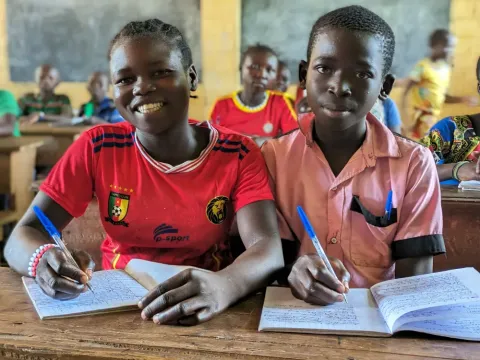
UNICEF and its partners work to stop practices that keep girls out of school in the Central African Republic. A European Union-funded project is working to mobilise local leaders to advocate against school dropout

- English
- Français
“I tell them that they have to stop sending their adolescent daughters for marriage. Here, you find girls being married off even at the age of 13 or 14, but I argue that their place is in the school. Things must change, and I am optimistic that they are beginning to change.”
And, conscious that actions speak more powerfully than words, she frequently mentions that her own two daughters study in the capital at the University of Bangui: one is aiming for a career in law and the other is studying business administration.
Her struggle to keep girls in school is not easy. Early marriages and - even worse - forced marriages, are not unusual in the Central African Republic. According to data from the MICS-6 survey (2018-2019) more than 6 in 10 women aged 20-24 were married before the age of 18.

Rakia Anour was one among 40 of Bria’s local leaders who attended a training workshop on how to stop the bad practices that push girls drop out of school. Organized by NGO COOPI, UNICEF’s partner in the Hautte-Kotto prefecture, it brought together mainly neighbourhood chiefs and women leaders.
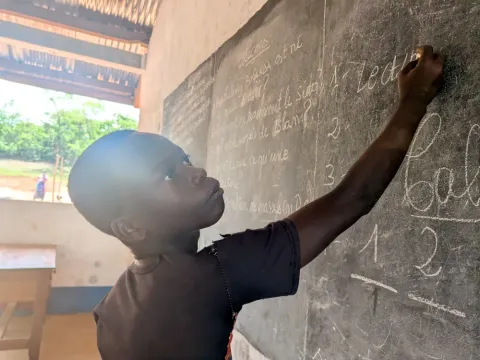
It is part of a project funded by the European Union that supports 150 schools countrywide. In Bria, three schools have been earmarked for classroom construction (Katekoundji, Piya and Batago), and three others for rehabilitation (Piyango, Dounia and Lycee Djialle). They are all located in sectors of the town where former internally displaced persons are gradually resettling.
But you these new classrooms are not only for boys says Rakia. “If we want to see girls reach the end of primary school and continue beyond, we must influence our communities against practices that play against girls’ schooling,” says Rakia.

This is also the conviction of Iwa Sashita and Davila Yashika, two women leaders in the Katekoundji district.
“In our sector, it is not so much early marriages that keep girls out of school, but the fact that many girls get pregnant at very early ages, often because of sexual violence.”
Bria is one of the towns in the Central African Republic deeply affected by the recent armed conflict. For several years, a diverse array of armed groups was present, with each of its neighbourhoods dominated by a different militia. Finally, in 2021, the government managed to gain full control of the town.
UNICEF is also working with the Ministry of National Education in the same prefecture (Haute-Kotto) and several others, with support from UNICEF Germany, to have a contingency stock of education supplies such as textbooks that can be used to response to emergencies, particularly for vulnerable children including refugees and returnees.
Defilement is a serious crime in the Central African Republic, punishable with heavy penalties. But applying the law is not easy. Victims may report the case to the police, but the complexity of the procedure can discourage their families, who often end up going for an out-of-court settlement, accepting a payment of money which encourage impunity. This reinforces a cycle that makes girls easy targets. And it increases the number of girls who drop out of school.
“We know that sexual violence is very difficult to uproot, but we are determined to eliminate it. Girls must be free and keeping them in school is essential for that,” says Iwa.

Iwa lives in Katekoundki, a neighbourhood tucked away in a high ground behind Bria’s airfield. Located five kilometres from the centre of Bria, it is one of the new neighbourhoods where former displaced persons are re-settling. The roads crisscrossing its plots are narrow footpaths flanked by new brick-and-waddle houses that have appeared over recent months.
Iwa Sashita stands at the entrance of a grass-thatcher school shelter, built by the parents themselves as a classroom.
“We are happy that soon we shall have a new school, and our children shall sit in proper desks in good classrooms,” she says.
Thanks to the work of leaders like her and many others, at least half of those future pupils will hopefully be girls.