A quick solution for clean water in times of trouble
Thanks to a funding from the European Union’s ‘Fond Bekou’, UNICEF supports the Ministry of Humanitarian Action in the Central African Republic with water-purification tablets that are used in emergency situations.

- English
- Français
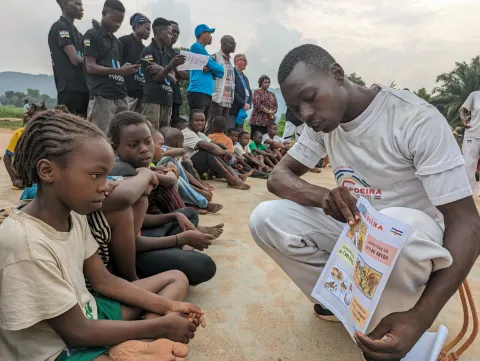
Under the generous shade of a big mango tree in the Central African capital, Bangui, Simplice Beweli, a water and sanitation officer with UNICEF CAR, addresses a group of 40 officials from the Ministry of Humanitarian Action. After opening a box, he shows them a packet of water purification tablets. Judging by their expressions, one wonders if his listeners are fully convinced by his explanations.
“There are times when people lose everything because of torrential rains or floods. Water pumps get broken. People, especially children, can’t live without water and you can’t wait. To act fast, you must use this product that makes water safe and drinkable.”
Then, he adds an instruction that takes them by surprise.
“Go to the vehicles. All of you. We are going to the river.”
About three kilometres away, the banks of the Oubangui River are bustling with activity. Leading the way through scores of young people pushing wheelbarrows full of sand and fishermen arriving in their canoes, Simplice takes off his shoes and enters the water along with some of the trainees, as by-standers look on with curiosity. They quickly fill some plastic jerrycans with water, carry them on their shoulders and promptly return to the premises of the ministry.
Back in the compound, the dirty water collected from the river is poured into buckets, carefully filtered on the way through cloth to remove any debris. Then, a tablet is added to each bucket which is then stirred slowly. “One single tablet is enough to purify 20 litres of water,” explains Simplice. He then urges the participants to wait and see the result.
Ten minutes later, the trainees are filled with wonder as they see that the murky liquid has turned into crystal clear water. They all scramble to get near the pails and take a picture with their mobile phones.

At the end of that training session, which took place in April 2025, UNICEF donated 2,000 kits of water-purification tablets to the Ministry of Humanitarian Action, thanks to funding from the European Union’s Bekou Fund.
Just three months later, the training and tablets were already having an impact when thousands of people in Bangui’s 7th and 8th districts became displaced in July after torrential rain badly damaged their homes. A second consignment, enough to cater for the needs of one thousand households, was donated in July 2025 to the Ministry. Part of it was sent to Obo and Rafai, two of the country’s most remote areas, in the southeast of the country.

Despite some progress achieved in recent years, 2.4 million people, at least half of them children, continue to require urgent humanitarian assistance in the Central African Republic. Even if the armed conflict has reduced in intensity, persistent flooding continues to be a key factor causing displacement. One of its worst effects is the damaging of water and sanitation infrastructure.
Drinking water is almost a luxury
Emergency response takes place against a background of a poor water, sanitation and hygiene (WASH) infrastructure in the country. Only 36 per cent of the population have access to basic water service, according to the 2025 Humanitarian Action for Children (HAC) Central African Republic. Also, 38 per cent of schools lack access to safe drinking water, and 39 per cent of health centres lack WASH services.

With these conditions, aggravated by natural disasters, people remain extremely vulnerable to disease outbreaks like cholera, mpox or Ebola, leaving thousands of people in urgent need of support.
With the increase of heavy rains in West and Central Africa, UNICEF and the Ministry of Humanitarian Action have learnt to take a more pro-active approach, pre-positioning relief supplies which could be used quickly in case of urgent need. Thanks to the purification tablets, victims of natural disasters shall not have to wait to satisfy their most urgent need: clean drinking water.