Nurturing life in the Central African Republic
World AIDS Day is celebrated on 1st December. This year’s theme is "Overcoming disruption, transforming the AIDS response". Youth groups in CAR show how community resilience can help in supporting vulnerable members.

- English
- Français
Brigitte* was born HIV-positive, but she only learned about her status at the age of 12, when her uncle — who had cared for her since early childhood — told her. Accepting her condition, she says, was not traumatic, and that same year, she began taking antiretroviral medication. Today, with her studies nearly complete and an 18-month-old son from a stable relationship with a partner who embraced her condition, she feels unafraid of what the future holds.
“I am part of a group that helps children and teenagers infected with HIV to accept their situation and move on,” she says “overcoming the stigma that still surrounds this condition. I am happy when I convince them that their condition is not an obstacle for them to lead completely normal lives.”
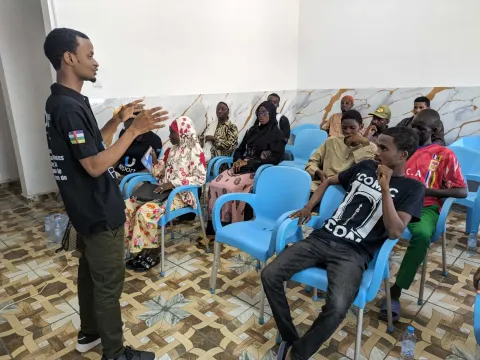
Brigitte is a member of the E Bata Gigi club in the capital city Bangui. The club is a mutual support group that welcomes HIV-positive teenagers. Once a month, she goes to their office in one of Bangui’s neighbourhoods, where she meets with her 17 fellow members — eight of whom are girls — who come from various parts of the city and even from beyond its limits. Sitting in a circle, each member shares their personal challenges as well as updates on the work they carry out in different health centres.
Florina and Sosthene, the group leaders, welcome all their friends and make them feel at ease, in a friendly atmosphere.
“Our group is called E Bata Gigi, which in Sangho means “Preserving Life”. We are all volunteers. We started in 2018 as a group of peer educators, and we are very proud to see that today we work in 19 health centres in Bangui and have 45 outposts upcountry”
E Bata Gigi is supported by UNICEF, with funding of the French Red Cross, which also pays for their office rent in Bangui. Dr. Kango, one of the country’s top specialists on HIV, from the Pediatric hospital in Bangui, is their doctor of reference, and they often meet him in his office for better planning.
“In our group we learn how to live with the disease, and to overcome the stigma that often is still attached to HIV-positive people. Encouraging each other is crucial,” says Sosthene.
Today, their clubs in the Central African Republic count around 20,000 young members. Their wish is to expand their presence throughout the entire country.
One of the girls explains that in her neighbourhood many young people are afraid to get tested, and those who have already tested positive often feel overwhelmed. She does her best to reassure them, using her own life story to show that knowing one’s status and following antiretroviral treatment is worthwhile. The club members also pay special attention to supporting adolescents as they transition from childhood to adulthood, helping them adapt to their new treatment routines as they grow older.

Leaders Florina and Sosthene explain that their club have made agreements with several health centres to come in support of children and teenagers every time they receive the monthly dose of drugs. That becomes an occasion to talk to them, listen to their worries and put them at ease.
According to UNAIDS, the HIV prevalence in the Central African Republic was 2.4 per cent in 2024. Although the country has made significant progress in HIV treatment, much of the population is not fully aware of this: unfortunately, less than half of those who test positive receive antiretroviral treatment. The situation is even more worrying for children and adolescents: of children under the age of 15 who are HIV-positive, less than a quarter are receiving treatment.

The commemoration of World AIDS Day, which takes place on 1 December 2025, is an important opportunity to highlight the impact that the funding cuts from international donors have had on the response to the HIV/AIDS pandemic as well as to showcase the resilience of countries and communities.
In 2025, a historic funding crisis is threatening to unravel decades of progress. HIV prevention services are severely disrupted.
Despite funding constraints, the E Gata Bigi youth in Bangui appear unbowed.
They are determined to do their part to deliver the promise of a future free of HIV for children.
*Her name has been changed for privacy purposes.