Enoch’s dream: replacing garbage with flowers
On this World Youth Day 2025, let's discover the work of young people who believe in protecting the environment.

- English
- Français
A few years ago, when he was a university student, every time U-Reporter Enoch Sonangba walked to his Faculty of Economics, he would feel bad to see piles of rubbish on the road.
One day he decided to put into practice the idea that had been on his mind for a long time: he gathered some of his fellow youth, and - to the curious gaze of passers-by - armed with hoes, wheelbarrows and shovels they removed the garbage, replaced it with soil, planted flowers and for several days carefully watered them.
But, after he and his friends created these “green spaces” in Bangui, frustration quickly replaced his initial enthusiasm.
“After hardly few weeks, the flowers had disappeared, and the rubbish heaps were back. No one seemed to care. I felt angry, but this disappointment also made me understand that change can only take place after a lot of patient public education”
Far from plunging him into discouragement, that initial failure made him understand why people can be resistant to changing behaviours.
“Our country lacks laws and policies to work for a clean environment,” he said. “We take it for granted that since we have plenty of forests and rivers, we shall always be like a paradise, but we can’t let down our guard; our environment is getting worse by the day.”

A disability that became a life lesson
He attributes a road accident he had at the age of 11, which led to the loss of his left hand, as teaching him that in life you should never give up. “I was devastated, and at the school I suffered a lot of bullying from my classmates, who kept making fun of me. But I convinced myself that, with determination, I could do anything I wanted, even with only one hand.”
He is convinced that people must be helped to think beyond immediate needs: “A man can cut down a tree and turn it into charcoal because it will give him money today, but he will find it difficult to plant a tree today and wait several years for its fruits.”
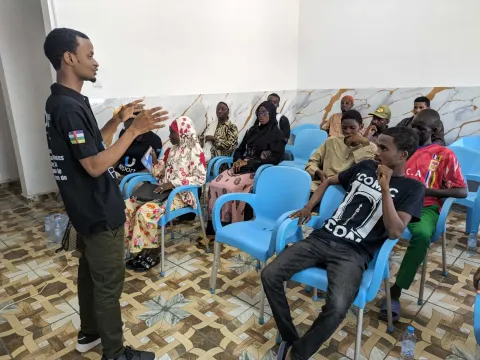
For the last few years, Enoch has devoted a lot of time to sensitizing young people, using the U-Report platform run by UNICEF. He doesn’t get tired of alerting other adolescents and young people that climate change is real, and that it is already badly hitting agriculture, livestock-farming, and above all adversely affecting children’s lives. He insists that engaging in environmental issues means taking care of our own ‘home’, planet earth.
“I keep telling my fellow youth that they shouldn’t expect to be paid for saving the planet.”
Enoch acknowledges that he has had some good experiences that keep him motivating, including at the Saint Therese school in Bangui, where with the help of the religious sisters, they planted fruit trees in the compound. Passionate about creating a green environment, in 2018, he undertook a training at Kenyatta University in Nairobi: “I was impressed to see how pleasant their campus was, with plenty of trees everywhere. I came back convinced that I could do the same in my own country.”
It is in his own village of Sebokele I, on the road to Mbaiki not far from the capital city Bangui, where he has set up a big tree nursery, with more than 14,000 seedlings. There, he sensitizes children in the nearby schools, where he is receiving a positive response.
Last year, with UNICEF support, he took part in an online training about negotiation and advocacy skills. “This course taught me that, to be effective in social change, we must be outstanding in persuading. If we convince people, we shall be able to change mentalities and behaviours.” Also, this year, he took part in the One Forest Youth Forum -an international youth convention for the promotion of sustainable development- held in Libreville (Gabon) from 30 July to 1 August.
Enoch says he dreams of his city, Bangui, becoming one day a beautiful urban space with plenty of decorative trees, where people will find it pleasant to walk under its shade. “Let us take our own future in our hands,” he concludes, “it depends on us.”