Fighting infections and malnutrition in remote areas of CAR
Waste management and infection control are essential elements to keep good hygiene in health centres. Thanks to a Korea-funded project in the northwest of the Central African Republic (CAR), UNICEF and its partners are working to improve standards.

- English
- Français
The village of Mbotoga is a quiet, placid place in the early evening. But this was not always the case, as Abel Yangany, who has been head of the local health centre for the last 25 years, recalls. “During the last decade or so things were tough, as people often had to run to the bush fleeing the violence of armed groups,” he says.
He says that during the last year he has witnessed not only an improvement in the security situation, but also changes that have improved the conditions of his local dispensary which provides basic health services to the locality of around 6,000 people. At the centre a broken borehole has been repaired, new toilets were built and a programme to support malnourished children has now started. After showing around the neat installations, he delivers a letter on behalf of his community: It contains a message of thanks to UNICEF, Caritas and the government of Korea.
“Despite insecurity and the bad state of the road, you endured many sacrifices to come to our aid. You shall always remain in our memory."
Mbotoga is located 80 kilometres away from the city of Bouar in northwest CAR. The rough 150-stretch road to Bocaranga makes this zone difficult to access. Twenty kilometres further, another health centre is found in the Bogang 1 Pende village. It recently benefitted from the same scheme as Mbotoga’s: a rehabilitated borehole, new toilets, a child nutrition clinic and an infection protection and control system (IPC).
One of the nursing assistants, Daniel Ndoyama, recalls the recent IPC training he underwent in Bozoum, the head of the prefecture of Ouham Pende, at the beginning of June 2025. Forty participants, from 10 local health centres under the same health district, took part, acquiring new skills in waste management. A few days earlier, one of his colleagues, Caleb Demanote, who took part in the same course, explained to us his daily routine of collecting used syringes, bits of cotton, gauze and other trash and disposing of them in line with the recommended guidance.
“Waste management is essential to keep good hygiene in my health centre as well as avoiding possible infections. I am happy I learnt this in the training, and I can put it into practice.”

A densely populated zone with poor health standards
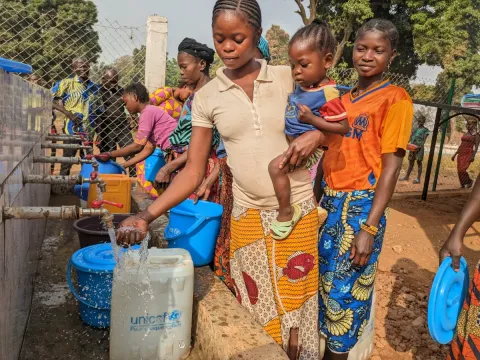
Next to the Bogang 1 Pende health centre, a newly rehabilitated borehole serves both the dispensary and the population at large. Brigitte Bai, bursar at the local water point management committee, explains that every month they collect 250 CFA (about 30 cents of euro) per household to have a fund that pays for repairs in case of breakdown.
Mbotoga and Bogang 1 Pende are part of the ten health centres in the Ouham Pende prefecture which benefited from UNICEF project, implemented by Caritas Bouar as partner, thanks to a funding of nearly $800,000 from the Republic of Korea. This zone is one of the most densely populated zones in the Central African Republic.
It also has alarming health indicators, like a high infant mortality at over 100 per 1,000 live births and a newborn mortality of 29 per 1,000 live births. The prevalence of chronic malnutrition is high, with 37.9 per cent of children below the age of five suffering from stunting. About 60 per cent of the prefecture’s populations live further than 15km from their nearest health centre.

Thanks to this project, 20,000 malnourished children have been able to start receiving treatment in the ten targeted health centres. It also provides improved access to safe drinking water, sanitation, and hygiene practices for people in remote areas.

As we leave behind the Bogang 1 Pende health centre, we discover two more boreholes recently rehabilitated in Moundi and Douya villages, as part of the same project.
And at the entrance of Bocaranga, at a displaced site inhabited by people of Fulani ethnicity who fled their homes because of insecurity, the camp leader, Ardo Salimou Moussa shows a borehole already drilled. Soon, the water point will be completed with a manual water pump and the 1,650 camp residents will have access to clean drinking water.

The newly rehabilitated boreholes and the ten health centres have become lively centres where people from remote villages meet.
“I am happy to see people coming here. If they can walk freely and receive our services, all I say is thanks be to God,” concludes Abel Yangani.