Fifteen smiles for a return to school
The poignant story of fifteen teenage girls from Djibalo, in CAR, who find their way back to school.

- English
- Français
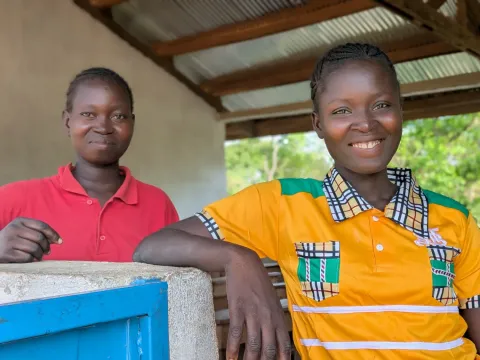
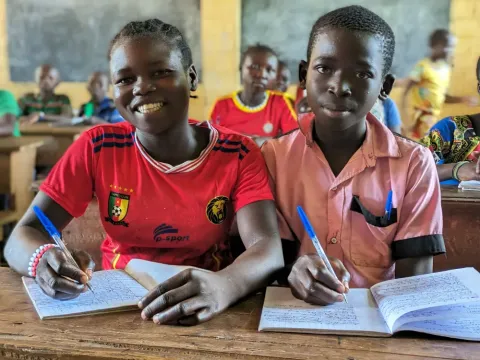
Sitting under the generous shade of a big mango tree, fifteen teenage girls exchange hopeful looks. For them, today marks a new depart. Following years of school dropout, they are -at last- back at the school desks. In front of them, a building still under constructions, destined to become their new classroom, is rising and is about to be completed.
At the age of 14, I found myself pregnant and already married. Today, I am divorced, and I want to return to school to offer a bright future to my child.
I can neither read nor write… When I think about it, I feel really bad. I have decided to change this and go back to school.
Their stories reveal a daily struggle against a combination of early marriages, poverty and pressure because of domestic work, in a society where girls’ education is often neglected.
Tucked away at the border with Chad, 83 kilometres from Markounda, Djibalo is one of the CAR’s villages where access to education remains a challenge. Children used to attend classes seated on the ground, in grass-thatched sheds lacking desks.
It was in this context that UNICEF, in partnership with the Education Office of Bossangoa Catholic Diocese (ECAC in its French acronym), thanks to the financial support of Education Cannot Wait (ECW), launched the building of a new complex made up of three classrooms, an office and new toilets, to offer Djibalo’s 427 pupils -including 210 girls – a learning environment worthy of the name.
For these fifteen adolescents, this project means more than walls and desks: it is a real second chance in life.
The efforts, often hidden, of some community agents are behind this success story. Louise Koiram, 54 years, chairperson of the Markounda branch of the Central African Women’s Association (OFCA in French acronym), partner with UNICEF, invested plenty of time and work with her team in a door-to-door exercise to convince the girls and their parents to join this programme of school return. For the last three years she has plied the paths leading to Djibalo and other nearby villages: Taga, Mainogo, Salojo, Maiogou, Sagou, in moto-taxi, to convince parents to give to their girls a second chance.
Myself, I never had a chance of going very far with my studies and I feel that I have lost a very important part of my life. But today I want to help other girls not to miss this chance.

Convincing the parents was not easy. Meeting their resistance, coupled with the travel on rough roads made her work an uphill task. But with plenty of patience and many hours of discussions, little by little Louise and her team gained some ground.
During our first two visits, things were very difficult. The hardest part was to change the mentalities and convince people that it is worth investing in education. Nevertheless, little by little people are beginning to understand.
Before reintegrating officially the school, these fifteen adolescents followed a catch-up special course during the months of holidays, which prepared them to join the course with the rest of the students.
When I see the women working for NGOs and for the United Nations, I tell myself that if I want to go far in life me too, I must study.

These fifteen girls are much more than just a statistic. They are the living proof that, with courage, support and perseverance, education can reinvent their destinies.
Djibalo is writing a new page of its history. A page which shows that the girls’ future is being written with hope and ambition.