Cash plus Education: helping CAR’s children stay in school
A UNICEF-run support programme for vulnerable families provides educational opportunities to reduce inequalities.

- English
- Français
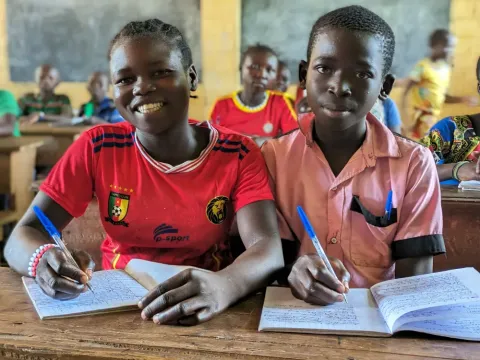
In the Central African Republic (CAR), as much as parents and caregivers want to see their children attend school, the barriers to attendance are high, whether due to poverty, lack of schools close by or other pressures. Only 66 per cent of children attend primary school and 8 per cent attend secondary school regularly. But only 27 per cent of children (24 per cent girls) and 12 per cent (10 per cent girls) complete primary and secondary schools respectively.
Behind the figures and statistics there are stories of courage, resilience and parental love from those who suceed. Like Samedi and Olga, two parents we met recently in north-west CAR.
In Bembor, 35 km from the town of Paoua, Samedi, who became blind at the age of 15, raised five children with his wife. Together, they grow sorghum to survive, but the difficulties are constant.

“I am entirely dependent on my crops for the family income. Because of their unreliability my children are often sent home from school,” he explains.
In a different village, Bégoula II, mother Olga finds herself on her own bringing up her 12 children, ten of whom are still at school. Like Young, her husband, Réné Marva, was registered as a beneficiary of UNICEF’s Cash Plus Education programme, but he sadly died a month before the first distribution.
"The income from my little greengrocer's and my husband's kiosk barely provided us with enough to eat. During the registration period, it was a stressful time", Olga says.
Today, thanks to the programme's support, she has renewed hope.
"With this money, I'm going to expand my business and launch other activities to help my older sons find their way.”
A response to educational obstacles
Access to education in the Central African Republic remains marked by major inequalities, particularly for children in rural areas, displaced persons, girls and children with disabilities. According to UNICEF data, in mid-2025, 844,000 children were considered to be in need of support to stay in school.
The Cash plus Education programme, implemented by UNICEF with funding from the European Union and Education Cannot Wait, targets the most vulnerable families with regular cash transfers over 24 months to help them keep their children in school. The objectives are clear: to prevent children from dropping out of school, to encourage them to re-enroll children who have dropped out, and to strengthen the transition between primary and secondary education, particularly for girls.
The programme foresees supporting 2,118 vulnerable households, including orphans, children who have dropped out of school, disabled children and children living in extreme poverty.
Through this programme, a more stable future is taking shape for families facing difficult situations as Olga says:
"Merci beaucoup pour votre soutien maintenant je me sens plus confiante après mon deuil, cet argent me permettra de me relever et de m'organiser et mieux construire l'avenir de mes enfants."