Access to water brings hope to Bangui residents
For people living in the capital of the Central African Republic, a clean water supply means much more than just covering their needs of drinking, cooking and washing.

- English
- Français
For four years during some of the worst moments of the civil conflict in the Central African Republic, Irene Ndende, 53, sheltered on the outskirts of the capital Bangui.
“In 2016 there were shootings every day and we had to run to Bimbo, where we lived as displaced,” says Irene. “While we were there my husband died, and in 2020, as peace returned to our place, I came back with my children.”
But although she was glad to back home, life was hard without a regular water supply. That changed in 2023 when the national water utility company, SODECA, installed a water pipe in her compound in the Castors neighbourhood, in Bangui’s 3rd district.
As she fills some buckets, in the company of her neighbour Cynthia Ngiabina, they chat and laugh. “We are both farmers, and when we come back from our fields in the evening, we don’t have to worry about going to fetch water far away,” she explains.

Very close to Castors, in quartier Yakite, also in Bangui’s 3rd district, Mariam Ali and her sister Kaoussar Djibril fill containers with water as part of her daily house chores. They have been living here since 2020 after returning from Chad, where they spent several years as refugees.
The two sisters, as well as Irene, are benefiting from the European Union’s Bekou Fund, which has provided funding to UNICEF to help instal water supply terminals in 1,400 vulnerable households in Bangui. Castors and Yakite used to be the scene of pitched battles during the worst years of the CAR conflict. Today, both places are lively and peaceful, and access to water has helped people resettle and lead normal lives.

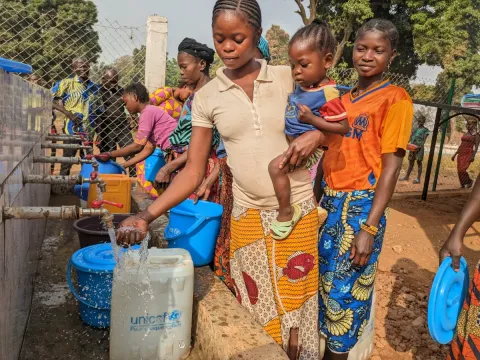
UNICEF, with European Union funding in the Bekou programme, has also installed five public water fountains in some neighbourhoods. In one of those neighbourhoods, Benz-Vi, most residents depend on the fountains to meet their daily needs, paying a contribution of 25CFA per each 20-litre jerrycan.
“Even though during the peak of the dry season things get tough, we manage to keep the supply going,” assures SODECA official Regis Sena.

At the break of the day, in the same neighbourhood, Benisia Agdugebo, 19, sets up a table in front of the water point where she sells hot doughnuts and rice porridge, which many of the water users buy for their breakfast. The place has become a lively social spot.
In many of Bangui’s neighbourhoods, formerly heavily affected by inter-community conflicts, water fountains have proved to be hubs of social cohesion. In the case of Benisia, she doesn’t even need to bring her jerrycan to the water fountain. In the house where she lives with her parents and siblings, next door, she has a water tap.

Not far from Ben-Vi, in the Banda-Bi suburb, Jeanne Bonda has a reason to smile. She and her grand-daughter Marcia Ouagalas, 14, get their daily supply of water from their tap at home after UNICEF installed it in 2023. A widow, Jeanne enjoys a quiet retirement in the company of her daughter, a teacher in a nearby school.
“Up to last year, I had to walk a long distance to bring water to my home, and at my age it wasn’t easy,” she says, “but ever since they brought the water to my home, I don’t have that worry.”

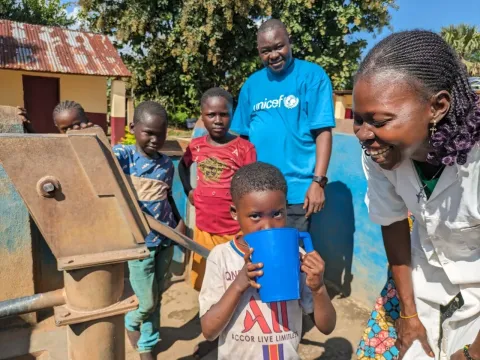
Rose Ndokoronji stops by at the Benz-Vi public fountain to quench her thirst at midday. A long queue of filled yellow jerrycans await to be collected by some of the busy neighbours who flocked here early in the morning. UNICEF continues to support the government and authorities in CAR to extend basic services, like water.
Bekou means “hope” in Sangho. Many ordinary people in Bangui have, indeed, reasons for hope when they can enjoy this basic facility in their neighbourhoods.