Women on the Front Line: In Mokolo, Aïssatou Lights the Way in the Fight Against Polio
Aïssatou’s dedication brings health information, hope, and protection to families in the remote communities of Mokolo.
- English
- Français
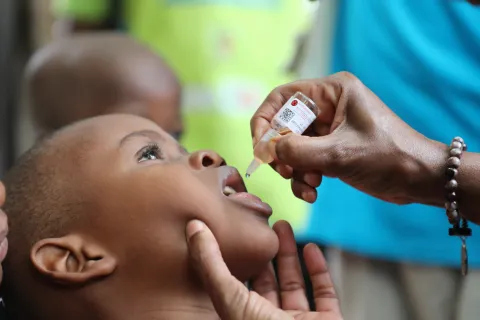
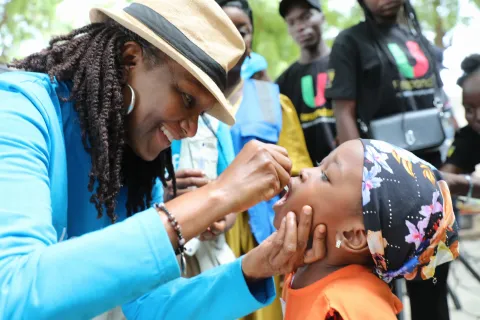
In a modest neighborhood on the outskirts of Mokolo, in Cameroon’s Far North, Aïssatou is a familiar figure. The women affectionately call her “our mother of light.” A name that speaks volumes about her role: illuminating, reassuring, and guiding families toward better health practices, especially to protect children against poliomyelitis.
Every week, long before sunrise, Aïssatou leaves her home and walks through the sandy Sahelian footpaths. In her hand, she carries the list of households she must visit. She moves from one hamlet to another, sometimes three kilometers, sometimes five or more, determined to reach the groups of women who have already gathered to discuss children’s health. In these community spaces, Aïssatou shares essential information, answers concerns, and listens to stories from daily life.
“Some women have to walk long distances or even sleep nearby to attend meetings or access vaccination. But they come, because they know it’s for the health of their children,” she says calmly. These gatherings, rooted in listening and solidarity, often become the first step toward an informed decision to vaccinate.
Aïssatou informs, reassures, convinces, accompanies, but above all, she listens. Sitting on a mat, surrounded by mothers and infants, she takes time to understand their fears, doubts, and daily constraints. When a vaccination campaign is announced, she knows that rumors will spread quickly. Some return again and again: that the vaccine causes infertility, that it is dangerous. Aïssatou confronts these rumors patiently, household by household. She speaks in simple words, drawing from her own experience. “The vaccine protects your children. It doesn’t make them sick. Look at mine, they are all vaccinated and healthy.” Her words carry weight because they come from a woman who shares the same reality as those she visits.

Local health teams rely heavily on her. At the Mokolo health center, where she regularly contributes, staff acknowledge it: without the commitment of women organized in community groups, mobilization would be far more difficult. Along with other role‑model mothers, Aïssatou helps welcome families, organizes waiting lines, reminds women of vaccination dates, and gives advice on breastfeeding. During campaigns, she is among the first to arrive and often among the last to leave.
Her attention focuses particularly on mothers who live farther away, sometimes up to seven kilometers from the vaccination point. Exhausted women, arriving with sick children after hours of walking. For them, Aïssatou looks for concrete solutions. She organizes small groups to share transportation: they pool money, share a motorcycle ride, support one another. And when no solution is possible, she travels herself to inform, encourage, and remind them that vaccination remains essential.
Little by little, change is becoming visible in the neighborhood. More mothers attend outreach sessions. Missed appointments are decreasing. Rumors are losing ground. Some fathers are beginning to get more involved too, encouraging their wives or accompanying them by motorcycle to the health center. “All the progress we see here is thanks to the model mothers. They do work we could never do alone,” acknowledges Marika, a health worker at the Mokolo 1 integrated health center.

When asked why she continues despite fatigue and the many kilometers walked, Aïssatou’s answer is simple: “I do this for our children. If we, the mothers, don’t stand up, who will?” For her, the fight against polio goes far beyond a health action. It is a collective responsibility, a duty toward the next generation.
Aïssatou has no official uniform, no salary, no motorcycle. She has something far more precious: the trust of her community, the attention of women, and the respect of health workers. Through her daily commitment, she embodies the spirit of the Gender Polio+ initiative: empowering women, strengthening community solidarity, and bringing health services closer to families so that every child, wherever they live, can be protected against polio.