When the Gold Rush Steals Children’s Dreams
In Mbal, Cameroon, gold mining threatens hard-won progress in education, forcing children to choose between school and quick earnings.

- English
- Français
In Mbal, in eastern Cameroon, the school had regained its vitality thanks to community efforts and UNICEF support. But a new adversary has emerged: gold. Torn between the promise of education and the lure of quick earnings, children face a cruel choice: to learn or to dig.
Gold Challenges Education in Mbal
In the village of Mbal, in the Betare Oya district of eastern Cameroon, calm reigns on this Monday afternoon. The community lives in harmony with the seasons, in an apparent tranquility. At first glance, everything seems fine. Yet behind this calm lies a deep dilemma threatening children’s futures: go to school or search for gold.
When School Was the Beating Heart of the Village
There was a time when Mbal’s public school was the center of village life. Children’s laughter, voices reciting lessons, and games in the courtyard filled the days. These sounds didn’t disturb the peace, they gave it meaning.
But in 2023, the school faced severe challenges. It lacked proper classrooms, a water point, and latrines. Children were exposed to waterborne and diarrheal diseases. The absence of water made school retention nearly impossible. Once children left the school grounds, many never returned.
A Turning Point Thanks to UNICEF and Partners
Faced with this alarming situation, UNICEF, with financial support from the Korea International Cooperation Agency (KOICA), intervened. New classrooms were built and equipped with desks. A borehole and latrines were installed for the school and the entire community.
The results were immediate: enrollment rose from 120 students to 226 in the first year, then to 323 the following year. Hope seemed possible again.

I want to go to school, but I also want to have money
The Gold Rush: A New Obstacle
But by the 2024–2025 school year, the trend reversed. Enrollment plummeted, from 323 to 237, then to 159 by the end of 2025.
This decline was not due to infrastructure, water, latrines, or teachers. The cause lay elsewhere shiny, tempting, and now destructive: gold.
In this part of Cameroon, numerous gold mining sites attract people from across the region. If gold-seeking affected only adults, the impact would be minor. But in Mbal, the gold rush is sweeping away children too.
When the Price of Gold Crushes Education
Despite efforts to keep children in school, soaring gold prices have undermined progress.
“The small nugget of gold used to cost between 2,500 and 3,000 CFA francs. Today, it’s almost 8,000 CFA,” says Serge Aboui, head of Mbal’s public school.
“As a result, children have abandoned school to work at the mines,” he concludes.
Efforts Struggle to Stem School Exodus
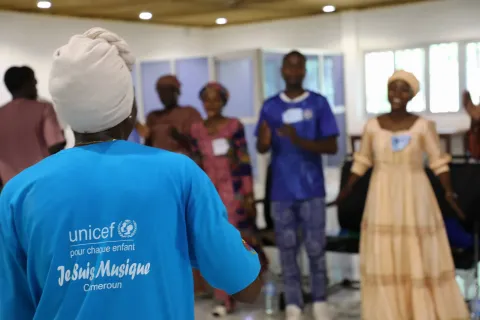
Local authorities and UNICEF have multiplied training sessions and set up community child protection networks to raise awareness among families. But on the ground, the gold rush shows no sign of slowing.
“Other communities envy us because our school is well-equipped. But our village needs its children. It hurts to see them trade their future like this,” laments the headmaster.
Children’s Dreams Trapped
Some children want to continue their education, but their environment makes it hard. Drawn by the lifestyle of peers working at the mines, others eventually follow.
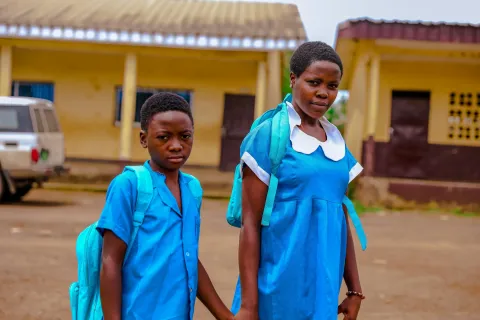
Philomène, 14, a student at Mbal’s public school, confides with disarming honesty:
“I want to go to school, but I also want to have money.”
Her dream, however, is clear: to become a doctor.
Beside her, Aboubakar, 19, a high school student in Betare-Oya, represents another possible path:
“My parents decided to send me to high school so I can achieve my dream of becoming a cardiologist. I only come here on weekends and during holidays to help my parents, while continuing to study. I have an exam this year.”
Aboubakar is among the few young people resisting the lure of gold, refusing to sacrifice education.

An Impossible Choice for Too Many Children
For many others, the choice barely exists. How can they resist when a child can earn between 20,000 and 100,000 CFA francs per day at a gold mining site?
“I don’t know what else to say to convince children to go to school. They only want gold,” says Bienvenue, voice heavy with despair.
“One day, the gold will run out. What will become of our children? What will they do?”
Saving the Future, Now
In Mbal, as in many parts of eastern Cameroon, gold comes at a high price and children pay the most.
It is urgent to save their future by strengthening controls on gold mining sites and strictly banning child labor. A child should never have to choose between the fundamental right to education and money.