Spacing births, nourishing futures: a transformation in Mokong
In Mokong, access to sexual and reproductive health services, including contraception, is transforming the lives of mothers and their children.
- English
- Français
In the town of Mokong, located in the Far North region of Cameroon, a quiet revolution is taking place. Led by the District Medical Centre (CMA) with support from UNICEF and its partner the Government of Germany/BMZ through KfW, this initiative focuses on prenatal consultations, routine vaccination sessions, and the treatment of severe acute malnutrition. Its cornerstone: contraception. Long shrouded by rumours and mistrust, contraception is gradually becoming a vital tool for enhancing the well-being of mothers and improving nutrition for children.
Every Tuesday morning, the backyard of the District Medical Centre transforms into a hub of learning and empowerment for mothers. On mats or wooden benches, 89 mothers gather to listen attentively to health staff as they share vital advice on the importance of exclusive breastfeeding and, crucially, contraceptives. This knowledge is essential for ensuring maternal health and the optimal development of their children.
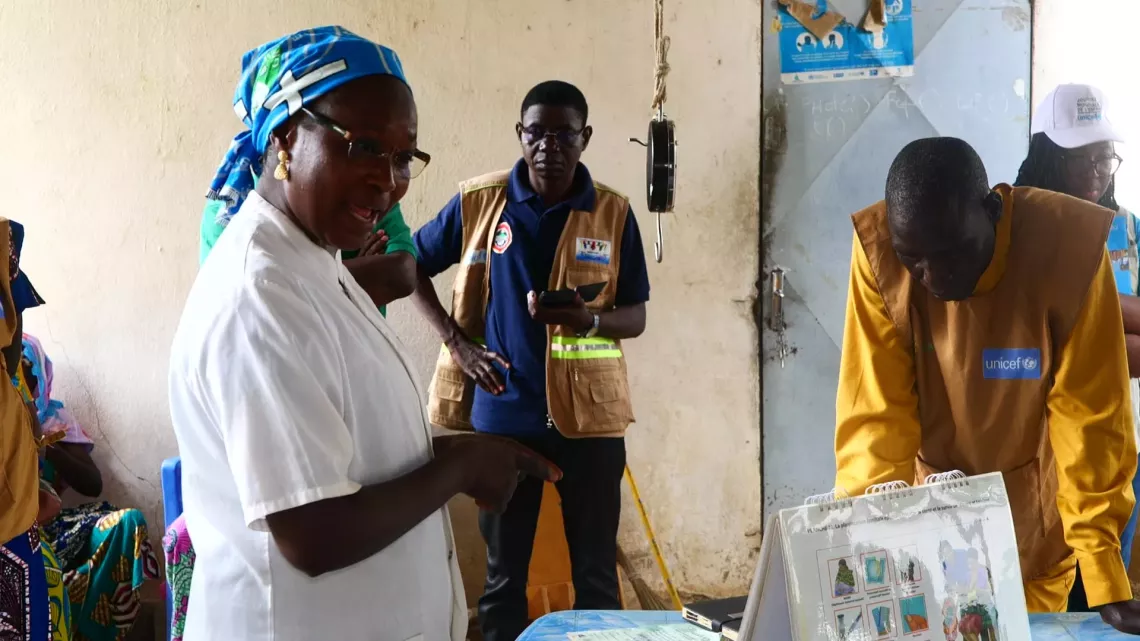
« When pregnancies are too close together, you, the mothers, become weaker. And your children suffer too. Imagine yourself with a four-month-old baby, when you are already pregnant: how are you going to take good care of both of them? That is why we advise you to space out births, so that children can grow up in good conditions. », says Julienne Kovou, nurse and nutrition focal point at the hospital.
« We have noticed that some pregnant women arrive with young children suffering from malnutrition. We have therefore launched an awareness campaign on contraception to educate them about the importance of birth spacing.», adds Julienne Kovou.
Once, Julienne Kovou had to pay out of her own pocket for the insertion of Norplant, a contraceptive method.
« This woman had undergone three consecutive caesarean sections, with no interval between births. A colleague and I chipped in to enable her to get an implant. There are cases of women who want to use contraception but are unable to do so because they cannot afford it. » Julienne Kovou advocates.

Persistent rumours and deep fears weigh heavily.
La Grâce Yada, 30, has also experienced the weight of rumours and prejudice. This mother of three has long been reluctant to use contraception.

« At the hospital, people talked about it. But in the neighbourhood, it was frowned upon.», she confides. « It was said that contraceptives caused infertility and heavy periods. I was discouraged. My husband had talked to me about it, but I refused because of the rumours.»
Like her, many women hesitate, influenced by persistent beliefs and a lack of knowledge about contraceptive methods.
The decisive role of information and marital dialogue

In the end, it was her husband who convinced her.
« He was worried that with the high cost of living, we wouldn't be able to take good care of our children unless we spaced out the births. After my second pregnancy, I agreed, while warning him about the side effects.»
She opted for a five-year implant. Three and a half years later, at her husband's request, she had it removed. Seven months later, she conceived her third child.
Tangible benefits for women
« With the adoption of contraception, I discovered that we can save money. It allows us to carry out certain projects. For the mother, it allows her to rest and regain her strength before another pregnancy. »
It also indicates more balanced breastfeeding and a calmer child who is growing well.
« I did not experience any side effects. My periods remained normal. Today, I encourage women to give it a try.»
A direct impact on children's nutrition and optimal development

Spacing births allows mothers to breastfeed more effectively and devote more time and resources to each child. Children are better nourished, better cared for, and develop more harmoniously. The link between contraceptive use and infant nutrition is evident in mothers' testimonials and medical staff observations.
The Mokong CMA, a key player in change

Christophe Haman manages the Mokong CMA and oversees a health area covering six villages.
« Here, mothers have one pregnancy after another without any time in between. We inform them about the different methods. Some accept, others are reluctant. But gradually, they come round to the idea when they see the benefits in others," he explains.
"Some women do it without their husbands' knowledge. They even hide their hospital records. They say that they are the ones who suffer, not their husbands. They pool their money so that they can access contraception."
Julienne Kovou, malnutrition focal point at the Mokong CMA, confides
Medical staff play a crucial role. During prenatal consultations, vaccination sessions or treatment for severe acute malnutrition, women are made aware of the issue. "We educate them on the subject, and that gives them courage," says Christophe Haman.
Persistent challenges to overcome
Despite progress, obstacles remain. Husbands are often the most hostile.
"But with the help of their wives and healthcare staff, we often manage to convince them," explains Christophe Haman.
Another challenge is the cost of certain contraceptive methods.
« The population is poor. Mothers are requesting free treatment, particularly for implants. », he pleads.
In Mokong, family planning is more than just a medical procedure; it serves as a tool for empowerment, resilience, and optimal child development. It enables women to take control of their bodies, enhance their ability to care for their children, and create a more secure future for their families.