Kangaroo Mother Care: A Lifeline for Premature Babies in Buea, South West Cameroon
In Cameroon’s South-West, Kangaroo Mother Care is saving premature babies. Supported by UNICEF, this skin-to-skin method turns a mother's embrace into a vital shield for newborn survival.

Every mother hopes for a healthy start in life for their child.
For many families, however, the journey to welcoming a newborn can be filled with uncertainty. Geographic barriers, financial constraints, limited access to quality maternal healthcare, inadequate nutrition, and disruptions caused by crisis can make pregnancy and childbirth particularly challenging. When a baby arrives too soon, those challenges often become even greater.
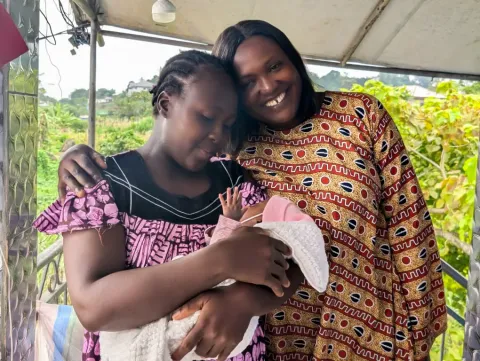
For Tina, a mother of twin babies, the joy of becoming a mother was quickly overshadowed by fear.
Her babies were born prematurely and immediately transferred to the Neonatology Unit at Buea Regional Hospital. Surrounded by unfamiliar equipment and worried about her newborn's fragile condition, she found herself asking the same question many parents of premature babies ask: would her babies survive?
"I was very scared. I had never experienced anything like this before."
Tina, Mother

Inside the Neonatology Unit, Tina was introduced to Kangaroo Mother Care (KMC), a proven method that places mothers and caregivers at the centre of newborn survival.
Kangaroo Mother Care involves prolonged skin-to-skin contact between a caregiver and a low birth weight or premature baby. The baby placed on the mother’s chest in an appropriate anatomical position that favors exclusive breastfeeding and digestion. and continuous close monitoring and follow-up of the baby. Through this approach, a mother's body becomes a natural source of warmth, protection, and comfort.
"Kangaroo care helps to reduce the morbidity and mortality of premature babies. We know that low-birth-weight babies are at a higher risk and can get very sick very fast due to low body temperature."
Major Njohjam Christable, Head of the Neonatology Unit, Buea Regional Hospital
For babies born too small or too soon, maintaining body temperature can be a matter of survival.
The practice requires mothers to hold their babies directly against their chest for up to 20 hours each day, creating continuous skin-to-skin contact that regulates temperature, promotes breastfeeding, strengthens immunity, improves weight gain and fosters emotional bonding.
Within the quiet walls of the neonatology ward, mothers sit patiently with their babies wrapped securely against their chests. Every hour spent skin-to-skin becomes an investment in their child's survival and recovery.
"KMC helps mothers gain confidence. At first, many are afraid because their babies are so small. As they learn how to care for them and see them growing stronger, they become empowered."
Kah Pamela, Nurse, Neonatology Unit

One mother in the unit recently gave birth to twins prematurely. During the first days after delivery, one of the babies required additional medical attention, leaving her separated from one child while caring for the other.
She describes feeling incomplete.
Only when both babies were finally placed safely against her chest for the Kangaroo Mother Care practice did she begin to feel whole again.
"When they finally gave me both babies, I felt complete. Holding them close gave me strength and hope."
Tina, Mother, Mother of twins
For another mother, Kelly, the experience has also transformed fear into confidence.
Spending long hours each day practising Kangaroo Mother Care has helped her develop a stronger connection with her baby and a renewed belief in her child's future.
"When I hold my baby, I feel like I am contributing to my child's growth. The bond is stronger and I feel that my baby is protected."
Kelly, Mother
Kangaroo Mother Care is a natural, effective and low-cost intervention that can be implemented in almost any setting. In crisis-affected communities, where access to specialised equipment may be limited, and health systems are under pressure, it is often one of the most cost-effective ways to improve survival outcomes for vulnerable premature newborns, like in South West Cameroon, where the Regional Hospital is one of the pilot health facilities for KMC with over 30 mothers and babies hospitalised with limited space and material resources.
At Buea Regional Hospital, health workers guide mothers from admission through discharge and continue providing support through follow-up visits to ensure babies continue to thrive at home, leveraging the use of KMC champions.

As part of the programme, UNICEF Cameroon, in partnership with the Regional Delegation of Public Health, continues to support efforts to strengthen newborn care services, including capacity-building training, providing essential equipment like radiant warmers, resuscitation kits, KMC chairs and bags to keep premature babies warm and strengthen the bond between babies and their caregivers.
The support also contributes to strengthening health systems and ensuring that vulnerable newborns receive quality care from birth through recovery.
Globally, an estimated 15 million babies are born prematurely every year. Many of these newborns require specialised care during the first weeks of life.
For families in the South-West Region of Cameroon, especially in the pilot health facilities with high-volume deliveries, Kangaroo Mother Care is providing the much-needed support.
It provides warmth, confidence and hope.
This programme is made possible through the support of UNICEF and its partners who continue to strengthen health systems and expand access to essential newborn care services.
Together, we can help ensure that every child has a healthy start in life.