From Awareness to Commitment: IUEC Bandjoun Mobilizes for Children's Rights
At IUEC Bandjoun, about 30 academics and civil society actors joined a UNICEF-led workshop to dispel misconceptions and put children’s best interests at the center of education and community action.

- English
- Français
Breaking through misconceptions
Before the training session on the evolution of children’s rights, faces were doubtful, almost indifferent. "Just another training course!" some muttered, dragging their feet as they headed towards the future Centre for Children's Rights at IUEC Bandjoun. Minds were preoccupied with the logistical details of the Centre’s inauguration, scheduled for the following day.
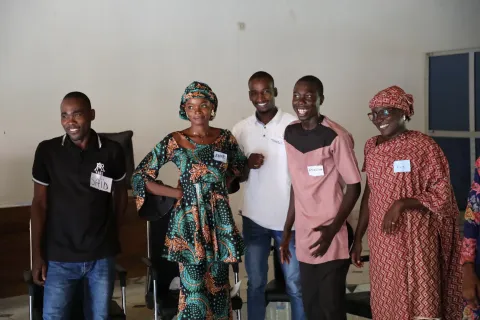
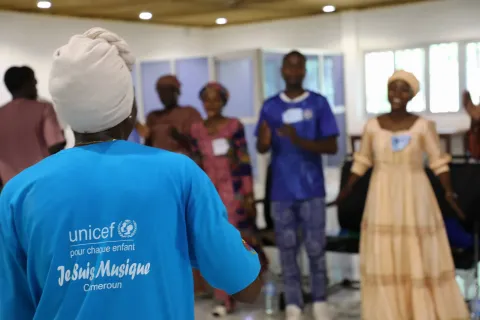
In the U-shaped room, some thirty lecturers, administrative officials, and civil society actors questioned the content of the training. Professor Jules-Roger Kuiaté, Vice-Chancellor of IUEC Bandjoun, immediately refocused the stakes:
"Humanity as a whole is at the heart of IUEC’s mission. We have always sought the well-being of the people around us. I am counting on you to ensure that our Centre for Children's Rights becomes the finest in the entire country,"
he declared, throwing down the gauntlet to his university’s academic staff.

A historical perspective: Africa as a pioneer of child rights
Following these opening remarks, Dr Eteri Kirtskhalia and Dr Albert le Grand Fosso from UNICEF took over. Using an interactive approach, the two UNICEF experts gradually piqued the curiosity of their audience. Dr Eteri was the first to set the scene:
"Children’s rights are universal and indivisible. Every child, regardless of their background, religion, or gender, and no matter where they are, must enjoy all of their rights. All children’s rights are interdependent; no single right can be realised without the others,"
she revealed, before demonstrating that children's rights are the result of a long historical process. This journey, she explained, spans from Ancient Egypt and Ancient Greece, with contemporary roots dating back to the 18th century. It was during this period that children were first recognised as an independent social category, notably through the works of Jean-Jacques Rousseau.

Dr Albert le Grand Fosso set out to completely deconstruct the idea that children’s rights are foreign to Africa. He reminded the audience that Africa has been a pioneer since the 15th century with the Manden Charter. "This charter proves that children have always held a privileged place in Africa," he revealed.
"Today, Africa is the only continent to have adopted its own specific convention on children’s rights: the African Charter on the Rights and Welfare of the Child, which is even more binding than the International Convention."
The two UNICEF experts noted that the United Nations Convention on the Rights of the Child (UNCRC), adopted on 20 November 1989, is the most widely ratified treaty in the world. It is built upon four core principles:
- Non-discrimination
- The best interests of the child
- The right to life, survival, and development
- The right to participation
"It is a binding treaty that sets out the minimum standards for children’s rights. State parties must submit periodic reports and take the recommendations of the Committee on the Rights of the Child into account. This means that the interpretation of children’s rights is dynamic," added Dr Eteri Kirtskhalia.
Rethinking pedagogy: placing the underage student at the centre of rights.
As the discussion continued, the lecturers gradually began to realise the gaps in their own knowledge regarding children’s rights.

"Previously, we treated our students under the age of 18 as adults, assuming that because they were at university, they were grown-ups. We now understand that even at university, those under 18 are still children and are protected by the United Nations Convention on the Rights of the Child and the African Charter on the Rights and Welfare of the Child. We intend to organise a feedback session for all 300 lecturers at our university so they can integrate children’s rights into their interactions with students. This training calls on us to revise our teaching methods—moving from a rigid disciplinary approach to a restorative one. It is about placing the student at the heart of the educational process and ensuring their well-being and fulfilment," says Dr Georesse Fotso, Vice-Dean of the Faculty of Agronomy and Environmental Sciences at IUEC Bandjoun.
The two UNICEF experts reminded the lecturers and civil society actors that they have a key role to play in social transformation through documentation, research, and advocacy in support of children’s rights.

"I have taken away two key concepts from this training: the best interests of the child and the right to child participation. I used to interrupt students when they were mistaken. I now realise that younger people are facing a crisis of role models and identity. They need to be heard to be better supported. I am committed to being more attentive to my students from now on," says Dr Soh Mabekou Sandrine, Lecturer in Molecular Biology at IUEC Bandjoun.
Turning civil society into a community beacon
Beyond the lecture theatres, the impact extends to the field. For civil society actors, such as Mr Sahguo Tagne Joseph of the Sahelian Alliance, the tools provided allow for a better balance between parental authority and a child's autonomy.
"On the ground, we sometimes encounter children in conflict with their parents. Today, we are equipped to explain to parents their role as guides. Through this training, we have a clearer understanding of the concept of autonomy. We now know that it does not mean a child can do as they please, but rather that they must gradually acquire the skills that will enable them to take full responsibility in adult life," shares the National Coordinator of the Sahelian Alliance for Research and Sustainable Development.

Mr Sahguo Tagne Joseph of the Sahelian Alliance
So that every child’s voice is heard
The Bandjoun training serves as a reminder of a fundamental truth: respecting children's rights is not an option; it is the bedrock of any emerging society. When professors of molecular biology or agronomy commit to swapping "rigid discipline" for a "restorative approach" and active listening, the entire education system begins to breathe again.