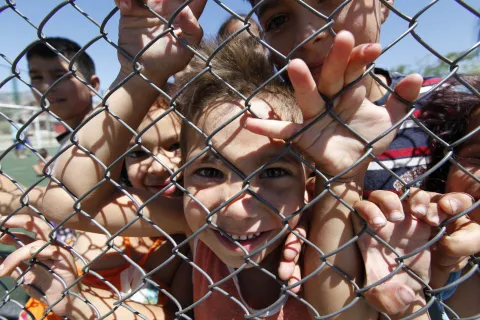
UNICEF - More than 400 million children globally live in poverty, missing out on at least two daily needs such as nutrition and sanitation
In High-Income Countries, 50 million Children Live in Poverty — Bulgaria is Among Those Most Affected
- Български
- English
NEW YORK, SOFIA, 20 November 2025 – More than 1 in 5 children in low- and middle-income countries – or 417 million – are severely deprived in at least two vital areas critical for their health, development, and wellbeing, according to UNICEF’s flagship report issued on World Children’s Day today. The report warns more children are at risk of falling into poverty as global funding cuts, conflict and climate threaten access to services crucial for health and wellbeing .
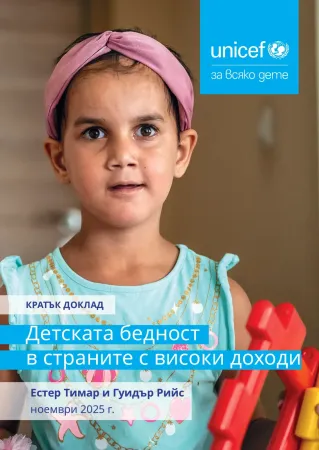
The State of the World’s Children 2025: Ending Child Poverty – Our Shared Imperative draws on data from over 130 low- and middle-income countries to assess the breadth of multidimensional poverty by measuring deprivations across six categories: Education, health, housing, nutrition, sanitation, and water. The analysis shows that 118 million children experience three or more deprivations, and 17 million face four or more deprivations. The report warns that even more children are at risk of falling into poverty as global funding cuts, increasing conflicts, and climate change, threaten their access to crucial services.
“Children growing up in poverty and deprived of essentials like good nutrition, proper sanitation and shelter, face devastating consequences for their health and development,” said UNICEF Executive Director, Catherine Russell. “It doesn’t have to be this way. When governments commit to ending child poverty by implementing effective policies, they can unlock a world of possibilities for children.”
The highest rates of multidimensional poverty among children are concentrated in Sub-Saharan Africa and South Asia.
The share of children facing one or more severe deprivations in low-and-middle-income countries dropped from 51 per cent in 2013 to 41 per cent in 2023, largely due to prioritising child rights in national policies and economic planning. However, progress is stalling. Conflict, climate and environmental crises, demographic shifts, mounting national debt and widening technological divides are compounding poverty. At the same time, unprecedented cuts to Official Development Assistance (ODA) risk deepening child deprivation across low- and middle-income countries.
Poverty undermines children’s health, development, and learning – leading to weaker job prospects, shorter lifespans, and increased rates of depression and anxiety. The report highlights that the youngest children, those with disabilities, and those living in crises are particularly vulnerable.
The report also examines monetary poverty, which further limits children’s access to food, education, and health services. According to the latest data, more than 19 per cent of children globally live in extreme monetary poverty, surviving on less than US$3 per day. Nearly 90 per cent of these children are in Sub-Saharan Africa and South Asia.
The report includes an analysis on 37 high-income countries, showing that about 50 million children – or 23 per cent of the child population in these countries – live in relative monetary poverty, meaning their household has significantly less income than most others in their country, potentially limiting their ability to participate fully in everyday life.
While poverty declined, on average, by 2.5 per cent across the 37 countries between 2013 and 2023 – progress has stagnated or reversed in many cases. In France, Switzerland, and the United Kingdom, for example, child poverty increased by over 20 per cent. During the same period, Slovenia reduced its poverty rate by more than a quarter, largely thanks to a strong family benefits system and minimum wage legislation.
Although child poverty in Bulgaria has gradually declined over the past decade, it remains both widespread and deep. More than 28% of children experience monetary poverty, which is the fourth-highest rate among high-income countries after Uruguay, the United States and Spain. Notably, Bulgaria ranks among the top 10 countries that have made significant progress in reducing severe material deprivation among children between 2015 and 2024, achieving the largest reduction of over 50%. Yet, despite these gains, one in five 15-year-olds reports skipping a meal because there was no money to buy lunch.
The State of the World’s Children 2025 highlights that ending child poverty is achievable, and underscores the importance of centering child rights, as outlined in the UN Convention on the Rights of the Child, in all government strategies, policies and actions aimed at poverty reduction, by:
- Making ending child poverty a national priority.
- Integrating children’s needs into economic policies and budgets.
- Providing social protection programmes, including cash support to families.
- Expanding access to essential public services, such as education, healthcare, water, sanitation, nutrition, and housing.
- Promoting decent work for parents and caregivers to strengthen their economic security, which is closely linked to children’s progress.
“Ending child poverty is not about resources or possibilities—it is a question of political priorities and strengthening the integration and effectiveness of policies. We welcome Bulgaria’s commitment to an ambitious national target: reducing the number of children at risk of poverty and social exclusion by 197,000 by 2030. UNICEF will continue to support national efforts to improve child well-being and ensure that the most disadvantaged children receive the assistance they need, including through the implementation of the European Child Guarantee,” said Christina de Bruin, UNICEF Representative in Bulgaria”
Every year on 20 November, UNICEF organizes the global “Go Blue” initiative, and iconic buildings around the world are illuminated in blue to support the cause of children’s rights. In Bulgaria, key buildings will be lit in UNICEF’s iconic blue – the National Palace of Culture and the Sofia Municipality building.
Notes for editors:
Multimedia materials available here.
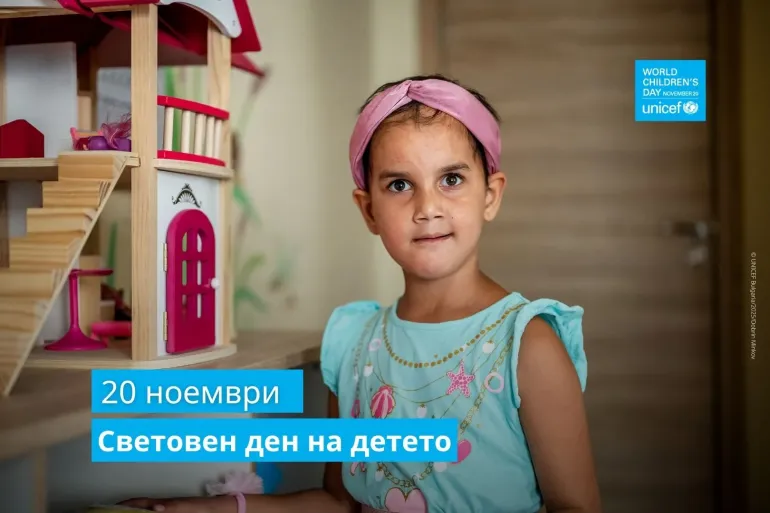
This year, World Children’s Day – UNICEF’s annual day marking the adoption of the Convention on the Rights of the Child on 20 November – is commemorated under the theme, My Day, My Rights, which aims to centre children’s voices and lived experiences.
Joint UNICEF estimates with Save the Children, along with analysis of survey data on multidimensional poverty, were used to calculate child material deprivation, looking at six rights that are constitutive of poverty: education, health, housing, nutrition, sanitation and water. The survey data cover 89 countries and were used for presenting individual country values. The estimates cover 133 countries and were used to calculate regional averages and other aggregate values. For countries with available survey data, the estimates took existing trends and extended them beyond available survey years. For countries that had partial data, they used available indicators like stunting or immunization coverage rates to calculate child poverty trends over time.
The World Bank’s updated monetary poverty thresholds now stand at $3.00/day for low-income countries, $4.20/day for lower-middle-income countries, and $8.30/day for upper-middle-income countries, reflecting the rising cost of basic needs. Using these thresholds, the World Bank estimates poverty rates and head counts based on data from a variety of surveys collated in its Global Monitoring Database. Poverty rate projections are used whenever survey data are not available.
Child poverty in high income countries is typically measured in relative terms – a child is living in poverty if they live in household earning less than 60 per cent of the national median income. Data comes from Eurostat for EU countries and from national statistical offices in other high-income countries.
Media contacts
Additional resources
About UNICEF
UNICEF, the United Nations agency for children, works to protect the rights of every child, everywhere, especially the most disadvantaged children and in the toughest places to reach. Across more than 190 countries and territories, we do whatever it takes to help children survive, thrive, and fulfil their potential.
For more information about UNICEF and its work, please visit: www.unicef.org
Follow UNICEF on X (Twitter), Facebook, Instagram, and YouTube