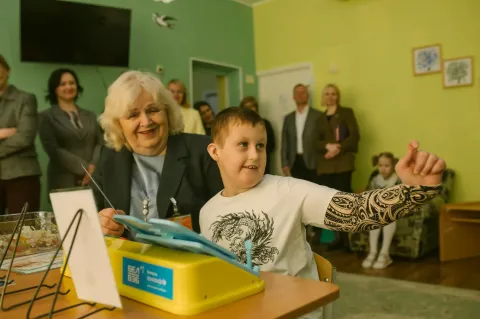
"We will teach you how to teach him"
How early intervention centers help parents of children with developmental disabilities

- русский
- English
"It was the most difficult time in my life," Elena recalls the first months after the birth of her son. Nazar was born with Down syndrome, and it was a shock for his parents as examinations during pregnancy didn't show anything. "My husband and I even thought of abandoning the child. We went to foster homes to see what the conditions for children with special needs were."
When Nazar was 4.5 months old, his parents took him to the Early Intervention Center (EIC) at the 19th children's outpatient clinic in Minsk. At that time, Nazar could neither roll over nor sit up. At the Center, he learned to walk, run and pick up objects. "They told me: 'We will teach you how to teach him.' I realized then that we were not alone." Now Nazar is 6 years old, he goes to an integrated group in a regular kindergarten. Laughs and gets upset, runs and plays with friends, counts and spells words. "I think everything that Nazar has now comes from the center and from the classes we attended there until he turned 3."
We met Elena and Nazar to find out how the early intervention and EIC classes affected the boy's development. Elena is a pediatrician. But she admits that despite her medical education, she knew little about Down syndrome. "A couple of phrases were spinning in my head: these children will perhaps never walk, they are lagging behind in everything and they will never be fully accepted by the society."

"Will never walk"
Despite the fears of his parents, Nazar quickly started crawling and then walking. The family went to the EIC once a week. First, there were classes with a pediatrician, a little later - with a speech therapist.
"The pediatrician held classes related to motor skills, taught Nazar to sit, walk, crawl. They even had to teach him to go down the slide correctly. I didn't know many things. For example, that it is important to put feet in a certain way when getting up."
A few weeks after birth, Nazar underwent a heart surgery. But now, according to Elena, the ultrasound doesn't show any traces of it.
The boy grew up strong. When he just started going to the kindergarten, he got sick quite often, but it's a usual thing for any child. Now he gets sick not more than 2-4 times a year. While we are talking to Elena, Nazar runs and jumps, playfully fights with his younger brother for a toy and tries to make snowballs.
"There are other children with special needs in our group in the kindergarten. And once the physical education teacher said at a parent meeting that she was trying to involve such children in all activities and games as much as possible. But she was never forcing them. I wanted to ask her a question and started raising my hand, but she cut me off: "I'm not talking about your boy, Nazar is interested in everything."

"He will never talk"
Nazar started talking when he was 2 years old. He knew about 15 words: mom, dad, aunt, uncle, and more.
"After the diagnostics at the EIC the staff told me: 'Look, he is almost turning over. Don't worry, he will learn everything, and we will help him.' I was happy to hear it as before the visit I read a whole bunch of nasty things on the Internet. Besides I was comparing him to his older brother, who was doing everything quicker. At the center they told me: 'It's not that bad, he makes eye-contact, he smiles and laughs. Yes, he is lagging a bit behind, but still there are many positive things.' I exhaled then: I realized that I was not alone, that there was a place I could go to and consult."
Now Nazar can spell words: B-A B-A. He can draw, though the lines are not that even. He knows numbers, he can count, but he still has to learn how to add and subtract. Elena sighs: "I don't work with Nazar as intensively as before. We have four children and all need attention. I think that everything Nazar knows now comes from the time before he turned 3 when we went to the EIC. Of course, he does not speak in complicated phrases, he does not completely retell fairy tales, but you can understand everything when it comes to small everyday things. He can also quote and retell his favorite books. Nazar doesn’t really want to learn hard, he is a bit naughty."
"I'm not naughty!" Nazar reacts instantly. "He understands everything," his mom smiles.

"The society will not accept him"
Elena is honest about the kindergarten and that the staff were reluctant to take Nazar. First, Nazar went to the nursery group and there were no children with special needs. A year later, he was moved to the integrated group.
"I didn’t get many complaints about him. He fell asleep on his own, ate on his own. But he couldn't get dressed, he needed help. The teachers are good, but strict enough. He follows the rules in the group. It is great progress."
Pre-school teachers and children quickly accepted Nazar. The boy found his first friend Denis.
"I was very happy. Denis is an ordinary boy, without a diagnosis. Of course, Denis invented more games and Nazar joined them. But they were very good friends.
It's a pity that now Denis goes to another group. There is another friend, Vanyusha, who also has the syndrome. It's not even friendship that they share but some kind of incomprehensible love. Vanyusha does not speak, but at some higher level they understand each other and play together. Unfortunately, Nazar has no friends in the neighborhood. I am also worried about that."

But Nazar has three friends at home – two brothers and a sister. And grandmother Toma who is also Nazar's love. I ask Elena how the lady manages to find an approach to Nazar. Elena smiles: "She just loves him insanely."
Nazar's siblings behave as normal kids around him: they play and get crazy together, but they can also quarrel and fight.
"We don’t overprotect him. Once I was putting shoes on Nazar's feet, he was over 2 years back then. A pediatrician at the EIC saw it and said: 'Lena, what are you doing? How old will he be when he finally starts to put on the shoes on his own?' The EIC personnel always told me to teach him to be independent. It took us a long time to learn how to dress and put on shoes. Nazar can't zip up his jacket on his own now. But he is doing everything else (90 percent) himself! Of course, he likes to say: 'I can’t! I don't know how! I don't want to!' He tries to manipulate. But I don't respond to such manipulations. He freaks out at first, but then he does it himself."
«Одевание и обувание нам очень долго и сложно давалось. Назар сейчас не может вставить собачку в замок и застегнуть куртку. Но все остальное (процентов 90) может сделать сам. Он, конечно, любитель сказать: «Не могу! Не умею! Не хочу!» Манипулирует. Но я ничего не делаю за него. Он психует сначала, а потом делает».

About superheroes
Nazar has a long thin stick in his hand. "It's a web! And I'm Spider-Man!"
Elena explains that now Nazar loves everything related to Spider-Man: songs, cartoons, games. "It is the biggest surprise for me and the biggest joy: he has interests, his personality is developing. Take his favorite cartoons and books. He used to like "Paw Patrol", but now he is fond of Spider-Man. He would go around quoting "Gruffalo". But now he can retell stories from the "Village of Dedmorozovka" which is his favorite book now."
As Elena talks, Nazar waves an imaginary web and shouts, "Where's Venom?" (an antihero in Spider-Man stories – ed.).
"We had many fears about his development, so now we are happy to see that he is developing better than we thought," Elena continues, and sadly adds: "But, of course, there are also problems. Not so long ago, we passed the Wexler test and were diagnosed with mild mental retardation. Nazar was not in the mood during the test, because we were not prepared, we were sent there out of a sudden. He sat under the table almost all the time and did not want to study. He could have done half of the exercises if he was in the mood."

Elena is rocking the stroller with the youngest child, and at the same time she is trying to catch the superhero who is running around.
It seems that there are more superheroes around us. The parents, the loving grandmother of the boy are definitely among them. And all the specialists who helped and are still helping them.
"I would have gone crazy, to be honest, without the help of the EIC staff. I remember my condition back then – I would have gone crazy for sure. Sooner or later, a mom comes to a point where she doesn't know where to go. It is very difficult to find specialists who are ready to deal with young children with special needs. Many speech therapists, for example, do not want to work with children under 3. And at the center they helped us move forward. It was very important for me."

Information
Every 700th child in Belarus is born with an extra chromosome. Parents are very frightened, experiencing shock and unwillingness to believe in the diagnosis. This is a natural reaction when they don't have enough information. To help parents and children with Down syndrome or other children with or at risk of developmental delay, under the auspices of the United Nations Children's Fund (UNICEF), in cooperation with the Ministry of Healthcare of the Republic of Belarus and with the financial support of the Government of the Russian Federation, an early intervention system is being developed and early intervention centers are created in Belarus. Today there are 37 Centers in Belarus, 5 of them are based on foster homes. 20,398 children under three have already received assistance from the EIC specialists.