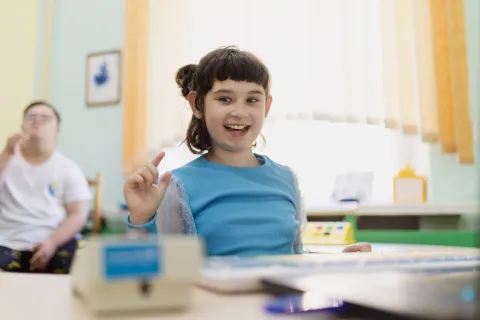
When a child can say, “I want a hug”
How assistive technologies help children with severe disabilities communicate and learn
- русский
- English
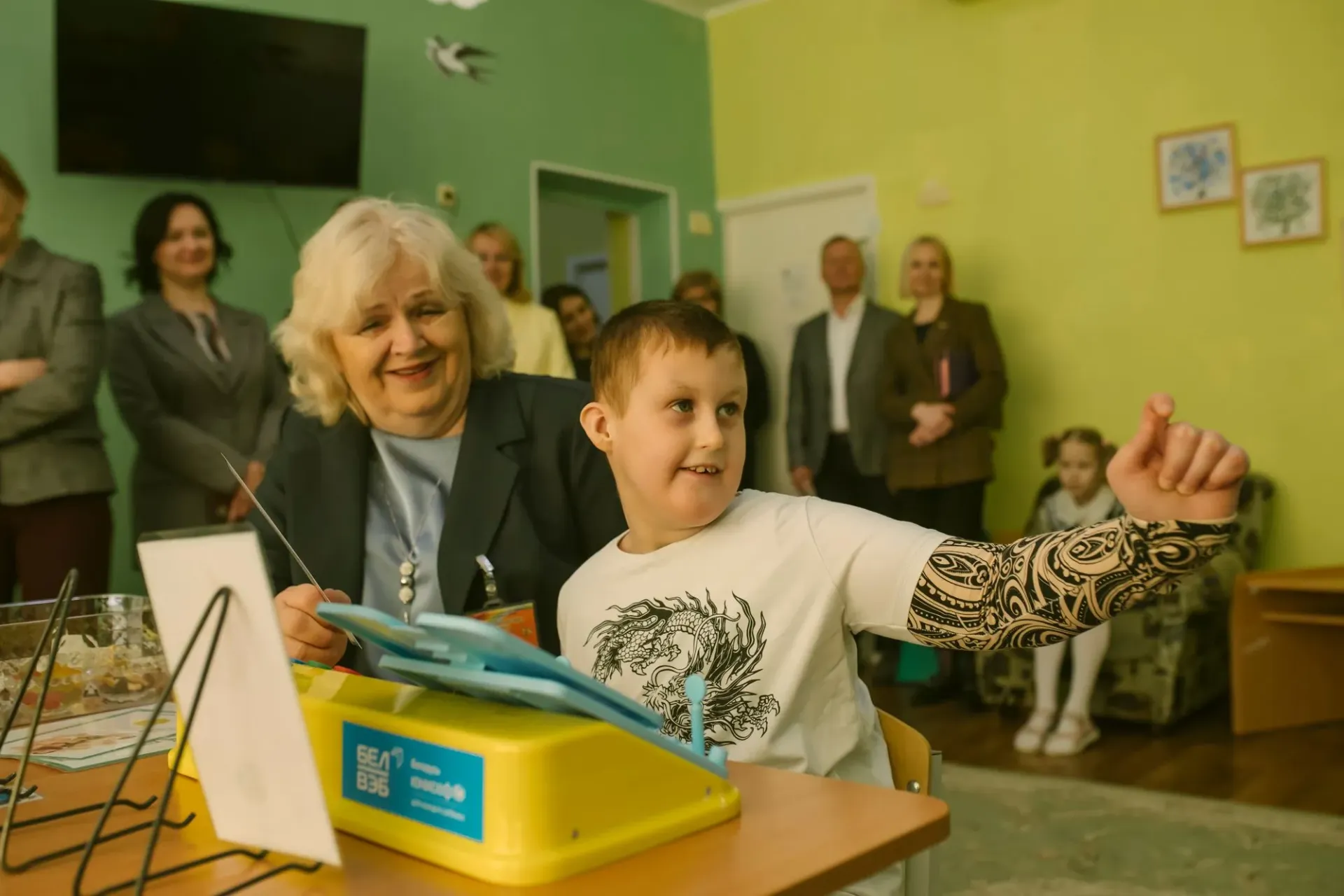
Roma presses a brightly colored button on communication device. A voice says out loud: “I want a hug!” He freezes for a second, then suddenly lights up: he smiles, looks at his teacher and immediately presses the button again. “There were such excited cries in the room,” his special needs teacher recalls. “It was pure childhood joy.”
Roma is 10 years old. He has cerebral palsy and speaks very little. In situations like this, communication is almost always based on guesswork. Adults try to interpret a look, a movement, a pause – sometimes correctly, sometimes not. But either way, the initiative usually remains with the adult, not the child.
Assistive technologies, such as communication devices, change the very principle of this interaction. They create a direct channel from the child’s inner world to the outside world. These solutions also include other alternative and augmentative communication devices, adapted computer access tools, eye-tracking technology and more. They help compensate for limitations in speech and motor skills, giving a child access to essential actions: receiving information, creating and sending messages, making choices and interacting with others.
In education, this is the basic level. If children cannot express a request, give an answer, make a choice or ask a question, learning becomes much more difficult – even if they are physically present in the classroom.
This is one of those small but powerful shifts made possible by long-term, systemic work and strong partnerships.
From one-off support to a systemic solution
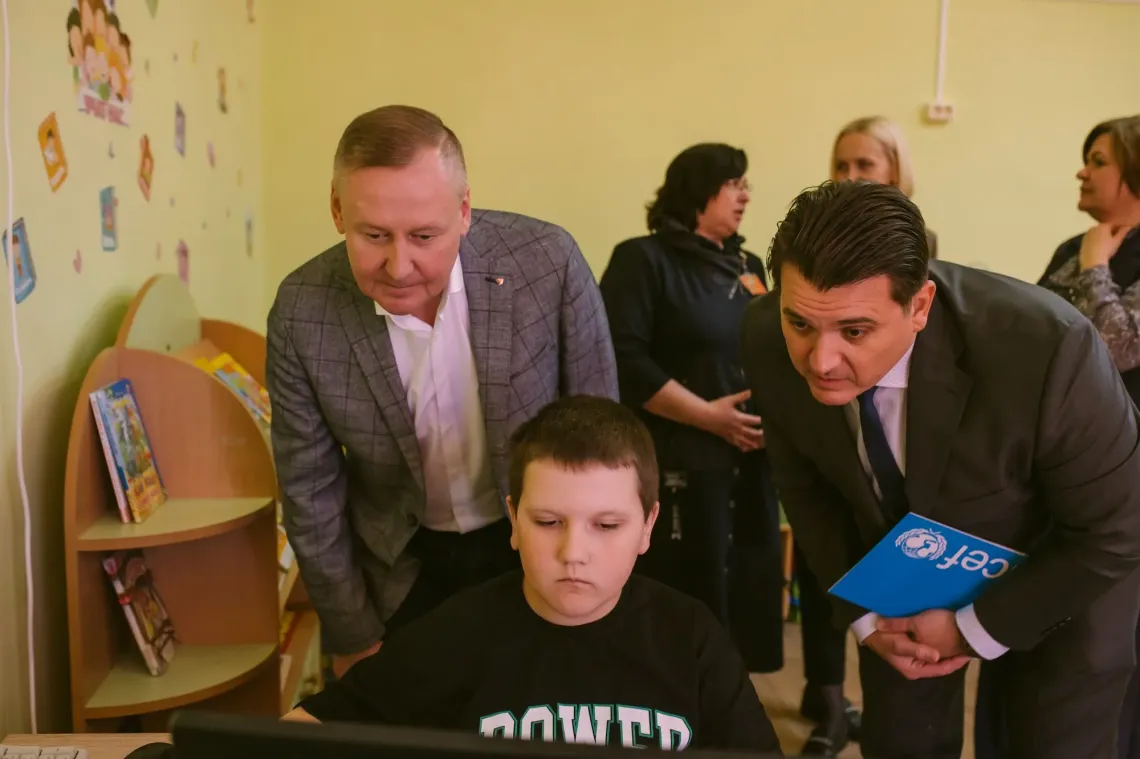
In 2025, with the support of BelVEB Bank, UNICEF in Belarus procured assistive equipment for four Centres for Correctional and Developmental Training and Rehabilitation in the Minsk region – in Kopyl, Pukhovichi, Smolevichi and Stolbtsy districts.
Roma is a pupil at the Smolevichi Centre, which we recently visited.
The equipment included alternative and augmentative communication devices, adapted input tools, specialized keyboards, rollerball mice and eye-tracking technology.
“Had I heard about assistive equipment before? Only that it was all very expensive,” says Olga, the mother of six-year-old Alisa, another pupil at the Smolevichi Center. “Even basic equipment for our daughter, who also has cerebral palsy – for example, a specialized wheelchair – costs a lot of money. We recently bought a standing frame ourselves, so we know exactly how expensive these things are.”Depending on the type of device, the equipment can be used both for individual sessions and for group learning. Importantly, it was not purchased as a universal set. It was selected based on the specific needs of each Centre concerned the children studying there and the tasks specialists needed to address.
“I think progress with assistive equipment also depends on the child, on the severity of the disability and on their individual characteristics,” Olga continues. “But I believe it will work for my daughter. Any purposeful action brings results – and modern technology even more so. Alisa used to be very frightened even by sudden sounds: if someone came to visit or the phone rang, she would literally jump and become very scared. After a year at the Centre, I see a completely different child: she has become more open, she is no longer afraid of sounds, and she is ready to connect with other children. The difference is huge.”
BelVEB Bank has been supporting the development of inclusive education for several years already.
Last year, with the bank’s support, 68 pieces of specialized equipment were delivered to six educational institutions in Belarus – three kindergartens and two schools in Minsk, as well as a social service centre in Berezovka, which together serve more than 90 children with special educational needs.
This work is also part of UNICEF’s broader programme to advance inclusive education in Belarus. Between 2022 and 2025, a joint project of the Ministry of Education and UNICEF helped deliver more than 400 pieces of assistive equipment to schools and kindergartens across the country.



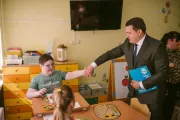
Why it matters?
Today, it is especially important to support children with severe and multiple developmental disabilities who study in these Centres for Correctional and Developmental Training and Rehabilitation. They are among the most vulnerable groups and are more likely than others to remain without access to specialized learning and communication tools.
These Centres concentrate expertise in working with children with severe and multiple developmental disabilities. Put simply, this is where professionals know how to teach and support children for whom standard educational tools are not suitable.
The Centres become places where specialists work with the most complex cases, develop individual approaches and help children acquire the basic skills they need for communication, learning and interaction. That is why access to modern technology is especially important here — without it, some educational opportunities remain simply out of reach.
Strengthening the work of these Centres through modern assistive equipment improves the quality of support for children and, in some cases, may contribute to their later integration into mainstream education, including learning in inclusive classrooms.
The Centres also play a coordinating role. Their specialists hold seminars and training sessions for teachers and share practical approaches to supporting children with severe developmental disabilities. Access to technology in one Centre can gradually influence teaching practices across an entire region.
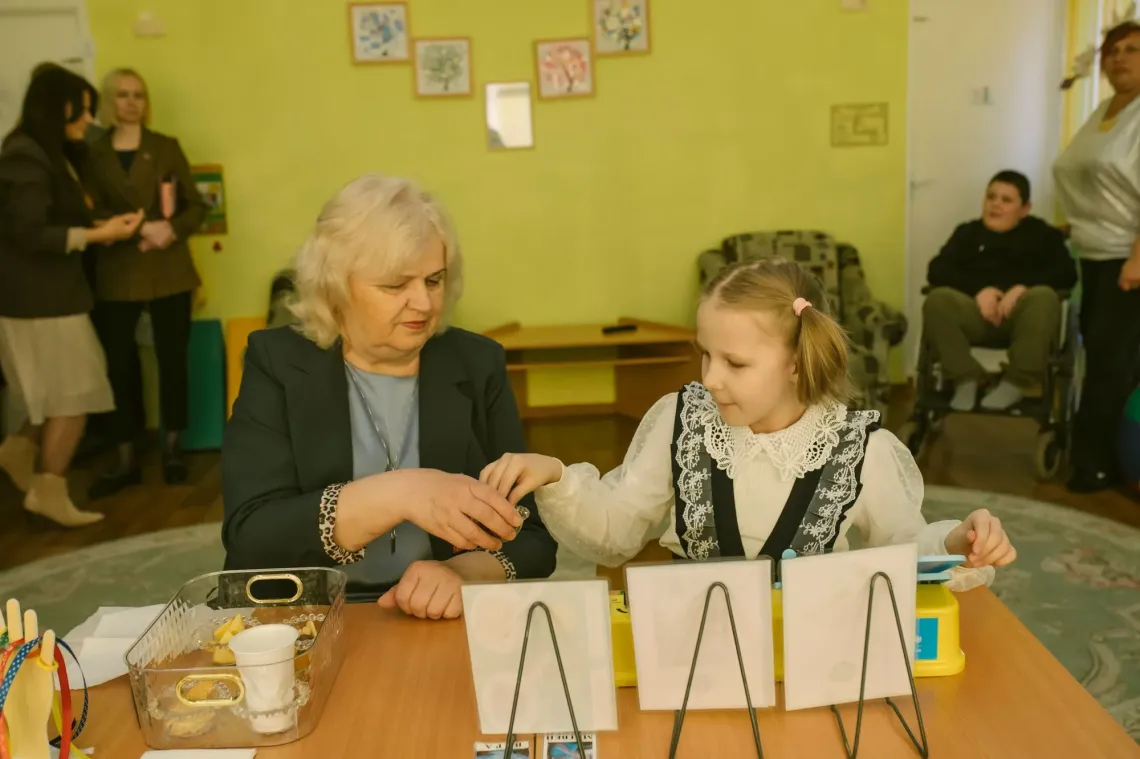
What assistive equipment makes possible
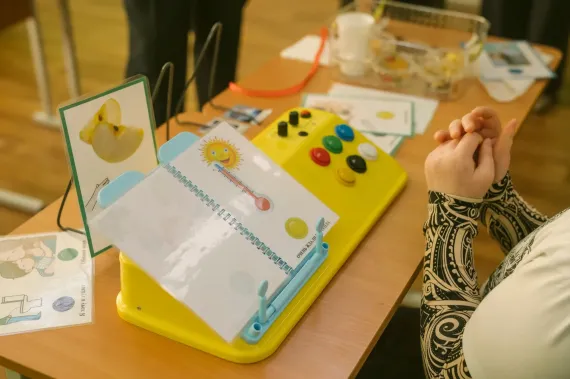
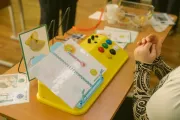
Communication devices and other alternative and augmentative communication tools allow a child to express needs, make choices, answer questions and initiate contact.
Alongside Roma, 32 other children attend the Smolevichi Centre during the day, while 13 more study at home. Most of them will use the equipment.
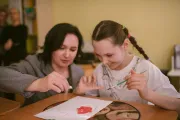
Ten-year-old Lyuba, who has autism spectrum disorder, also works with a communication device. For her, it has become not only a tool for communicating with a teacher, but also a way to interact with other children. Lyuba does not speak and does not greet people even with a gesture – something that is quite common for children with autism.
“One morning, after the communication device appeared, I put a card on it and walked up to the children,” says Galina Ivanovna, a special needs teacher at the Smolevichi Centre. “Lyuba looked at the card. Thought for a moment. Then pressed it – hello! I waved to her and said, ‘Hello!’”
It is a simple moment, but it reflects an important change: the child gains a tool to take part in basic social rituals. And this begins to affect the whole group – other children see it, repeat it and join in.
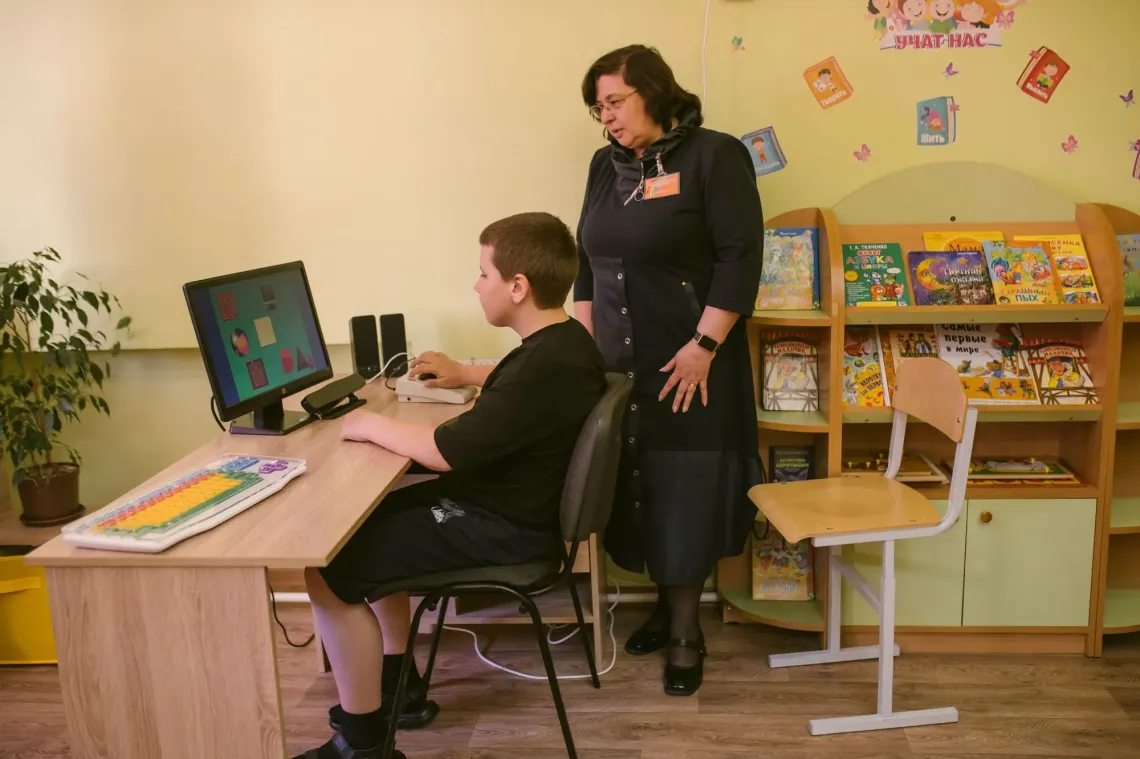
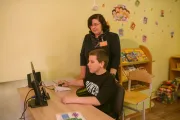
Yegor is in the 3rd class and follows the Centre’s educational programme. He does not speak, but he confidently works with educational computer programmes. The equipment is complemented by voice output, which allows him to take part in lessons.
Tatsiana Mikhailovna, a teacher-defectologist, has developed 150 game-based presentations adapted to the children’s abilities.
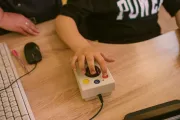
“We created game presentations specifically for our children – they work on tablets and on computers. But it was difficult for the children to use a mouse, so we had to guide them hand over hand, with an adult’s hand and the child’s hand together. Now, with the rollerball mouse, it is much easier.”
Adapted input devices such as rollerball mice and specialized keyboards make it easier for children with physical disabilities to use a computer. What previously required constant adult support becomes possible for the child to do independently.
Eye-tracking systems make it possible to control a computer using only eye movements. This is critically important for children who cannot use their hands: it gives them access to learning materials, communication and the digital environment.
Assistive technologies do not change diagnosis. But they give a child the opportunity to act: to choose, to answer, to ask, to join an activity. In education, that means access. In daily life, it means participation.
And sometimes, that process really begins with one simple action – pressing a button, followed for the first time by a response the world can understand.