When kilometers turn into opportunities
How the support of the participants of the Minsk Half Marathon opened new ways for children to learn

- русский
- English
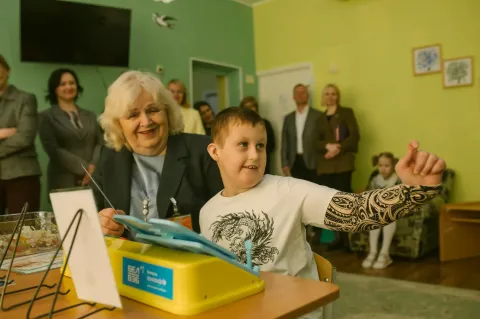
Arthur and Sasha are focused on their work at the computer. They find the right images, answer questions, and confidently use a trackball and a special keyboard. Both Arthur and Sasha study at the Borisov Center for Correctional and Developmental Education and Rehabilitation (Center). Because of the characteristics of their psychophysical development, many everyday tasks are challenging for them, but with the help of assistive technologies, they are increasingly able to manage independently.
Elena watches them and cannot help but remember a very different time. Fifteen years ago, she was working with her own son, who also had psychophysical developmental disabilities. Back then, teachers and parents had to cut out, label, and laminate cards themselves because specialized educational materials were almost unavailable.
Much has changed over the years. Elena once taught geography, but her personal experience led her into the field of special education. Today, she works as a teacher at the Borisov Center and sees every day how technology opens new opportunities for children.

The new assistive equipment appeared here thanks to people who are used to moving forward: participants of the UNICEF Friends Team charity run at the Minsk Half Marathon. They covered kilometers in support of inclusive education, and now children are overcoming distances that cannot be measured in meters: from communication challenges to communication, from dependence on assistance to independence, from hidden potential to visible achievements.
What are assistive devices?
For many people, a computer mouse or keyboard is an everyday tool. For some children, however, these devices become a way to express a thought independently for the first time, make a choice, or ask for help.
The use of assistive technologies is now considered one of the modern approaches to educating children with psychophysical developmental disabilities. These are specialized devices and software solutions that help compensate for limitations related to speech, motor, visual, and other impairments. Thanks to them, children can participate more actively in the educational process, communicate, acquire new skills, and become more independent.
Thanks to the participants of the UNICEF Friends Team, the Center received a communication device, a laptop, an adapted keyboard with large keys, a receiver, and a trackball (roller mouse).
Each of these devices helps overcome different barriers. Communication devices allow children to find it difficult or impossible to use spoken language to express their needs and interact with others. The adapted keyboard and trackball make the digital environment more accessible.
"Children are naturally drawn to computers, laptops, and their mothers’ phones. And when learning takes place through play, they absorb the material much better. These programs and this equipment allow us to use various games and work through everyday situations and communication scenarios that are very important for such children," says Elena.
This becomes especially evident during lessons. Ten-year-old Sasha, who loves drawing most of all, eagerly participates in game-based exercises, while her namesake Sasha, usually quiet and more comfortable in calm surroundings, gradually becomes more confident when tasks are broken down into clear, sequential steps.
According to Elena Vladimirovna, modern technologies do more than simply hold a child’s attention. They make it possible to repeatedly practice situations that children encounter every day: greeting someone, asking for help, making a choice, or approaching another person. At first, these actions take place in educational software, then in the classroom with a teacher, later in communication with other children and parents, and eventually outside the center as well.
"I notice that children have become quicker at finding the right answers, better at concentrating, and more confident in navigating tasks. First, we reinforce these skills here, and then we transfer them to real life. I believe that the results and positive changes are definitely there. Our children are learning and developing," says the teacher.


Resource Centers
Centers serve as centers of expertise in working with children who have severe and multiple developmental disabilities. Specialists here know how to educate and support children for whom conventional educational tools are not suitable.
Today, the development of inclusive education means not only creating conditions in kindergartens and schools. It is especially important now to support children with severe and multiple developmental disabilities who study in Centers. It is here that specialists work with the most complex cases, select individualized approaches, and help children acquire fundamental communication, learning, and interaction skills. Therefore, the availability of modern technologies is not an additional opportunity for us but a necessary condition for quality education," notes Anastasia Anatolyevna, Director of the Borisov District Centre for Correctional and Developmental Training and Rehabilitation.

The Borisov District CCDER serves 80 children. Of these, 63 attend the center every day, while another 17 receive education at home. The center works with families from almost the entire Borisov District and also serves as a resource center for supporting children with autism spectrum disorders. Its specialists advise teachers from other educational institutions, help implement modern teaching approaches, and share practices related to the use of assistive technologies.
That is why the impact of this support extends far beyond a single institution. The new equipment helps dozens of children currently studying at the center, while the expertise accumulated by specialists becomes part of the broader support system for children with psychophysical developmental disabilities throughout the region.
These changes have been made possible in part thanks to the support of participants in the UNICEF Friends Team charity run at the Minsk Half Marathon. Each participant completed their race in a matter of hours. For the children studying at the center, the journey toward new skills takes months and even years. But now there are a few more opportunities along that journey, meaning that even more children will be able to take the next step toward unlocking their potential, communicating, and learning.
This year, the UNICEF Minsk Half Marathon charity team is taking the starting line under a new name: TEAM4KIDS. The new name reflects what unites all participants: they run for children and help create more opportunities for their development, education, and realization of their potential. The name may change, but the goal remains the same: to support every child.