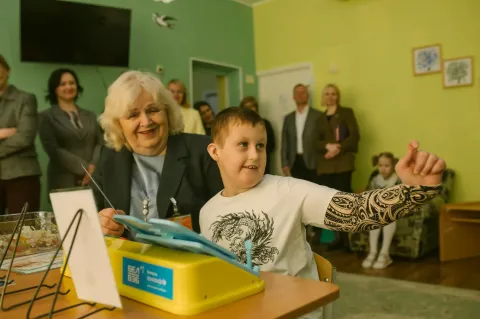
Zakhar's story
How the "Family for Every Child" programme prevents children from being placed in institutional care
- русский
- English
When we talk about the "Family for Every Child" programme and deinstitutionalization, people often ask how many children from institutions have found families. This is an understandable and important question, but there's another equally important one: "How many children have been prevented from ending up in institutions?"
Globally, children with disabilities are almost 17 times more likely to be placed in institutional care compared to other boys and girls. Parents often say "they'll be better off there", when they lack psychological support during tough times, when they don't know where to turn for medical advice and assistance, or simply when they can't afford quality rehabilitation services.
Zakhar could have been part of "17 times more likely" statistics. He lives with his family, thanks to his loving parents, the psychological support they received, attentive doctors, social workers, and other specialists.
It is crucial to work proactively (on preventing child-family separation) and to care for vulnerable families, using the "Family for Every Child" programme as an example.
Olga, Zakhar's mother, doesn't always remember every detail of the days spent with Zakhar. They were often very similar: it was precisely the routine activities with her son that helped him develop and move without a wheelchair. But the first year of life was distinctly memorable.
"Zakhar has a level 4 of health impairment. He had a congenital neuroinfection, resulting in bacterial meningitis and all the ensuing consequences, such as complete hearing loss. Plus, Zakhar has cerebral palsy. For the first year, we fought for his life as best as we could: he underwent 9 brain surgeries. In the end, we pulled through," shares Olga.

In Zakhar and Olga's story, there is no pivotal moment, no climax where the parents gave up and decided to send their son to an institution, and then were helped – and the child remained with the family. There was no critical point where the programme burst into these people's lives and saved everyone, like in a movie. It was just the daily work of the family and specialists – without drama or special effects. This proves how critically important it is to pay attention to vulnerable families. And that this work needs to continue and be intensified in the Vitebsk region and throughout the country.
In 2023, the first stage of the "Family for Every Child" programme focused on supporting at-risk families so that children do not become social orphans (placed in shelters while their parents are alive); it is vital to support them. These include families with children with disabilities, families in a socially dangerous position, large families, foster parents, etc. Such families need additional support because they are extremely vulnerable. Hardships and sorrows that occur in the life of every person can quickly turn into a disaster for such families.
"We identified a list of families we wanted to meet and offer help. Clinics, Early Intervention Centers, and Territorial Social Service Centers (TSSCs) helped us in this," says Marina Fedorova, Director of the Vitebsk Regional Center for Correctional and Developmental Education and Rehabilitation and a member of the interdepartmental team.
About 700 families were identified in the Vitebsk region, including Zakhar's family. Specialists determined the families' or children's needs through questionnaires and conversations and offered the necessary support. The programme assesses the situation and identifies problems by analyzing what needs to change and what can be done to change the situation.

"We had already received various forms of state assistance," says Zakhar's mother. For example, financial aid, additional payments for purchasing hygiene products for children with disabilities, for buying shoes for the child. But after talking with a social worker, we decided we needed additional medical help. In February, we were already receiving palliative care in Postavy, and in April, we plan to go to the National Clinical Center for Palliative Medical Care for Children in Borovlyany. This is vitally important for Zakhar. And it's important to me that the doctors will tell me how to care for my son and help him.
Although I have secondary medical education, such information is worth its weight in gold. After the questionnaire, families with children with disabilities were organized to have outreach training in our district. There were sessions with a psychologist, additional trainings on how to properly care for children with disabilities, how to position them in bed, in a wheelchair, how not to harm them.
I thought to myself: here's my Zakhar sitting in his wheelchair, legs crossed, just enjoying life. It turned out that he needed an abductor, a device placed on the seat of a wheelchair, intended for the forced separation of the legs. It's predominantly used for muscle spasticity and other musculoskeletal issues. Because the child ends up in a forced position, which isn't very beneficial; the muscles need to be corrected. Or when he's lying in bed on one side feeling fine, but it was not ideal either; there are nuances to consider. Things seem simple, but even small details matter to parents,” says Olga.

Each organization oversees its own area. There are cross-sectoral situations that relate to education, healthcare, and social protection. For example, a child with a disability might attend preschool or study at a specialized center. It is related to education. Children need medical care, and their parents need advice on medical home care. That's healthcare. The family might need additional social benefits and services and that is social protection.
It is crucial to understand that families need comprehensive support. In practice, in case management specialists from various agencies conduct a detailed assessment of the family and child's needs to identify the reasons for their vulnerability. They communicate, share information about the child, discuss support algorithms that would be optimal for getting the family out of crisis.
The programme team has already undergone training. This is also a priority area of work in the first year. Capacity development is necessary to teach specialists how to act to assist families in difficult life situations and in socially dangerous positions; understand the specifics of case management; learn about the mechanisms of deinstitutionalization established in national legislation; explore approaches to working with children with disabilities and building relationships and communication with the family.

While we talk with Olga, Zakhar is impatiently waiting to go home. He fiddles with keys in his fingers as it calms him down.
Zakhar likes coming to the center, learning, seeing his peers and the staff. His dad is waiting outside to help him into the "throne"; that's what the parents playfully call the car seat in the front. Zakhar enjoys the changing landscapes outside the window and the first breeze of spring through the slightly opened window. At home, his beloved cat awaits, always running to him for cuddles. A tasty dinner from mom is waiting at home. Perhaps, his older brother, who often visits, is waiting at home too.
Zakhar’s family awaits him at home.