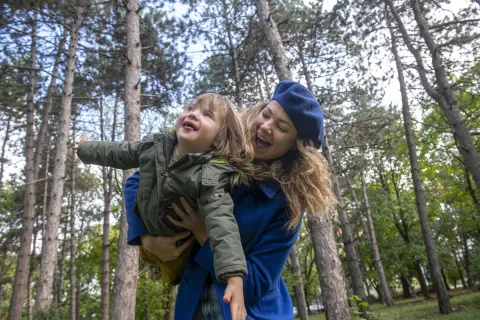
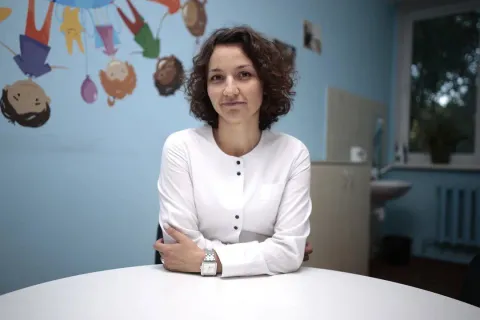
"I was afraid to miss a chance when it would be a lot more complicated to help Sofia"
How Early Intervention Centers impact the lives of families with children
- русский
- English
When you're under three years of age, you’re just playing with toys, with toys that are at hand. Just the way you can. So does Sofia. But she doesn't know how many people from the Early Intervention Center are helping her with this and how these games influence her development and change her life.
Sofia is playing, hiding her legs in a multi-colored sea of plastic balls in a dry pool. The balls are rolling happily and rustling pleasantly. And her legs, like on the waves, are disappearing and appearing again and again. Sofia is looking at her mother and smiling, so carefree and joyful. And her mom’s smile is full of warmth and love. A year ago, when they first came to this room at the Early Intervention Center in Children's Clinic No. 3 in Minsk, mother Olya was happy. However, her happiness was followed by a sense of alarm.

"She didn’t understand my speech": how mother found out about the Early Intervention Center
— Sofia was one year and nine months of age when we contacted the Center. I was worried that Sofia didn’t talk much and didn’t always understand what I was asking her to do. She seemed to have a lack of understanding of my speech. Usually, a child at this age pronounces a sufficient number of words and responds to simple requests: "bring the ball", "bring the spinning top". However, my child didn’t act that way (but if she did, I had to repeat it to her several times), Olga recalls, Sofia’s mother.
Moreover, at an earlier age, Sofia was not keen to master motor skills according to her age: she did not sit down on her own and did not begin to walk as expected according to her age. At first, the parents waited, then the waiting turned to anxiety, then there was a massage course, then a second one. Unfortunately, this did not deliver the desired result.
After yet another rehabilitation course, doctors suggested contacting the local Early Intervention Center.
To date, 40 Early Intervention Centers for children aged 0 to 3 years are established in Belarus under the aegis of the Ministry of Health, with the UNICEF’s (United Nations Children's Fund) technical assistance, and financial aid from the Government of the Russian Federation. Early Intervention Centers help parents and children with developmental disorders or risk factors of the said disorders.

I was afraid to miss a chance": How Sofia Ended Up at the Early Intervention Center
Sofia is playing. At full speed, the car is about to take her to the top of the world – the playroom of the Early Intervention Center.
Mother recalls how difficult it was to achieve other results: "crawling", "standing", and "walking". When Sofia took her first steps at one and a half years of age, her mother was happy. But it was momentary.
"Her motor development was so important to me that all my attention was focused on that.” When she started walking, I began to focus on other skills to find out what else she couldn’t do," Olga laughs.
Back then, I was in no laughing mood. Olga noticed that Sofia’s game involves throwing toys around or putting them in rows. Instead of words, there is a drawn-out singing of one sound. It became clear that Sofia did not understand speech.
"Even though they say "don’t compare children," you come to the playground and can’t help but compare. You see that one of your child’s peers is climbing the slide, the second is shouting "mom, mom," while yours is sitting in the sandbox and not paying attention to anyone. It’s scary," Olga recalls.
It was unclear what to do. Olga was taking Sofia to private early development centers and taking online course on child development. However, there was no effect. Everyone said: "Don’t make things up, just wait." But Olga noticed that "something was wrong." I didn’t know where to apply for help. As a result, I called the Early Intervention Center.
"I was afraid. I thought they wouldn’t accept me without an appointment. I was afraid that everyone would think that I had a problem child. I was afraid that something bad would turn out. One thing I was afraid of the most is that I could miss a chance and it would be a lot more complicated to help Sofia," Olga says.
The Center's specialists agree with her.
"The age of up to 3 years is the "golden period" to effectively intervene and get high results in the child’s development. Owing to the natural brain plasticity, it is more likely to teaching the brain to act differently, consolidating the existing positive experience, compensating for the identified developmental delay, and, if possible, completely eliminating it. The sooner parents seek help and the more actively they get involved in joint work, the faster the effect is achieved," Elena Lepeshko explains, a pediatric neurologist, the head of Oktyabrsky District Early Intervention Center, a certified expert in identifying developmental and behavioral disorders in infants.
At the initial appointment, during the expert assessment, and after the use of diagnostic techniques, no serious developmental disorders were detected in Sofia. It was decided to register Sofia for the surveillance program.
"I calmed down. The situation was brought under control. I was no longer alone," Olga recalls.
Parents of a child under 3 years of age can contact the Early Intervention Center with any issue related to the child’s development (speech disorders, potty training, fear of strangers, motor delays (the child does not roll over, sit, walk, etc.). You can contact us yourself. However, specialists (doctors, teachers) issue appointment to children with detected developmental disorders or risk factors of the said disorders (premature babies, children who have suffered congenital pneumonia, birth asphyxia, etc.). At the Center, help is provided at no charge.

At first, Sofia was registered for an early intervention program – "monitoring". These programs provide parents with monthly face-to-face and online counseling, with detailed recommendations and analysis of issues in question. The child’s development level and the degree of achievement of the goals set are assessed. This program takes place if the child has a minor delay or a local problem (for example, potty training) and is usually enough to smooth the waters.
A psychologist and a speech pathologist were visiting her, keeping in touch online, while Sofia was attending weekly classes at the Center. At the same time, mother Olya was regularly sending videos of their daily lives to the specialists: how they ate, how they walked, how they went to bed, how they played together at home, and much more. Based on what they saw, the specialists provide recommendations, sorted out the difficulties that had arose, and yet had the opportunity to establish a developmental environment for Sofia’s daily life.
"It was a breakthrough moment": How Sofia’s Home Environment Changed
Sofia is now playing in another room, with a psychologist. She is ironing clothes, cooking food.
"Sofia, let's put a lid on the saucepan!" "Aunt Nadya" suggests, the center’s psychologist Nadezhda Bulavitskaya. Sofia obediently closes it.
Mom is happy and smiling. She still remembers the great joy when she has realized that her child understood her.
"It was a breakthrough moment. As soon as we began to study regularly, Sofia began to understand speech and pronounce her first words. For a while, my husband and I couldn’t get enough of it and spent entire evenings "exploiting" the child: "Sofia, close the door. Sofia, turn off the light," Olga laughs. "It was the time she felt needed and important."
It was not the Center’s specialists who were magicians, but Sofia’s parents who were heavily involved in the process.
"The development in children under three years of age mainly takes place in their natural environment – at home, in a comfortable and familiar environment. Therefore, our work is based on close interaction with parents so that they can adopt and apply the acquired knowledge independently at home," Nadezhda Bulavitskaya explains, the Center’s psychologist.
"I thought: I don’t see anything wrong with this – she keeps getting dressed with our help again and again." But it turned out that we made mistakes. For instance, our task was to captivate and motivate Sofia to participate with us in all daily activities at home, to teach her to be more independent. However, when we got dressed, I sat her on my lap. It was necessary for her to sit on a chair and take an active part in the dressing process: it was necessary for her to extend her hand to put on a blouse, pull on her pants to her mother’s emotional encouragement, and attach hook-and-loop fasteners on her shoes,” Olga recalls.
The Center's psychologist explains why all this matters:
"Parents often come to us with one problem in mind, for instance, "the child does not speak." At the same time, they don’t see that the child has delays in other areas. Child’s skills and abilities are interconnected; everything happens in stages. Therefore, at first, it is essential to develop skills in one of the areas of development (fine motor skills, cognitive activity and play) and then actively engage in speech development.
Specialists have worked with all areas of family life. For instance, screens and a stroller have completely disappeared from Sofia’s schedule. They have been replaced by walking. She has moved to her own room to sleep, where she had a private play area.
Not everything worked out right away, but the specialists helped a lot.
"If they put pressure on me, I would break down." However, they always praised and supported. This inspired me not to give up and move on.
The interdisciplinary team of the Early Intervention Centers includes doctors (neurologist, pediatrician, rehabilitation physicians), teachers (teachers and speech pathologist), psychologists, and physical therapy instructors. At least two of them are present at the initial appointment. At the time of the initial appointment, specialists first determine what stage of development the child is currently at, what amount and format of assistance the child needs to be provided with. An individual early intervention program is developed for each child, and immediate development goals are determined.

"I was explained how to play": How Sofia’s Toys Changed
Sofia is playing. She is now taking care of the animals that "live" with "Aunt Sveta" – speech pathologist Svetlana Kazei. They have been staying in their board game houses for a long time, behind doors closed.
"Knock-Knock! Who is here? Dog! Aw, aw! Sofia, open the house! "Aunt Sveta" happily asks. Sofia is repeating everything responsibly and diligently.
Just a year ago, most of Sofia's toys were squeakers, rattles, or musical toys. She liked them; this is why her parents bought them. However, Sofia played with them little time: she would knock and throw them out.
"I was explained how to play and what to play. Now I understand which toy is for what: for movement coordination, speech development, fine motor skills, gross motor skills, and so on. Everything is balanced, so that we play different games in a proper manner.
Sofia's toys are completely different now. They are organized by topic. There is a table adjusted to her height, the space in the room is zoned, everything unnecessary and not suitable for her age has been removed. Sofia is playing completely differently: attentively, enthusiastically, attracting loved ones to play together; mastering role-playing games – the most complex type of gaming activity.
The Early Intervention Center uses different forms of working activity. Specialists visit homes, provide online counseling, and conduct individual and group sessions with children right at the Center.

"How good it is to feel that a child is becoming your friend": How Sofia’s Life Changed
Sofia is playing, getting the doll to bed. When she falls asleep, you can finish the session. Next Tuesday she will come here again: a 20-minute session with a speech pathologist and a 20-minute session with a psychologist. Then mother will consult with them for another 20 minutes. These sessions are essential both for Sofia and for mother allowing her to receive knowledge, support, sort out the difficulties she faces to at home, and get detailed answers to issues in question.
"Sofia will soon turn three years old, and we will leave you behind. I will miss these meetings," Olga smiles. "I already understand what to do next, where and what direction to move I have gained experience of knowledge and skills that I can apply myself."
When Olga thinks about what would happen if there were no any Center in their life, Olga becomes sad.
"I don’t think we could achieve success on our own. We wouldn't change everything in our lives so drastically. We would still have incomprehensible games and screams. I don’t think we would enter a regular kindergarten. Everything would begin to snowball. Now the foundation for her successful future has been laid."
In September, Sofia entered a regular kindergarten. There she is already learning to make friends and play with children. Although there is still something to work on and Sofia does not have as many words as her mother would like, the experts feel secure about her. Friends, school, university are the future for Sofia. Just recently it seemed unattainable.
Mother is thrilled with her daughter's success. She tells how recently Sofia herself figured out how to stand on a high chair to get something, or how she now, with an air of importance, takes her parents to an entertainment center, and then to a cafe.
"I already know that we have to take small steps towards our goal. Mental processes are developing, knowledge and experience are accumulating and, as a result, she makes something "funny and unpredictable". Watching her become independent and so business-like is such a joy. How good it is to feel that a child becomes not just someone who needs to be fed, clothed, educated, but becomes a friend who understands you and can be involved in different activities with you," mother smiles.
Sofia has put the doll to sleep and is running to the door. Her beloved grandfather, who has a soft spot for her granddaughter, is waiting for her outside. Now he will take her to the kindergarten, and in the evening Sofia will be playing with her mother. The girl does not know that several specialists taught her mother how to properly organize games and space for her. She also doesn’t know how many difficulties, worries, and hopes are behind these games and results, how many victories there have already been, and how many are yet to come
Sofia is just playing.
Sessions at Early Intervention Centers are held at no charge. Addresses and contact details of Early Intervention Centers can be found here.