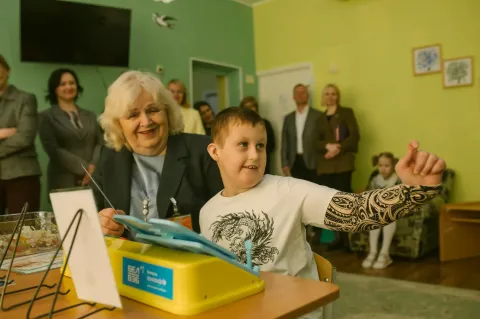
Severity of childhood disability decreased by 3%
Outcomes of the joint project of UNICEF and the Ministry of Health of Belarus

- русский
- English
20,398 children aged under 3 years have received care in Early Intervention Centers. The severity of childhood disability has decreased by 3%.
These and other outcomes of the joint project of UNICEF and the Ministry of Health of Belarus on the prevention of childhood disability were discussed by over 200 specialists from all over Belarus at an online conference held in Minsk on November 29-30.
The project — “Disability Prevention and Social Integration of Children with Disabilities and Psychophysical Development in the Republic of Belarus” — was implemented under the auspices of UNICEF in Belarus in cooperation with the Ministry of Health of the Republic of Belarus and with the financial support of the Government of the Russian Federation.
There are 34,954 children with disabilities in Belarus (as of 2020). UNICEF and the Ministry of Health have created an effective early intervention system in Belarus to lower this figure.
Its paramount task is to early identify developmental disorders or risks of their occurrence in children aged 0 to 3 years. The sooner parents refer to the right practitioners capable to identify the challenge and offer solutions, the more likely it is to adjust the baby's condition.
The project was launched in 2017. In 4 years, Belarus has approved the needed regulatory documents, prepared a methodological and technical base, introduced new methods and norms for providing interdisciplinary assistance to families with children with developmental disorders or the risk of their occurrence.
The outcomes of the efforts were announced at the online conference:
- there were 37 Early Intervention Centers in the country, and 5 of them were based in orphanages;
- 20,398 children received free care;
- about 1,000 specialists throughout Belarus were trained in modern methods and approaches to work with children with disabilities;
- specialist services were offered to 96.9% of children under the age of 3;
- 94% of mothers and fathers were satisfied with the clarity and detail of the recommendations provided during their visit (according to the Internet surveys conducted among the visitors of the Early Intervention Centers (EIC).

“One of the main project outcomes is a 3% reduction in the severity of childhood disability, which is really significant for our country. I would like to thank the United Nations Children's Fund (UNICEF) in Belarus and the Government of the Russian Federation for the expertise and financial assistance provided,” said Boris Nikolaevich Androsyuk, Deputy Minister of Health of the Republic of Belarus.
Thanks to the project efforts, early intervention centers have been fully equipped with office, rehabilitation and play equipment. All centers have certified screening tools and scales for assessing the development of children under 3 years old, which allow early diagnosis of developmental disorders, including autism spectrum disorders. All methodological materials and project developments have passed international expertise.
“Our work has been focusing for more than four years on understanding how to identify challenges at an early stage, how to support children, their families and professionals. Naturally, this work requires constant efforts, and we have not achieved the desired outcome yet. However, there is support provided by the government, there are strategic documents and practices. What we have created together over these four years is a sustainable systemic change for the benefit of children. Therefore, I want to acknowledge the achievements of all those who have participated in the project and express my hope that the work of UNICEF and its partners will continue in this direction,” said Tanya Radochay, UNICEF Representative in Belarus.
The project pays special attention to children born prematurely, with extremely low or low body weight. Specialists have developed an algorithm for working with families that have such babies. The Parenthood School project has been launched in 5 regions of the country; parents of premature babies attend the school to learn the skills of caring for and developing their baby.
A follow-up observation ward has been operating at the MOTHER AND CHILD State Republican Scientific and Practical Center since July 2018. Medical doctors monitor the physical, neuropsychic and cognitive development of such babies there. 387 children have been helped by the ward practitioners over the past 3 years.
Specialists have begun to maintain a register of premature babies, thanks to which it is possible to forecast adverse outcomes and individual risk factors for each child.
The project helps not only the child, but also the whole family. This is a comprehensive referral support of various practitioners, including psychologists. Moreover, at every stage: when the mother is in the maternity clinic, and the child is in intensive care; when the mother is already at home, and the baby is still in intensive care; when the mother and the baby stay in the hospital, and when the whole family comes home.

Breastfeeding support rooms have been launched, where mothers can get practical support from specialists and make an individual breast milk bank in the Preterm Newborns Department. All these measures build mutual understanding between the mother and doctors, and they also prevent depression in mothers and the crisis in family relationships.
“Today we can say with confidence that the project has been useful, it has brought visible practical outcomes in addressing the most pressing social issues. That is why the Russian Federation pays special attention to financing development projects in Belarus and intends to continue cooperation with Belarusian colleagues from the UN to ensure progressive solving of the problems that are significant for the socio-economic development of the country,” said Pyotr Valeryevich Frolov, Minister-Counsellor of the Embassy of the Russian Federation in Belarus.
A public awareness campaign — Just Children — has been held to reduce stigma and discrimination against children with disabilities and their families. The latest polls conducted by UNICEF in Belarus show that 80% of respondents believe children with disabilities are just children. This figure was 76% in the first wave of the campaign. And 68% of the surveyed agree that children with disabilities should study in secondary schools with other children. This figure was lower (63%) in the first wave of the campaign.
These results have been achieved thanks to numerous mass media publications. The mass media publications have narrated stories of families with children with disabilities, schoolchildren with complex diagnoses who study in secondary schools with their peers, make friends with their classmates and dream of a future profession.
Thanks to the information campaign, the website — www.prostodeti.by/crv — has been launched; the website has published information for parents about the availability of early intervention services and operations of the Early Intervention Centers throughout Belarus (a map of their locations and contact details); this information allows parents of children under 3 years old to apply to the centers without a doctor's referral and get specialist care if necessary.