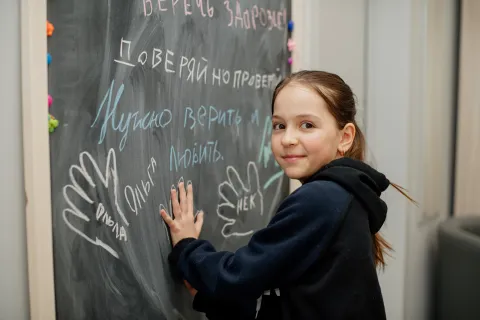
“I’ve been heard”
Belarusian teenagers cope with bullying under a pilot school-based support program

- русский
- English
Helga* faced bullying for the first time in her first grade. Then she experienced various shapes of bullying in different schools. Now the girl studies with the same children who used to bully her for several years. However, both Helga and the situation in the class have changed. A program has worked that helps create a friendly school environment and cope with bullying. This is what Helga has described.
*Helga is the alias that the character calls herself
Bulling means “intimidation” or “harassment”. This means that the child is repeatedly abused physically or psychologically by another person or group of people.
In 2020, the Ministry of Education of the Republic of Belarus and the Belarusian State Pedagogical University (BSPU) named after Maxim Tank, with the support of UNICEF in Belarus, launched a program — “Adaptation of the model for creating a friendly and supportive environment in general secondary education institutions” (“Bullying? Not at my school!”) — to cope with this issue. The program has already proven its effectiveness in Europe. For example, the same program has halved the level of school violence in Croatia. Currently, 43 schools in Belarus participate in this program.

“I decided to tell my story because maybe it will help someone. It will let the person know that he or she is not alone. If I realized back then that I was not the only one, it would have been easier for me.
“It seemed to me that this was optionally normal”: Helga and bullying in elementary school
They started bullying me when I was in the middle of first grade. I can’t go into details: it was a long time ago; and the brain erases painful memories. I remember that when I went to school, I adored animals, I was always inventing something, and I knew a lot. I was also sociable, so that I wanted to discuss all these things and to share them with the world. And the world was my yard and my school.
However, the kids at school didn't like it. Some skirmishes began. One girl deliberately broke my first tablet PC. My parents bought me beautiful shoes, and they were stolen. Bullying gradually began. I was verbally bullied for the fact that I loved cartoons, not games, that I liked “My little Pony” cartoons and stuff. It was gathering momentum. A crowd of children tickled me, dropped me to the floor, and they would hit me. It was kind of... unpleasant.
Naturally, I understood that something was wrong, but it seemed to me that this was optionally normal. Moreover, two other children were bullied in this class. The teacher didn't notice anything. So, I just thought: “Sometimes they don’t like me, but it’s okay, we live, we live.”
I didn't ask for help. On the contrary, I tried to hide this carefully from my family for a very long time. I was afraid that I would be punished for being something different. But when things got really bad, I addressed this issue to them. They couldn’t but noticed that I had bruises, that I was depressed, and that I didn’t want to go to school.
They supported me, but not in the way I needed. Neither my mother nor my grandmother faced such a situation: they always had many friends, everyone loved them. They didn't know how to help. “Don’t pay attention, laugh at this, laugh at their jokes, they will understand that it doesn’t bother you and they will leave you alone,” said my grandmother. It didn't work. My grandmother also advised me to hit my instigator back. I really don’t recommend doing this: you can run into even bigger troubles. And there is no need to use violence against people.
When it got really bad, I was transferred to another school. Mostly the kids from my kindergarten studied there. We had a close-knit team in the kindergarten: I am thankful to our day-carers who put a lot of effort into this. All over sudden, everything became good: no bullying, everyone was friends with me, including those who didn’t know me before. I felt relieved, although I didn’t fully understand what had happened to me before.
However, this school was closed a year later due to its alarming condition. I enrolled into another school, and bullying started again.
“There is a direct correlation between safety and bullying”, explains educational psychologist Elena Chizh, mentor of the program called “Bullying? Not at my school!” “Bullying does not practically occur in classes where the team is close-knit and children feel safe. Therefore, first of all, our program is aimed at ensuring a friendly environment in schools.
One of the first steps is to explain what bullying is to teachers, parents, and children. So that everyone can recognize it and take action. In all schools, teachers constantly “monitor” the situation, raise “red flags,” and pass information on to mentors.
Mentors are freelance program participants (educational psychologists) who are not part of the team. They help you deal with various situations with an open mind and take the right actions.
“I realized that I needed to fight”: Helga and the “Bullying? Not at my school!” program
I engaged in the “Bullying? Not at my school!” program when I was in the eighth grade. At the retreat, teenagers from different schools and I discussed what bullying was, looked for ways to deal with it, and how to bring this message to all other children in schools.
I didn't have any expectations, but I liked it. I liked the approach. No one cared about your name or appearance. If you wanted to be called “Cactus”, you would be called “Cactus”. This does not mean that others will like your choice. They explained well how to express dissatisfaction without humiliating a person. For example, even if the person smells, you can gently say that this is unpleasant for us, and “it would be nice if you take a shower”.
My voice was important there. We figured out how to deal with bullying at school. I had things to offer, and I offered them. I was supported and heard. That was “wow” for me! If I suggested anything in the class, I was not heard at all. So, that was a big push. And then I felt that I was respected. It was nice.
I realized that I was not the only one. Many people face this today. It became easier. I also learned new things and heard things that confirmed many of my thoughts.
I finally realized that bullying could not be tolerated: it had to be actively fought. Thanks to this program, I began to do this at my school. Based on my experience, I believe that, first of all, children should supervise children. Many things invisible to teachers happen during school breaks. When we are on duty, we very carefully observe younger schoolchildren and their behavior and games.
We also had homerooms for younger schoolchildren. Young children often simply do not understand that doing things like that is bad. We explained this to them, told them about bullying and its consequences, and what help was available for victims. The program also helped us conduct such homerooms: we had a communications training.
I want to see less bullying in schools. And I do my best for this. If you are experiencing bullying, do not be silent. Shout about this everywhere. Just yell. Approach everyone you can. If the class teacher does not react, go to the deputy principal; if the deputy principal does not react, go to the principal; if the principal does not react, go to the police, especially if you are beaten. Seek support. Don't shut up. Don't withdraw into yourself. Talk, talk, talk, shout, shout, shout, shout about this again wherever you can.
Children are active participants of the “Bullying? Not at my school!” project. Teenagers decide how they will create a friendly environment in each school participating in the project. Adults guide and help.
“A teenager who participates in the development of school values — safety, respect, mutual assistance — is more likely to follow these rules than someone who has been given them from top. This is because s/he formulates these values. In addition, children hear each other better, it is easier for them to adopt the rules of behavior, and they are more likely to quickly turn to each other for help. This is also why the “Bullying? Not at my school!” project pays a lot of attention to the peer-to-peer format,” explains Anastasia Bazhenova, Child Protection Coordinator at UNICEF. Helga is one of the most active project participants at her school.
“I have my life”: Helga and changes
Has the program offered me a new way out of the situation? It is more like a new entrance. I am still in the same class with these same children. We haven’t become friends. However, I feel differently.

I have my life. There are several friends in my life who will go with me through fire, water and copper pipes. I have a job: I write scripts for games. I help people: I participate in the anti-bullying project, I visit several elderly people, I help orphans and animals. I travel a lot around Belarus. I’m preparing for university studies: I plan to be either a chemistry teacher or a veterinarian.
I changed my name. Helga is not a little downtrodden girl I was. This is the goddess of the lower world. “Goddess” means exalted, empowered. The lower world is a place where no one wants to go, but many will be there. This name is my defense.
“Bullying leaves scars on everyone. It greatly affects the rest of the lives of absolutely everyone involved. Even observers suffer witness trauma, which is not easy to live with later. Aggressors and their supporters may develop a wrong behavior pattern that may lead them to crimes. Victims face severe self-esteem issues and more. That’s why it’s so important to stop bullying immediately, or better yet, not to allow it at all,” explains mentor Elena Chizh.