World Children's Day: Inspiring young artists on the climate crisis
An arts and crafts workshop on climate change inspires Rohingya refugee children

- বাংলা
- English
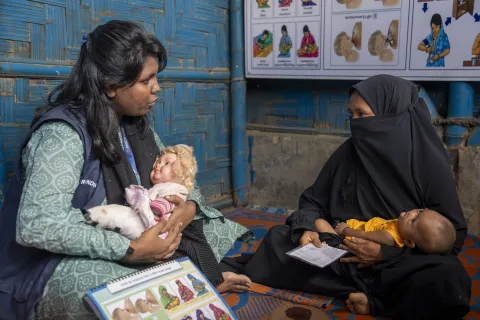
As the world commemorates World Children's Day, UNICEF and partners organized a two-day arts and crafts workshop for children living in the Rohingya refugee camps in Cox’s Bazar, in a bid to raise awareness and empower young minds.
The workshop aimed to engage and educate children between the ages of 9 and 15, creating a space for the young minds to express their thoughts, fears, and hopes regarding the climate crisis through art.
"Empowering these children with awareness on the climate crisis, we are encouraging them to voice their owns concerns and ideas on how this crisis is affecting children just like them all around the world," shared Suhana, a UNICEF consultant, and the instructor for the workshop.
Unveiling the Canvas of Concern
The workshop’s initial day laid the foundation for a creative exploration of climate crisis. The session commenced by introducing young participants to the critical connection between climate change and their rights as children. Through interactive discussions and exercises, the dense subject matter was broken down into digestible concepts for eager young minds, and the children began expressing their concerns.

UNICEF Bangladesh/2023/Sujan
“We need to plant vegetables and trees to get oxygen and food. If we throw polythene in the river the fish will get sick or die. That’s why I drew the reduce, reuse and recycle where people are using trash cans to throw away waste and there are trees being planted.” – Asofa, 13
“Before starting, we did some hand exercises and free hand drawing. We talked about planting more trees to get more oxygen. We need to plant vegetables, fruit trees to get oxygen and food. We also need to think about what we eat. If we throw polythene in the river the fish will get sick or die. We need to use less polythene. We shouldn't litter. That’s why I drew the reduce, reuse, and recycle where people are using trash cans to throw away waste and there are trees being planted,” shared 13-year-old Asofa.
From sketching the impacts of global warming on their communities to envisioning a sustainable, green future, each stroke of pencil became a powerful statement.

UNICEF Bangladesh/2023/Sujan
“I drew a safe planet where there are lots of trees to give out oxygen. The two hands show that the planet is safe.” – Esma, 11
“I drew a safe planet where there are lots of trees to give out oxygen. Since there are many trees here, the planet is green. The two hands show that the planet is safe. It is our responsibility to take care of it,” shared 11-year-old Esma.
The workshop buzzed with energy as the children delved into their artistic endeavours, driven by a shared commitment to make a difference.
From Sketches to Solutions
On the second day, the children returned to find their artworks waiting, eagerly anticipating the vibrant hues that would bring them to life. The workshop transformed into a kaleidoscope of colours as the young artists meticulously filled their sketches, each stroke echoing a collective call for environmental action.

UNICEF Bangladesh/2023/Sujan
“I drew two different kinds of Earth. One where we have cut trees down and there is no oxygen. But on the other side, if we plant trees and keep our environment green, then we can survive.” – Towhid. 15
“I drew two different kinds of Earth. One where we have cut trees down and there is no oxygen. It will also be very hot if there are no trees, and people will not be able to survive if there is no oxygen. But on the other side, if we plant trees and keep our environment green, then we can survive. One side of earth is green and cool while other is dry and hot,” said 15-year-old Towhid about his artwork.

UNICEF Bangladesh/2023/Sujan
“We pollute water when we throw polythene or other waste in it. Fish can die due to water pollution. Sometimes, the fish will get sick and if we eat those fish - we will get sick.” – Ruma, 11
“We pollute water when we throw polythene or other waste in it. Fish can die due to water pollution. Sometimes, the fish will get sick and if we eat those fish - we will get sick. Now, there's less fish for us to eat. This is how climate change is affecting us,” said 11-year-old Ruma.
Planting Seeds of Change
The children participating in the workshop were left with new knowledge on how to implement their own artistic skills but also a heightened awareness of our collective role in safeguarding the planet.
By sowing the seeds of environmental stewardship, the workshop nurtured a generation to observe the climate crisis not merely as a threat to our future, but as an obstacle to overcome together. Through art and education, these children are one step closer to realizing a sustainable and just future for our planet and all of its people.