“Our work, our community, our well-being.”
Supported by the German Federal Ministry for Economic Cooperation and Development (BMZ) through the KfW Development Bank, clean water now flows through Camp 8W as a shared promise.

CAMP - 8W, UKHIA, COX’S BAZAR, BANGLADESH – For families living in Camp 8W, the simple act of turning on a tap was once a daily struggle. Water had to be collected from low-lying areas, where contamination was common and illness spread easily. But today, thanks to a strengthened water network supported by KfW, life has changed for thousands of Rohingya refugees.
At the heart of the camp stands a 90,000-litre central water tank, connected to a network of tap stands each serving 70 to 80 families every day. Every drop is chlorinated through an automatic dosing system, ensuring safe drinking water reaches homes reliably.
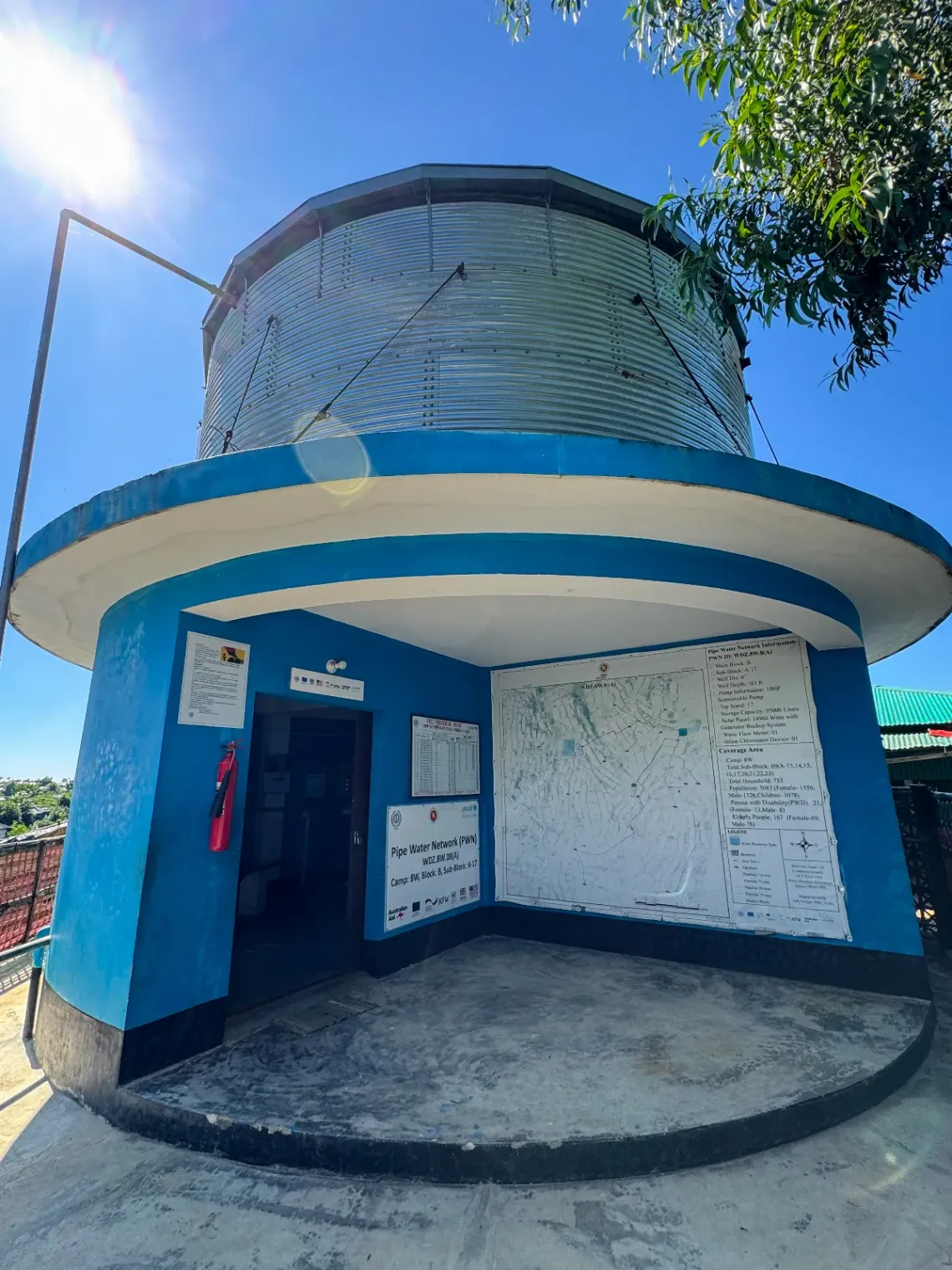
The camp’s 90,000-litre tank distributes water across multiple tap stands, meeting the needs of 70–80 families every day. © UNICEF/Bangladesh/2025/Jaser
But the real story of Camp 8W is not only about pipes and tanks. It is about people. Especially, Water Committee Members who voluntarily stepped forward to support their neighbours, learn new skills, and build healthier, more resilient lives.
A Community That Leads From Within

“Our work, our community, our well-being.”
When Salamat Ullah, 35, arrived from Myanmar years ago, nothing felt safe, not the shelters, not the water, not even the latrines.
“There was no proper water, no proper latrine. If someone fell sick, there was no nearby hospital,” he recalls.
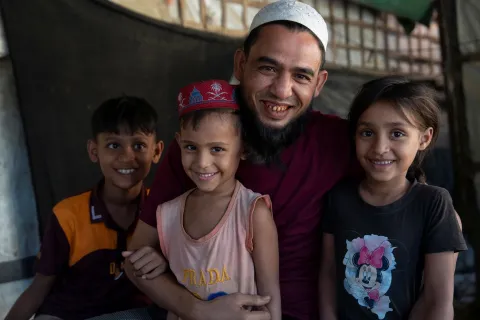
Today, Salamat serves as the WASH Committee leader, known locally as a Majhi, a word meaning “leader” in Rohingya language. He volunteers to monitor facilities, solve problems, and make sure families use water safely.
But the journey was not easy.
“In the beginning, people fought at tap stands. Someone took more water, someone took less. No one understood. And people kept drinking water from the floor or uncovered containers. That made things worse.”
After receiving UNICEF-supported training, Salamat went block to block, raising awareness about hygiene and safe water use. Slowly, conflict diminished. Today, families queue peacefully, manage water responsibly, and keep their homes cleaner.
Salamat dreams of a future where children grow up educated, confident, and ready to take on leadership roles.
“If they learn, they will stay aware. They will protect our water system. I only ask that this service never stops. Safe water must always continue.”
Women Leading Change in Hygiene and Dignity

Across the camp, Satera, 28, a WASH Committee member, moves through her block with practiced ease. She checks tap stands, shares hygiene messages, and listens to community concerns.
“People listen because they see sickness decreasing,” Satera says. “When the community appreciates cleanliness, it becomes easier to guide them. I like doing this voluntarily, after all, it is for our well-being.”

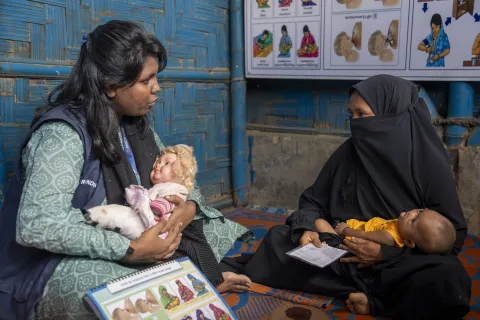
Hasina, 22, a Menstrual Hygiene Management (MMM) facilitator, gathers a group of adolescent girls. A few years ago, she explains, women in the camp used old black cloth instead of hygiene kits, unable to speak openly about their needs.
“People felt shy. They suffered silently,” she says.
Training changed that for her and the women she supports. Mothers now encourage their daughters to express menstrual health concerns. Husbands understand how to support their wives. The community feels safer, more confident.
Rebuilding After Loss and Finding Hope Again

For Mohammad Jokoriya, 48, a dedicated member of the Water User Group, the path to safe water included tragedy. When Block B’s WASH facilities burned down in a fire, sickness spread rapidly.
“Children got diarrhoea. The water situation was very bad,” he recalls.
With reconstruction and the shift to deeper, cleaner water sources, the change has been dramatic.
“Before, the water had iron. Now it’s clean. Life is easier.”
Children Leading Through Play

In a quiet corner of Camp 8W, two 12-year-olds, Sirajul Islam and Noor Sadia, sit with friends around a colorful Ludo board. But this isn’t the usual game familiar across South Asia. Their version is built around WASH themes, where each roll of the dice teaches a hygiene message: handwashing, keeping water covered, proper waste disposal.
It’s learning disguised as play, one of the most powerful ways messages travels in the camp.


“When we grow up, we want to continue this work,” Noor says shyly. Sirajul nods beside her. “We want to be leaders, someone who helps others.”
A Network Sustained by People, Not Just Pipelines
Safe water now reaches every corner of Camp 8W but the real achievement is the unity behind it. From committee leaders to women volunteers to children learning through play, the community stands as the system’s strongest safeguard.
What they’ve built is more than infrastructure.
It’s confidence, connection, and the quiet beginning of a stronger tomorrow.
_________________________________________________________________________________
***
UNICEF extends heartfelt thanks to the German Federal Ministry for Economic Cooperation and Development (BMZ) through the KfW Development Bank for their steadfast support and meaningful contribution to improving the lives of refugee children and their families in Bangladesh.