It takes a village: Parenting at the Rohingya refugee camps
In the Rohingya refugee camps, mothers, fathers, and community leaders are learning how to raise children with love, care and respect

- বাংলা
- English
Life in the Rohingya refugee camps is extraordinarily challenging. Children and families live in highly congested conditions and depend heavily on humanitarian assistance for essential needs, including protection, food, health, education, water and sanitation, and shelter. These challenges are further compounded by the impacts of humanitarian funding cuts.
Amid these hardships, parents like Habi Mohammed, 38, a father of four, are learning how to raise their children with love, care and respect.
“The daily struggle often leaves little time or energy for parents to focus on children’s emotional needs,” says Habi. “If we are not careful, we might spill that stress onto our children."
Last year (2025), a community outreach worker visited Habi’s shelter during a door-to-door visit. That was the first time he learned about the father-to-father session on positive parenting. Without thinking much, he agreed to join.
Today, Habi has already attended 20 positive parenting sessions – two every month – without missing a single one. Habi says that the sessions have helped him change his approach to parenting and see his children as people who need encouragement, understanding, and time.
In one instance, Habi noticed that his eldest son, 12-year-old Yousuf, who studies in Grade 5, had not been paying attention to his studies. Habi admits that in the past, he would have scolded or even hit Yousuf, believing that fear would make him study harder.
This time, he remembered what he had learned about communicating with children and applying positive reinforcement in the positive parenting sessions. So, instead of raising his voice, Habi sat beside his son and asked what was wrong. Yousuf told him that all his friends had a football to play with, and he did not. He wanted one too.
Habi listened with patience and made a promise to his son. If Yousuf were able to rank among the top five in his next exam, he would buy him a football. From that day on, Yousuf started studying with new determination. Habi watched him sit longer with his books, reading, writing, and revising.
“I didn’t even wait for the result,” Habi says, smiling. “I bought the football before his exams started because I wanted to appreciate how hard he was trying.”


Habi’s commitment to becoming a better father is very much influenced by his own childhood. Growing up with a disability and financial hardship, he had a strained relationship with his father. Today, he is determined to break that cycle by fostering trust, encouragement, and open communication with his children.
“The first time I became a father, I felt like I had reached the moon,” says Habi. “From that day on, I have promised myself I will do everything I can to keep my children happy.”
This positive change is not an isolated case.
Like Habi, a total of nearly 28,000 parents, caregivers, community and religious leaders – including over 13,000 mothers and female caregivers, over 13,000 fathers and male caregivers, and about 1800 community and religious leaders – in both Rohingya refugee camps and host communities in Cox’s Bazar are learning practical skills on positive parenting, as of December 2025. With generous support from BMZ/KfW Germany, UNICEF and partners are working together to mainstream positive parenting in the camps.
The structured parenting sessions are based on a comprehensive positive parenting intervention package developed by UNICEF, with technical support from BRAC Institution of Educational Development (IED). So far, 144 project staff and 441 community outreach workers have received training to guide parents and caregivers on healthy child development, non-violent upbringing, positive parent-child relationships, and emotional well-being.
Parents and caregivers who have participated in the sessions report visible improvements in children’s daily lives: healthier meals made from locally produced food, increased school attendance, and stronger protection from child marriage, exploitation, and abuse. Children are safer, more confident, and growing up in homes where they feel heard and supported.

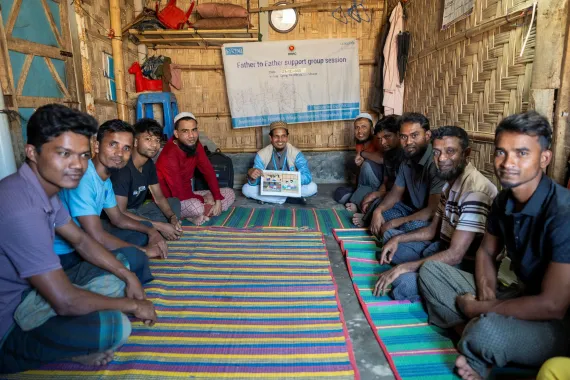


For many fathers, the sessions are also changing long-held beliefs.
“Fathers are learning that parenting is not solely a mother’s responsibility,” says Mustafa, a community outreach worker who facilitates these sessions. “They need to be present too, not just to provide but to be a part if their children’s growth.”
In one of the father-to-father sessions, Mohammed Amin, 33, shared how he learned about the golden first 1,000 days of a child’s life and the importance of exclusive breastfeeding. In his family, babies were given rice when they were just one month old. Now he has learned that solid food should not be introduced before the child turns six months old, to support healthy brain development and physical growth.
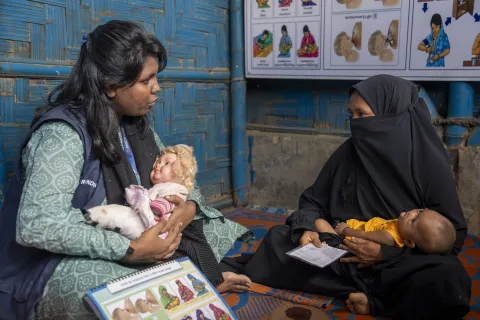
Across the camps, mothers are also learning and leading change.
In one of the mother-to-mother sessions, Noorbahar, proudly recited the names of all routine childhood vaccines. So fast that it almost sounded like spoken word poetry. Another mother, Shaukat, reflected on why education matters, especially for girls.
“Education gives our girls the ability to stand on their own feet and to stand up for themselves,” says Shaukat.
The learning does not stop with parents.
Positive parenting sessions also engage community leaders and religious leaders, because their voices reach families in places where programmes alone cannot.
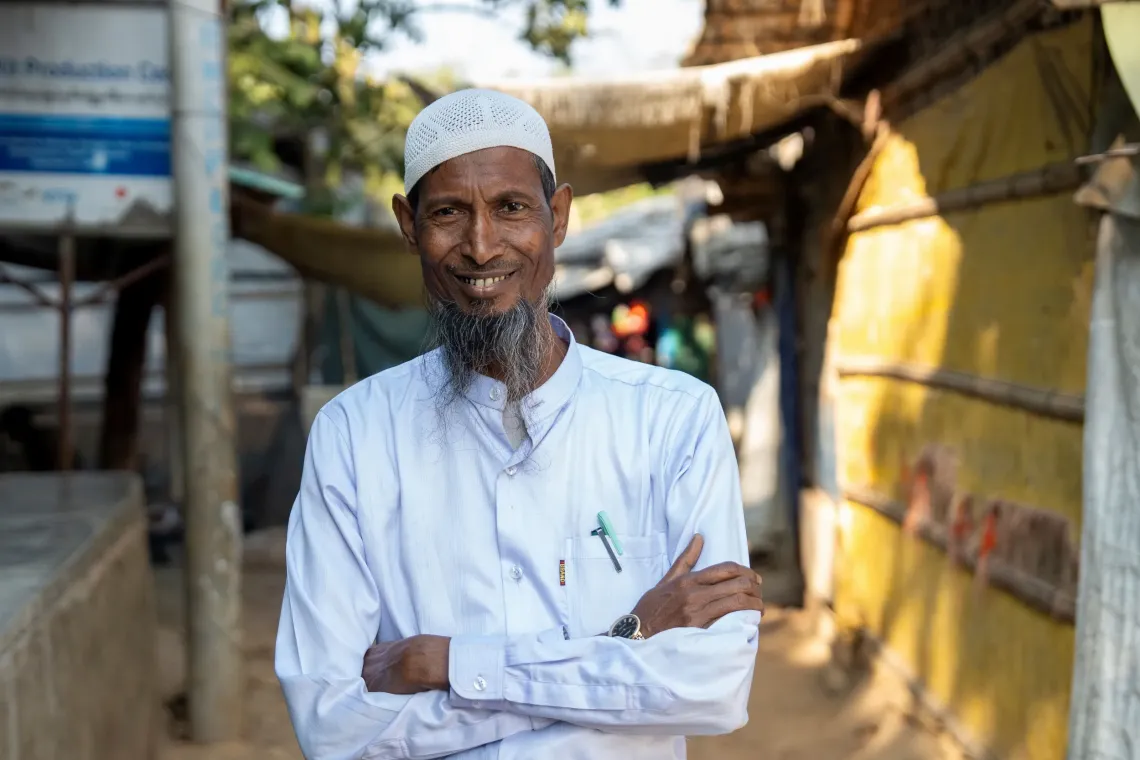
Nur Hossain, 60, a religious leader, says the sessions encouraged him to speak more openly with parents about keeping girls in school, the harms of child marriage, and the importance of choosing health facilities for childbirth so newborns receive proper care and birth registration.
“Girls below the age of eighteen are not physically or mentally ready to give birth,” says Hossain. “So, I tell parents that child marriage is harmful.”
Hossain shares these messages wherever people gather – in mosques, classrooms, tea stalls, and community meetings.
“But reaching everyone is difficult because the camps are not easy to reach, and our population is large,” Hossain adds. “That is why continued sessions are essential.”
Developed with inputs from adolescents, parents, community and religious leaders, the sessions reflect cultural values of the Rohingya population while addressing harmful norms. Slowly, families are realising that positive change does not come from one mother or one father alone. It grows through everyday conversations at home, in classrooms and tea stalls, through parents and families learning together, leaders speaking up, and communities choosing care and protection.
Because it takes a village to raise a child.