In the face of adversity, Rohingya refugees get creative
Short films produced by Rohingya teenagers put the spotlight on the challenges and dreams of young people growing up in a refugee camp.

- বাংলা
- English
A girl picks up a school bag and starts pacing around a small room. She looks at some drawings by other children on the walls. A clock is ticking as she gets increasingly anxious and frustrated. But she can’t leave the shelter. A narrator’s voice explains why: Sofa is a girl – so her parents make her spend all day inside their shelter.
The scene is part of a short film created by 13-year-old Sofa who lives, along with hundreds of thousands of other Rohingya children, in the refugee camps of Cox’s Bazar in Bangladesh.
“We thought about a story that mattered to us,” Sofa explains. “It’s about parents who don’t allow their children to go to school. It’s important to share our struggles.”


Sofa is one of 15 Rohingya children age 11 to 13 who took part in a recent five-day long workshop on filmmaking. The workshop was organized by UNICEF and facilitated by The One Minutes Jr., an international initiative that seeks to empower young people through art.
“I felt amazing operating the camera and acting in my own movie,” says Refat, 13, another participant. “I never thought I would make a movie before this workshop.”
Young artists from around the world facilitated the workshop for the children, who learned the basics of filmmaking, including scripting a story, operating a camera and editing footage. The workshops ended with each participant making a short film on a topic that’s important to them.
“Working in the camp was a very special experience,” says Misha de Ridder, one of the workshop facilitators. “We found stories about the longing for nature, longing for returning home one day, and the importance of education. Hopefully we were able to inspire them and give them a spark of hope for the future – so they know that nobody can put a fence around their imagination.”

“I want to tell their stories to inspire others and make a positive change.”
The films, all a minute long, capture the unique challenges faced by Rohingya children, who have been refugees for six years now. But they also highlight how these children continue to dream of a life beyond the refugee camps.
Minara, 12, wanted to depict some of the challenges specific to women and girls. Her story is a powerful and creative depiction of the burdens young girls face when they are married off in childhood. “I got the inspiration for my story from a girl who lives near me,” she says. “I wanted to show what happens to a girl’s life when she gets married before eighteen.”
“I want to make more movies in the future, especially about girls’ lives,” she adds.


“My friends and family were really proud of me when they saw the movie.” - Umme, 12
Other children wanted to highlight some of the traditions and culture of their community.
Umme, 12, made a film about how Rohingya girls and women decorate their face using sandalwood. “It's our special way of looking beautiful,” she says. “I wanted to show everyone our traditional things because it’s important to us. It’s part of who we are.”


“It feels really good to operate the camera but my interest in acting. Being an action hero is my dream,” says 12-year-old Md. Rohomatullah.
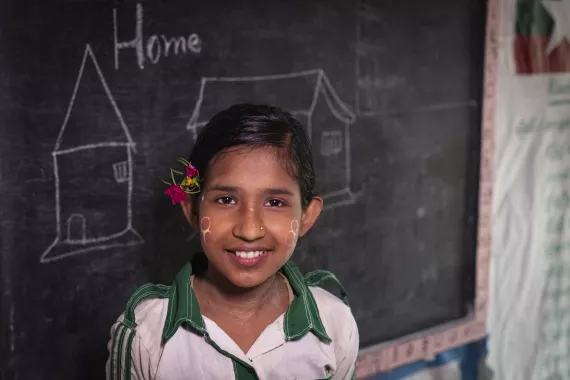


“I came up with the story because I missed my home in Myanmar during staying in the Rohingya shelter.” - Nur, 11
The children also told stories about life in the camps – what they love and the things they miss about home. Rohomatullah, 12, created an ode to his learning centre and his teacher. Nur, 11, made a film about how much she missed her house back in Myanmar.


“I wanted to show how we help each other.” - Refat, 13


“I used to play football beside a drain which is not hygienic at all.” - Jamil, 13
The creative ways in which these children highlighted the realities of refugee life could be striking. Using a dream sequence approach, Jamil, 13, imagines the camp’s dirty environment has been transformed into a beautiful landscape where he and his friends can play without worrying. “I imagined a camp with a green environment and enough space to play football,” he says.
Refat, 13, decided to focus on the lack of access to services in the camps, including medical services, and how residents have to act as ambulances, carrying the sick over difficult terrain. “I came up with my story because in the camp there’s no level land and ambulances,” he says. “So, I wanted to show how we help each other.”
All of the workshop participants have spent around half their lives in the congested camps – home to almost a million refugees – with access to only basic services and at heightened risk of violence, fires and landslides. Ensuring even basic rights such as healthcare, adequate nutrition, education and protection are a constant challenge, so opportunities like this – to express creativity through art and play – are even more limited.
UNICEF has been on the ground since the beginning of the crisis, working for the rights of Rohingya refugee children. Today, there’s a large-scale education programme in the camps to try to help ensure that girls don’t drop out of education and that Rohingya children can continue to learn in their own language.
But as the crisis enters its seventh year, there’s no immediate hope for a safe return to Myanmar.
“The films made by these children are wonderful examples of their creativity. But they are also reminders that Rohingya children in Bangladesh are growing up without the opportunities to nurture that potential, to enjoy a childhood that every child deserves,” says Ezatullah Majeed, UNICEF Chief of Field Office, Cox’s Bazar. “We need to continue to do more to ensure the rights of these children so that they can learn, grow and dare to dream big.”
Of the US$40 million appeal for education, till now only 70 per cent is funded. Urgent support is required to enable UNICEF to accelerate efforts so that every refugee child in Cox’s Bazar can learn.