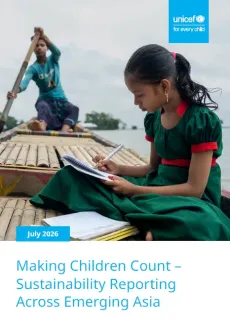
Making Children Count – Sustainability Reporting Across Emerging Asia
Children are missing from Asian ESG reporting, just as the region writes the rules. UNICEF benchmarks 1,399 companies in 9 markets and suggests how to close the gap.
Highlights
UNICEF's Making Children Count: Sustainability Reporting across Emerging Asia report makes the case for including children's rights in corporate sustainability and ESG reporting. Children make up around one in three people in emerging Asia, yet they remain largely invisible in corporate disclosures.
The report analyses 1,399 listed companies across nine Asian markets – India, Indonesia, Thailand, Malaysia, Vietnam, Pakistan, Bangladesh, Nepal, Sri Lanka – against 26 child-rights indicators. While many companies make broad human-rights commitments, few identify children as stakeholders or report how their operations and value chains affect them. Across 20 of the 26 indicators, what companies report achieving for children falls at least 50% short of what they pledge.
This gap is also an opportunity. Asia is where the next generation of ESG rules is being written and child-rights indicators can be embedded into that architecture as it is built, rather than retrofitted years later.
The report sets out concrete recommendations for companies, investors, regulators and governments to seize the moment and move children from an afterthought to a measurable line in corporate accountability.
---
An open methodology. Alongside the report, UNICEF has published the complete assessment framework — free to reuse and adapt with attribution. Investors, companies, ESG raters and regulators can apply it to assess child-rights disclosure in their own portfolios or extend the research to more companies and markets worldwide.
----