Youth House in Vayk: A place to connect, grow and belong
In Vayk, a new youth centre is providing adolescents and young people with a place to connect, access psychosocial support and turn their own ideas into action.

- Հայերեն
- English
For many people travelling south through Armenia, Vayk is a familiar and picturesque mountain town on the road to Syunik — a place to stop for a coffee, take in the surrounding landscape or simply have a short break before continuing the journey.
Life in smaller towns like Vayk has its own pace and sense of community. But for adolescents, it can also mean having fewer places to spend time with friends, discover new interests or take part in activities outside school. For many, the daily routine is familiar: school, then extra classes, then going back home.
The community welcomed ethnic Armenian refugee families both in 2020 and in 2023, which meant that many children and adolescents had to build new routines and make new friends in a new place they could call home.
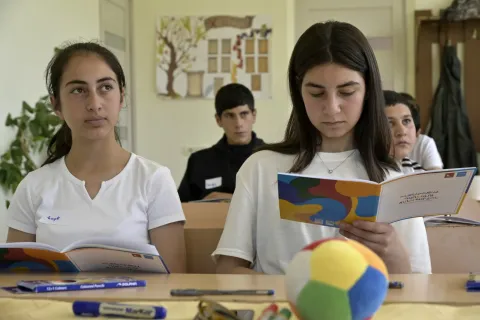
Vardush, 16, had to flee her homeland with her family in fall 2023 and eventually settle down in Vayk, Armenia. Her friends from her hometown are now scattered across different parts of Armenia. Since then, she has tried to build a new circle of friends.
Since May, whenever she has some free time, there is one place she heads to.

“Whenever I have free time, I come straight to the youth house,” Vardush says. “I enjoy it so much, I don’t notice how several hours pass when I’m here. This place is different from anywhere else. I meet new people, mingle and connect.”
Vayk’s youth centre was established in April 2026 by UNICEF and the Armenian Progressive Youth NGO, in partnership with Armenia’s Ministry of Education, Science, Culture and Sports and with financial support from the Government of Japan. The primary objective behind the centre was to serve refugee and host community adolescents and young people from across the 16 settlements of Vayk community as a safe space for psychological support and skills to develop their resilience. The centre alsooffers them non-formal education, mentoring and counselling, and opportunities to practice leadership and entrepreneurship, as well as take part in recreational activities and in the life of their communities.

For Vardush, connection is only part of what she has found here. “I try not to miss any of the workshops or discussions organized in the centre,” she shared. Among those that have stayed with her the most are sessions with a psychologist, particularly one discussion about personal boundaries and learning to say “no”.
“One of the sessions with the psychologist that impressed me the most was about how to say ‘no’ when something is not in your best interest or simply when you don’t feel comfortable to,” she shares. “I always struggled with that. Now I can say ‘no’ with much more confidence.”
Vardush dreams of becoming a history teacher one day, helping children learn from the past, remember important historical moments and through that be able to identify values that have helped her and made her more resilient.
For now, Vardush comes to the centre to learn from others. But she is already imagining a day when the roles might be reversed. “Who knows,” she says. “Maybe one day I will lead a session for young people here myself.”
“UNICEF sees community-based youth centers like this one in Vayk as essential platforms for supporting refugee and host community adolescents’ psychosocial wellbeing and as a foundation for their inclusion, learning, participation, and a successful transition to adulthood. Vayk's youth centre is designed to go one step further: young people are not only invited to participate in activities designed for them. They are also given opportunities to design and lead activities themselves,”
One of Vardush’s peers, Nare, visits the youth house from the nearby village of Zaritap. Nare recalls a different session with a psychologist, which prompted her to reconsider a habit that occupies hours of many adolescents’ days: her phone. A discussion about dependence on digital devices helped participants look more closely at their own habits.

“A few questions helped us realize that many of us were actually so dependent on our devices. I can’t say I have overcome it completely, but one message stayed with me: instead of spending hours scrolling through reels, go for a walk with your friends and try to use at least some of your online time to learn something new,”
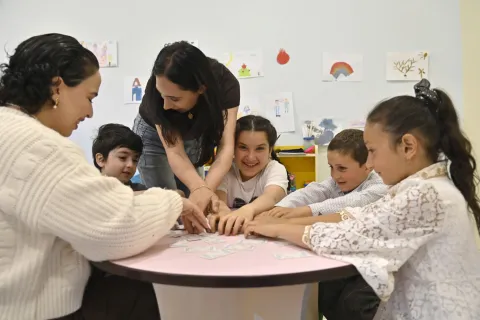
Nare has already had the chance to develop and implement her own initiative. Together with other young people from Zaritap village, she received a small grant and organized a community event to bring together displaced families with its long-time residents of the community. Through a quest and a series of games, people of Zaritap spent time together and made new connections. At the end of the quest, everyone received an award in line with Nare’s and her peers’ thinking: everyone was a winner.
“I’m 17, but they trusted me to develop a project, prepare a budget and manage it,” she says. “That was a huge experience for me.”
Building and refueling that trust in adolescents is an important part of the model behind Vayk’s youth house, especially for those who have gone through trauma and loss. Young people are not treated simply as recipients of services, but as people capable of identifying what their communities need, developing ideas and seeing the results of their own actions.
For communities such as Vayk, bringing these opportunities closer matters. The centre is the first of its kind in Vayk community and one of only a few in all of Vayots Dzor marz, addressing a gap in safe and inclusive spaces for adolescents and young people, including those who have experienced displacement or have limited opportunities for participation.